

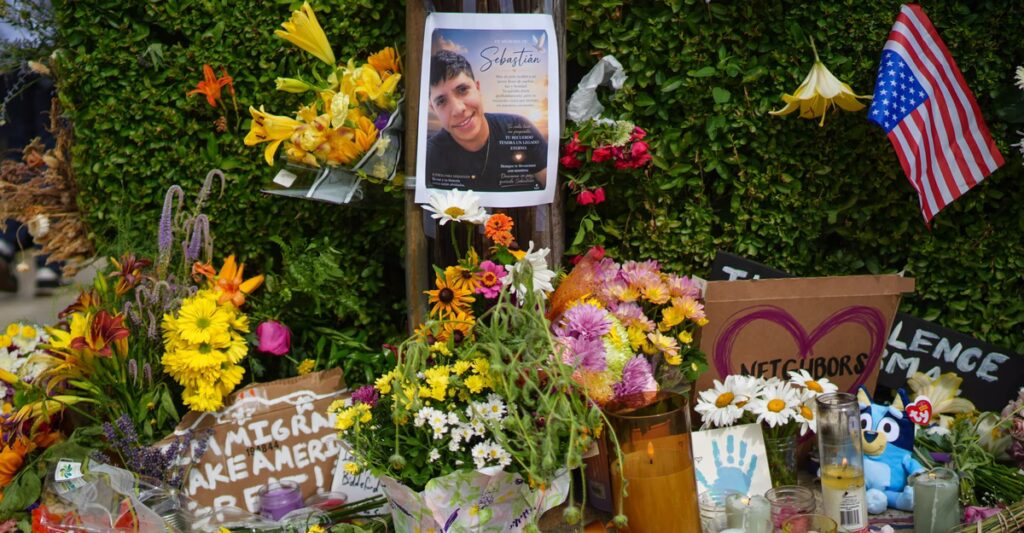
Late last night, at the end of a day that started with the killing of a 26-year-old Colombian man in Maine, the second fatal shooting involving a vehicle-stop in a week, the Immigration and Customs Enforcement official Liana Castano sent out an email to top ICE supervisors around the country. “Effective immediately,” Castano wrote, “vehicle stops are suspended until further notice.”
It was an extraordinary directive to ICE officers on the street, essentially telling them to no longer attempt to pull over suspects in cars. ICE has been ramping up immigration arrests across the country in recent weeks to roughly 2,000 per day, nearly doubling the number of people it takes into custody compared to the spring. Many of those arrests have occurred during stops by ICE officers traveling in unmarked cars. Castano’s email said exceptions would be made in instances when ICE pursues criminal suspects in cooperation with other police agencies. But ICE officers, operating on their own, were told to stand down.
“All personnel are instructed to prioritize other existing operational methods, outside of vehicle stops, to conduct immigration enforcement activities,” Castano instructed, according to a copy of the email I obtained. The existence of the order was first reported by The Daily Wire.
The decision to suspend vehicle stops was made by DHS Secretary Markwayne Mullin, with backing from the acting director of ICE, David Venturella, according to a senior administration official who was not authorized to discuss internal deliberations. During his confirmation hearing in March for the top DHS job, Mullin said he didn’t want the department to generate as much controversy as it did during the ICE crackdown in Minneapolis that left two U.S. citizens dead. Maine senator Susan Collins, a Republican who is running for reelection, said on social media that she spoke with Mullin last night and asked him to halt all non-urgent vehicle stops by ICE. Asked about the halt on vehicle stops, DHS said in a statement: “We are always evaluating our procedures to keep our officers safe and criminals off our streets. We will not disclose or discuss law enforcement tactics.”
The officer involved in the fatal shooting in Maine was hired by ICE this year from the Department of Veterans Affairs’ Police, according to the senior official. The officer has worked in federal law enforcement since 2017, the official said. Neither detail has been previously reported. The shooter in Maine has not been publicly identified; nor has the shooter in Houston.
[Read: Another fatal ICE shooting]
President Trump’s immigration crackdown has put unrelenting pressure on ICE officers to increase their arrest numbers and deliver on Trump’s promise of the largest mass-deportation campaign in U.S. history. ICE officers have historically tried to make arrests by apprehending their targets at home, but word has gotten out—through social media and legal clinics—that officers can’t enter homes without a search warrant from a judge.
That has left ICE more dependent on vehicle stops, as officers try to catch people getting into their cars as they head to work in the morning. Officers have received relatively little training in how to conduct vehicle stops safely, veteran officials told me. And the Trump administration has fast-tracked new recruits through ICE’s training academy or sent other new hires with previous law-enforcement experience onto the streets after online courses.
Last Tuesday, after the fatal shooting of Lorenzo Salgado Araujo by an ICE officer in Houston, seasoned officials at the agency told me they were concerned about insufficient training and the lack of a vehicle pursuit policy setting limits on the use of force during traffic stops. Salgado Araujo, a 52-year-old construction contractor who came from Mexico as a teenager and sent his three sons to college, had “weaponized his vehicle in an attempt to run over an ICE law enforcement officer,” according to DHS. The officers involved in Salgado Araujo’s killing had been in the neighborhood looking for another man.
The shooting in Biddeford, Maine, yesterday morning also took the life of an immigrant father who was not ICE’s target. The 26-year-old, identified as Joan Sebastian Guerrero, was shot through his windshield by an officer “fearing for public safety” when Guerrero tried to drive away, according to DHS.
No videos of the shootings have emerged to substantiate DHS’s claims, and the officers involved were not wearing body cameras, according to the department. But there were widely circulated bystander videos and security camera footage depicting the scene after the shooting in Maine. One ICE official who watched a video of the lead-up to the shooting told me he was troubled to see officers standing in each other’s “field of fire” and failing to give clear commands. But the exact sequence of events preceding the shooting remains unclear.
The FBI and DHS’s internal-affairs division are investigating both killings, which appear to involve victims who disobeyed officer commands and attempted to flee. Those actions, on their own, would not authorize officers to use lethal force, according to attorneys and ICE officials I spoke with. Officers must be able to demonstrate that they fired because of a well-reasoned fear of imminent harm.
[Read: ICE after Minneapolis]
There was growing unease among senior officials at ICE about traffic stops well before yesterday’s shooting. ICE has added nearly 8,000 new officers over the past 9 months as part of a hiring spree, the goal of which is to more than double the size of the workforce. Many of the new hires were sent through a fast-track course that cut the amount of training time they spent at the academy to just 42 days, less than half of a standard course. Officials at DHS reversed themselves this spring and returned to the longer training regimen, amid the backlash to the ICE crackdown in Minneapolis. But veteran ICE officials I’ve spoken with say officers receive less training in vehicle stops than most police departments, and the branch of ICE that handles detention and deportation, Enforcement and Removal Operations, lacks clear guidelines on the use of force involving vehicles.
ICE’s undercover tactics create an elevated risk, they warn, because officers using unmarked cars are more likely to cause a driver to panic than a police in a car with sirens and flashing lights. Videos of ICE officers drawing their weapons during traffic stops have circulated online since last year. Officers are trained to view vehicles as deadly weapons. That does not mean they can open fire when someone is attempting to drive away. Most immigration violations are civil offenses, not criminal ones, and ICE officers were traditionally instructed to avoid vehicle chases or confrontations with fleeing suspects that could create unnecessary risks. Now, following two deadly shootings, that’s become official policy.