

The Philippines on Friday condemned as racist a video posted by a state-run Chinese publication that depicted the country as a karaoke-singing monkey doing the bidding of the United States and Japan, as tensions rose again over territorial claims in the South China Sea.
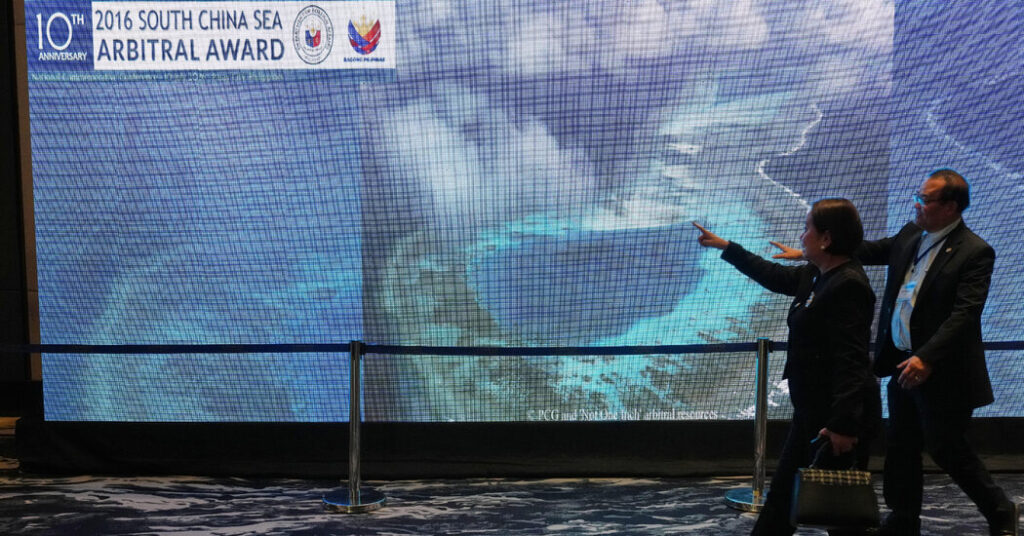
The video was created with artificial intelligence and posted by China Daily on its Facebook page last week, as the Philippines commemorated the 10th anniversary of a legal victory over China, in which an international tribunal rejected Beijing’s expansive claims to sovereignty over the South China Sea. The tribunal also ruled that China had violated international law by causing “irreparable harm” to the marine environment, endangering Philippine ships and interfering with Philippine fishing and oil exploration.
But while the decision was legally binding, there was no mechanism for enforcing it. So China continued to build new military bases in the South China Sea and lay claim to the waters, ignoring international criticism. This has led to many skirmishes with regional neighbors, particularly the Philippines, which analysts have warned could potentially be a flashpoint for a bigger conflict.
In the video, which is roughly a minute long, two human arms representing the United States and Japan force a monkey onto a karaoke stage in the middle of the ocean and force it to sing. The primate sings, “We attempt to bypass China and initiate the so-called maritime delimitation talks,” referring to negotiations about physical boundaries. But the two hands intervene, saying the monkey was not following orders — presumably because it uttered the words “bypass China” — and toss it overboard to be water cannoned by a ship. The last scene casts a document titled “South China Sea Arbitration Award,” as litter.
The Philippine defense secretary, Gilberto Teodoro Jr., criticized the video last week, calling it part of “contrived history.” The video appears to have gained traction online this week.
On Friday, the Philippine Department of Foreign Affairs said it had lodged a formal diplomatic protest with Beijing, saying that China had gone “beyond legitimate political debate by resorting to demeaning, dehumanizing and racist depiction of Filipinos.” Disagreement over legal and political issues, it said, “does not justify resorting to imagery that has no place in public discourse of responsible states.”
In a statement on Friday, it said that Leo Herrera-Lim, an under secretary with the department, had raised the issue with China’s ambassador in Manila, Jing Quan, on Thursday, demanding that the video be taken down. But the video had already spread widely online.
China’s Embassy in Manila did not respond to a request for comment, but it has repeatedly rejected the arbitral award.
Japan, along with the United States, is among the most vocal backers of the Philippines against China’s claims in the region. Tokyo is not involved in the South China Sea dispute, but has a similar issue with China over the Senkaku islands in the East China Sea.
Japan and the Philippines recently said that they had begun talks to delimit overlapping maritime claims east of Taiwan, involving the northernmost Philippine Islands, known as the Batanes, and outposts of Japan’s Okinawa Prefecture.
China claims Taiwan, a self-governing island, as its own, and last week, according to reports in Chinese media, Chinese scholars suggested Beijing also has rights to the Batanes Islands. The Philippines rejected those claims.