

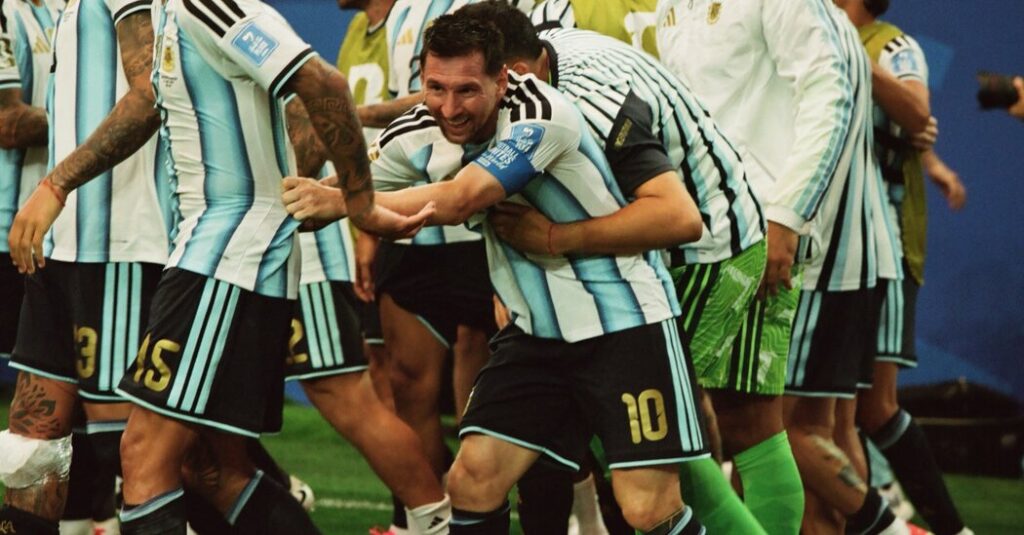
Who is the best player at the 2026 World Cup? Lamine Yamal, the adorable Spanish teen whose braces sparkle when he grins? Kylian Mbappé, France’s supercharged Bugatti? Vinícius Júnior, the obligatory Brazilian showman? Or maybe Erling Haaland, the giant Norwegian demigod who lives inside a haunted volcano and celebrates goals by swallowing opponents whole and spitting out their bones to spell insults in Viking runes? (That last one is possibly a nightmare I had when I passed out during a mandatory hydration break, but it seems true.)
The actual answer is both obvious and surprising: Lionel Messi. On the one hand, it’s like saying that the most important star in the solar system is the sun. Messi has reigned over global soccer now for 20 years — a sort of shy, benevolent dictator. But also: Messi is now extremely old. By soccer standards, he’s basically on death’s door. Last week, between two Argentina wins, he celebrated his 39th birthday. (Yamal is still not quite 19.) During the vast stretch of the Messi era, we’ve seen plenty of glorious players peak and fade — Neymar, Gareth Bale, Kevin De Bruyne, Luka Modric and multiple Ronaldos, including Messi’s longtime foil, Cristiano. Somehow, Messi remains. His career, like his feet, seems to move at a different time signature than everything else on earth.
This will almost certainly be Messi’s final World Cup — a fact that makes perfect sense but is also kind of horrifying. When it hit me, I felt a wave of panic. So I decided to fly to Dallas. Argentina was scheduled to play two matches. I wanted to get a glimpse of real-world Messi — not video game Messi, not YouTube Messi — before he was suddenly gone.
I saw more Messi than I ever could have imagined. Across the city, baking in the Texas sun, countless people were walking around in Messi jerseys: the black No. 10 over Argentina’s blue and white stripes.
Over the course of a week, I saw baby Messis, elderly Messis and pregnant Messis. I saw Messis on motorcycles and Messis in wheelchairs. Messis kissing and Messis fighting. I saw a bald Messi with his head painted blue. Every morning, in the breakfast room at my hotel, I had to squeeze past a crowd of Messis huddled around the waffle machine, waiting for hot waffles in the shape of Texas. I saw Messis wearing Messi jerseys waiting in line to buy more Messi jerseys. I saw one Messi playing an electric guitar. At the Dallas Museum of Art, I saw a Messi looking at Impressionist paintings. At Dealey Plaza, I stood for an hour and watched a shocking number of Messis posing for photos on the spot where John F. Kennedy was assassinated.
I’ve been around intense sports fandom before: playoffs, elimination games, championship parades. But I’ve never seen anything quite like this. It felt uncanny — the uniformity of it, the sheer gravity-warping density of Messis. It was serious and silly at the same time, a combination of military invasion and Comic-Con. And I was right there with them. What were we doing here?
There was a moment, outside the stadium, in a crowd of 10 million Messis, when it suddenly clicked for me. A Texas street preacher was evangelizing on the edge of the crowd, and as he screamed through his bullhorn, the sea of Messis stared back at him blankly. They weren’t interested in his gospel, I realized, because the impulse to follow Messi was itself a kind of religion. What was this trip to Texas if not a holy pilgrimage? Why else would we be suffering in this merciless heat, sweating through tubes of sunscreen, getting price-gouged for tickets and hotel rooms and ride-share services? We had joined a cult — the cult of Infinite Messi. It made our lives simple. We followed. We watched. We no longer had to be American, Chinese, Indian, Mexican or even Argentine. We were just witnesses. We stood together, simply and inseparably, like a row of blue and white stripes.
Before the Austria game, I headed to the stadium several hours early, just in time to see a solid red column of Austrians marching up the road, singing and chanting. It was festive and impressive. But when the procession reached the arena, the Messi fans swallowed it the way an ocean swallows a creek.
The stadium was full: a crowd of 70,649. The first big roar came well before kickoff, when the arena’s big screen showed Messi stepping off the team bus. We watched him walk down the hall. He was here. History could happen. Later, the crowd roared again when Messi emerged onto the field. Although Messi is small, he was gigantic on the screen. We watched him jogging around, pinwheeling his arms, stretching. He was surrounded by teammates and yet alone at the center of our attention.
When the actual game started, it felt, paradoxically, both crucial and beside the point.
Every time Messi touched the ball, the air in the building changed. Our collective awareness thickened. It wasn’t the usual superstar thing: a collective appreciation of skill, speed, touch, aura. (Although, there was that.) It felt more like seeing an endangered species — as if an ivory-billed woodpecker had started flying around the field. We all knew we were witnessing the end of something.
What we most wanted to witness, of course, was another goal. Messi came into this match tied for the record of the most goals scored in World Cup. In Argentina’s opening game, against Algeria, he scored his first-ever World Cup hat trick on a perfect variety pack of goals: the first, long-distance power; the second, delicate and close; the third, a sort of parlor trick that only looks normal coming from him.
With the next goal, he would stand alone.
Almost immediately, the record was at his feet. A few minutes in, two Austrian defenders chopped down an Argentine attacker in the 18-yard box. Foul. Messi, the infallible, stepped up to take the penalty kick. This was it. Seventy thousand of us started to compose the speeches we would someday give our grandchildren about being present for this moment.
Messi placed the ball on the grass. He backed up and then trotted forward. A million cameras winked as he swung his leg to strike — and then, inexplicably, the ball missed the goal. He missed the shot so badly that it made no sense, except maybe as a nod to his supporters — he missed it just as we would have missed it.
Messi dropped his face into his hands. He looked up at the sky. Then he turned his back and walked away.
This is my favorite thing about watching late-career Messi. Not the goals or the celebrations — the walking. He spends most of his time on the field just straight up strolling like a retiree. Head down. Little choppy steps. Fifteen feet one way, 15 feet the other. You half expect him to start scattering birdseed for pigeons. Defenders follow him around, suspiciously, matching his pace, like prison guards. As his teammates pass the ball among themselves, Messi throws little glances around the field. Clearly, he is scheming. But he’s in no hurry. He looks like a bank robber an hour before a heist, trying his best to seem inconspicuous.
As soon as the ball arrives, Messi is fully Messi. His feet move like a drum roll, like hummingbird wings, like a chef dicing an onion. Against Austria, after his penalty miss, Messi pitter-pattered around, creating chances for himself and others. Finally, in the 38th minute, it happened. Argentina’s forwards went racing ahead. The ball pinged out wide, and then back to the center. A teammate, cleverly, let it pass through his legs — because there, behind him, inevitably, was Messi. He wielded his holy left foot, turning the ball into a missile, and this time he did not miss: It curled, waist-high, past the goalie and into the back of the net. This was exactly the right goal, elegant and strong. At the end of the game, as a sort of bonus track, Messi added another in extra time — an “11 out of 10” degree of difficulty goal that he created, somehow, out of nothing, the way a prophet might make water spring from a rock. The stadium erupted in the kind of incoherent, body-waggling, head-shaking joy that happens very rarely when reality outperforms itself.
In recent days, the World Cup has entered its final phase: the cold brutality of the knockout rounds. Every country’s hopes and dreams are being fed, very publicly, into a meat grinder of pure math. This week, 32 teams are being crunched down to 16. Next week, they will be pulverized to eight — and then four, and then two, and then (tragically, triumphantly) one.
Last week in Dallas, however, we were still basking in the easy fun of the group stage. Forty eight teams, 16 stadiums, three host countries. Everything seemed possible. It was one big carnival of international joy. On Messi’s off-days, I traveled all over the city to watch matches with other fans. One night, I ended up pressed against a wall at a dance club, watching Colombians balance tequila bottles on their heads to celebrate a victory over the Democratic Republic of Congo. The next night, I went to Oak Cliff, a historic hub of Dallas’s Mexican American community, to watch Mexico take on the Czech Republic. There was a block party on Jefferson Boulevard: lowriders bouncing, meat sizzlng on sidewalk grills, people wearing huge Aztec headdresses. The Texas Theatre was showing the game on its big screen. Fans sat in plush red seats wearing Mexico jerseys, waving Mexican flags, screaming and chanting, “Mexico!”
Midway through the game, I learned a spooky piece of Dallas trivia: This was the theater where Lee Harvey Oswald hid out after shooting Kennedy. (They still have a movie poster signed by the arresting officer.) I walked over to the spot where he was arrested; as soon as I stood there, Mexico scored.
The next night, I watched Japan play Sweden to a scrappy 1-1 draw. After the match, across from Dallas Stadium, I popped into a Walmart.
The store was absolutely stuffed with Japanese fans, still in full regalia: face paint, flags, wigs, headbands. I watched them steer shopping carts past multiple images of Lionel Messi — Messi smiling down, beatifically, from a display of Lay’s potato chips; Messi standing proudly, in statue form, on top of a huge pile of Michelob Ultra. I watched a man in a Japan jersey, wearing a giant green foam cowboy hat, spend a very long time choosing a bar of chocolate. It was one of the strangest, funniest, most uplifting scenes I have ever stumbled into. A week later, I’m still smiling about it.
I needed all this. In my everyday life, I can be cynical and depressed and pessimistic and angry. But in Dallas, again and again, I found myself lifted up on waves of joy. Everywhere I went, the wide-open Texas spaces were stuffed with surreal crowds of foreigners advertising their foreignness, reveling in it, laughing about it, bonding over it. When I checked into the hotel, a whole United Nations of fans was lounging together in the lobby, watching a match. In the hallways, fathers played soccer with their kids. And partying Argentines, day after day, kept taking over the pool.
After joy comes the Hunger Games. We are solidly in the knockout stage now. One by one, teams are being eliminated. Goodbye, Ecuador. Goodbye, Senegal. Goodbye, beloved Japan. The waves of joy are settling down. At the moment, Messi is still here. Argentina plays Cape Verde on Friday, a game it should survive. But it is likely that, eventually, even Messi will lose.
And what will we do when Messi is gone?
In Dallas, at the end of the week, we got a little taste of it. It was June 27, the day of Argentina’s final match of the group stage. Nothing was at stake. Argentina had already clinched the group; Jordan, its opponent, had been eliminated from advancing. So Messi did not start. The crowd roared, nevertheless, when the arena’s big screen showed him emerging from the bus. It roared again when he stepped onto the field to warm up. Then, before kickoff, he sat down.
In Messi’s absence, the other players played. It wasn’t their fault, but the shape of the game felt wrong. Watching other people walk around is nothing like watching Messi walk around. There were occasional blips of excitement, but the game never got Messi exciting.
What do we lose when a superstar disappears? We lose, yes, our chance to watch them do more unbelievable things. But we lose much more than that. We lose a certain relationship to time. We lose currency. Our foot slips suddenly, precariously, out of one of the footholds that has allowed us to cling to the world.
I first became aware of Messi through my son, who played soccer as a little boy. Like all 21st-century boys who played soccer, he loved Messi. We watched Messi highlights together and took turns playing as Messi in video games. In our backyard, we ran around pretending to be Messi. For a while I coached my son’s soccer team, badly, and it crossed my mind that maybe there was a nonzero chance that my son could be the next Messi. (LOL, no.)
My point is that these memories — the urgency of them — are stored up, like a battery, in the existence of Lionel Messi. And so when that man suddenly goes away — when he is no longer current and public and playing — then where do all those memories go? What are they attached to?
Against Jordan, early in the second half, the crowd exploded: Argentina’s bench players, including Messi, had started jogging on the sideline. Finally, at the 60-minute mark, Messi subbed into the game. He didn’t look sharp. He dribbled into crowds and misplaced passes. Maybe, for once, it wasn’t his night. Which is fine. That’s allowed! But Messi wouldn’t allow it. Twenty minutes into his shift, he drew a foul and stepped up to take the free kick. The defense formed a wall in front of him, but they left a little gap — and so Messi tucked the ball through like a coin into a slot. Goal. Up in the stands, the infinite Messis erupted, and the vibration of joy spread, instantaneously, from the arena across the world. And I realized that Messi will never be gone. In his decades of pitter-patter steps, he has vibrated himself way too deep into the collective unconscious.
After Messi’s heroics, after his final game in Dallas, I found myself back at the hotel, in the middle of the night, in an elevator full of Messis. One of them noticed my press badge. “Do you work for FIFA?” he asked. No, I said, I’m writing an article. “Can you put us in it?” he said. And I said I would try.