

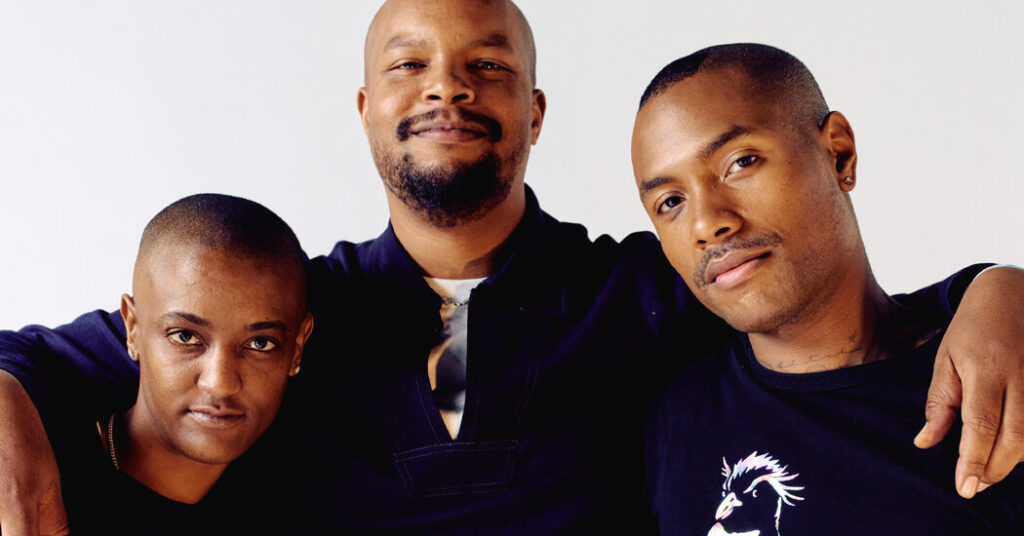
When the Los Angeles hip-hop crew Odd Future emerged in the late 2000s it started a tectonic disruption that would rearrange the upper crust of popular music. The collective excelled in shock and slapstick in equal measure. Tyler, the Creator, now an arena-filling star, was the antic figurehead, preoccupied with demonic theatricality. Earl Sweatshirt was the missing-in-action, pottymouthed wordsmith who would go on to become a sage veteran.
But Odd Future was hiding a whole world just behind those extroverts. Along with Frank Ocean, one of the first indications of the many mellifluous layers lurking within the crew came in the form of the Internet, an off-kilter soul band whose best known members were the DJ-turned-singer Syd and the producer Matt Martians. The group released its debut album, “Purple Naked Ladies,” in 2011; the guitarist and vocalist Steve Lacy, then just 15 years old, joined the group in 2014.
Over four albums — including, most recently, the major-label sleeper hits “Ego Death” (2015) and “Hive Mind” (2018) — the Internet became one of the most innovative forces in contemporary R&B music, reviving the neo-soul tableaux of the 1990s refracted through the lens of online disaffection and queerness.
Its members have also dispersed, achieving breakout successes of their own. Lacy, now 28, had a surprise viral TikTok hit, “Bad Habit,” which went to the top of the Billboard singles chart in 2022. That same year, Syd, who is now 34, was credited as a writer and producer on “Plastic Off the Sofa,” one of the most boisterous songs on Beyoncé’s “Renaissance.”
On July 17, both Syd and Lacy will release their third solo albums — Lacy’s “Oh Yeah?”, which features SZA and Erykah Badu, and Syd’s “Beard” — continuing to push, gently and sometimes with a sly wink, against the boundaries of modern soul. And in an interview with Popcast, The New York Times culture chat show, the Internet’s members revealed that they are finishing up new music as a band, with an eye toward releasing the collective’s fifth album next year.
These are edited excerpts from the conversation, which can be watched in full or listened to below.
JON CARAMANICA One of the things that struck me so much when I was spent time with you guys in the early Odd Future era was how much of it was not musical, it was social — a bunch of people who genuinely enjoyed hanging out and being rowdy together. And then out of that comes a certain energy, and then comes the music.
SYD Well, me and Matt were the ones who didn’t really enjoy [expletive] [expletive] up.
CARAMANICA How did you come to understand yourself musically given that you were the ones trying to preserve a little bit of peace?
MATT MARTIANS Good catch. I’ll say this: You guys know artists — the music you put out a lot of times isn’t necessarily the music you actually ride in your car with or chill with your girl with. A lot of the Odd Future guys have made songs like Internet songs.
I’ve found that it’s good to just understand things instead of agreeing with them. We understood why they were [expletive] [expletive] up. Just like they understood why we wanted to chill. And I think it can survive like that. But it was always that middle ground of like, we all like this type of music. We all like chord changes and weird stuff. So, it’s not as weird as you may think.
JOE COSCARELLI Steve, you were coming up in L.A. as a young musician at the time. What was it like first watching from the outside and then being welcomed in?
STEVE LACY It was funny because I was super Christian when O.F. came out, so I was like, “This is devil-worshiping music. I’m not trying to go to hell.” Then I went to the studio and we started worshiping Satan together and then I started my music career. No, I’m just kidding. It was super dreamy.
COSCARELLI Syd, you were bearing a lot of the brunt of the conversations around the misogyny and the homophobia apparent in early Odd Future lyrics, marketing and extracurriculars. Was that hard on you, personally? And were you leaning on your bandmates in the quieter wing of the collective to get through that?
SYD Yeah, I was, because this is right before we even started the band, really. I definitely leaned on [Martians]. It was a little bit tough. I didn’t mind it that much at the time. Looking back though, it was like, yeah, dang, I did have to answer all those questions. But to be honest, I was probably the best one to do that.
MARTIANS For me, I just knew what she needed and a lot of times it’s similar to Steve — like artists just need somebody they can call, that one person that’s outside of it. That’s all they need sometimes. So I try to do that in a lot of artists’ lives. I tried to be the outside man and one that you can call that’s like, hey man, go get some pizza, cut your phone off for a day, don’t worry about what nobody’s talking about.
SYD He talks me off the ledge.
MARTIANS I’m just trying to give a macro perspective on everything. You know, being an artist is a branch on the trunk, it’s not the trunk. So I always try to remind everybody of that. Because I used to think it was the trunk, and it will ruin your life.
CARAMANICA You guys are close to a new Internet album. Talk to us a little bit about that, and how do you think about that album, especially vis-à-vis your individual work?
MARTIANS We’ve been working on it, on and off, for four or five years. We’ve just been in and out of the studio and it just built to this moment. We didn’t plan for it to be almost finished around this [solo album] situation.
We want to do things that aren’t money plays with the Internet. That’s part of the reason why we did our solo thing, so when we come to the Internet, we can do things we think are cool.
Think about if you were in a band, and it was just a band, we didn’t have solo records. Having that release valve for a band is a very important thing, because it allows you to be able to get your ideas out and not feel shuttered. That’s the symbiosis of how they both work together and don’t ever clash into each other.
CARAMANICA Is there a tell for you guys where you’re like, “I feel like this is a Steve solo thing,” or “it’s absolutely an Internet song?” How do you know?
SYD When we’re making something together and we feel excited about it, that’s usually a good sign. And then we’ve also submitted things from our own collections for the album. We have Steve beats on the album, there’s a Syd beat on the album. And then Matt’s been sampling other beats of ours. We’ve made every group album with a different process. The process on this one is different than the process on “Hive Mind” and different than the one on “Ego Death.”
MARTIANS I will say it’s similar to “Ego Death,” more than any album. We always have a pattern: We make a very sort of “we don’t care” album, then we make an album like, “all right, let’s sustain this.”
COSCARELLI Steve, there’s a song on your new album called “Show You Me” that almost sounds like Oasis, but it has you singing pretty openly about bisexuality. When did you get more comfortable putting that kind of thing on record?
LACY It’s not even a thought, really, it’s just how I live. I think I’m just very fluid, so I just write freely. This album is a lot of jokes, you know? I think sex and sexuality is kind of funny. I laughed so much throughout this album.
CARAMANICA Do you find, at this stage of your career, accessing that humor is both easier and more necessary?
LACY I don’t think I thought about it that way. I was taking the approach of trying to write how I talk — this flow of conversation where it’s not all just one emotion, fluid, packing all types of emotions in: anger, sadness, comedy.
CARAMANICA I wonder how what happened in 2022 and 2023, when “Bad Habit” became such a huge viral hit, shaped your thinking about how a song should sound. What did you take from that experience, in terms of song construction, that is on this album that maybe wasn’t on the prior one?
LACY Performance. I thought about what’s funnest for me when I’m playing live shows. And I’m like, oh, OK, the ones that I can sing together with everyone. I find those songs are the ones I thoroughly sat there and really dove into the words. I think where I ended up at the end of “Gemini Rights” — I’m on bigger stages, headline vibe — and I’m like, I don’t feel prepared for where I ended up. So this next album is just kind of me trying to be as prepared as I could.
COSCARELLI Syd, you had your own big breakout moment between albums, behind the scenes. The Beyoncé song “Plastic Off the Sofa” started as a demo from 2017 with you and the singer Sabrina Claudio. What did you learn about the way the music industry works and specifically the way Beyoncé works as an executive producer to see that song end up on “Renaissance?”
SYD Another surprise. I sent several songs and, matter of fact, before the pandemic hit, I was in a writing camp for the Beyoncé album for like a whole month-and-a-half and wrote handfuls of songs that went nowhere. Then, after the pandemic, I just tapped back in with one of her team members, and was like, yo, where y’all at with the project? She was like, we’re still at square one. So I sent some stuff.
Even to hear the whole album, I was surprised. The whole album was really modern and that’s why I was so surprised to hear it on there.
COSCARELLI How different does it sound as a Beyoncé song than what it sounded like as a Syd song?
SYD The drums are different. And Beyoncé went crazy on the vocals. All the runs she did were not on the demo. I remember getting invited to her mixing engineer’s house to hear her recording of it and being like, oh my god … she had — did she have fun? Like, it sounds like she had fun. I love that for her — and me.
CARAMANICA It’s interesting, each of you have talked about having moments where something happened that was almost outside of yourself. But then it’s almost like a rubber band snapping back to its original shape. Is that because the foundation that you have from being so young when you first came together is so firm?
SYD I think it’s our friendship, and our friendships have evolved over the years, too.
MARTIANS We’ve gone through stuff with each other just like any band. But I say the thing that keeps us all together is the family aspect, and we’re genuinely proud of each other. And if we all do well, it makes the band look better. So when the solo albums happen, we have to all get behind those, as well. We are really family-oriented behind the scenes. And I think, of course, you fight your brother. And the next night y’all at dinner laughing.
We don’t really have any drama. We want to treat being a musician like a blue-collar job in a way, where we clock in and we do the best that we can. But then after that we go home to our families and we do the best we can there.
The post The Internet, Odd Future’s Laid-Back Arm, Branched Out and Grew Stronger appeared first on New York Times.