

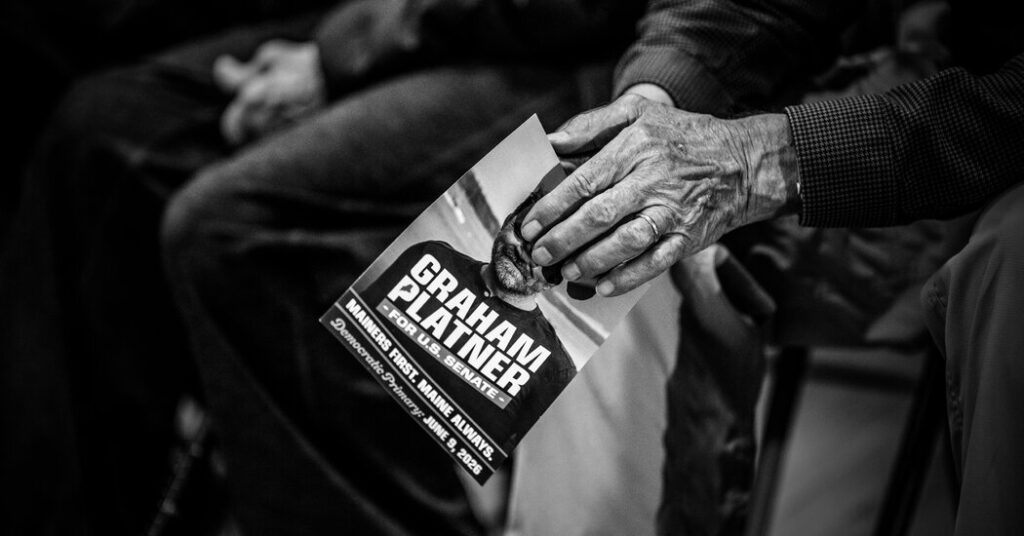
Graham Platner is out. Just months ago, the oyster farmer and Marine combat veteran looked like the answer to the question Democrats keep asking themselves: Where are the candidates who can excite people? Mr. Platner, running in Maine for the U.S. Senate, drew crowds most politicians only fantasize about, won Bernie Sanders’s endorsement and, after Gov. Janet Mills suspended her own campaign, pulled even the reluctant party establishment in behind him. Now he has suspended his campaign, brought down by an allegation of rape, which he denies, that landed atop months of damaging revelations.
Maine Democrats are scrambling to field a replacement before the state’s deadline late this month, leaving in peril a seat that is key to their chance of flipping the Senate. It’s tempting to treat this as a story of one flawed man and a vetting process that failed. There is truth in that, and the party should absorb the obvious lesson about scrutinizing candidates before it pours itself into them. But the more uncomfortable lesson is the one that the Platner boom offered before the bust. The hunger that lifted him — the overflow crowds, the volunteer armies, the sense that here, at last, was someone who meant it — was real. It was also a hunger the party keeps trying to satisfy with a personality instead of a purpose.
Let’s concede what is true in the case for candidates like Mr. Platner. Democrats do need fresh, charismatic, younger contenders, and they should stop treating the next name in line as an entitlement. A party is strongest when it is a genuinely big tent, willing to host real disagreement rather than enforce a single approved script. Voters can tell the difference between a coalition and a focus group, and they are drawn to the former.
But a big tent is only worth pitching if something is argued inside it, and that is precisely what this midterm cycle has lacked. Handed the chance to litigate what the party actually believes, Democrats have mostly declined. What is the party’s answer on immigration, moving beyond its proper outrage at President Trump’s methods to include an affirmative account of who should be allowed in and how? What would it do about the cost of housing, beyond lamenting it and suggesting inadequate fixes? What does it want from the public education system? What is its response to the disruption that artificial intelligence is about to send through the work force and society more broadly?
On each of these issues, voters keep saying the same thing: They want change, they want action and they are tired of being managed. The discontent reaches the party’s own base. In Associated Press-NORC surveys, many Democrats have described their party as weak or ineffective, and by early this year only about seven in 10 still viewed it positively, well below where it once stood. Among all voters, the party’s favorability rating is below 40 percent.
One sign of the party’s dysfunction came in May, when the Democratic National Committee released an embarrassing autopsy on the party’s presidential loss in 2024. Instead of offering honest reflections and a vision for the future, the report resembled an incomplete homework assignment, filled with notes like, “This section was not provided by author.” It was another missed chance to chart a new path.
The party’s private answer, too often, seems to be that Washington is broken and therefore nothing can be done. Why stage a fight over specifics that will only expose divisions? But that gets the task exactly backward. If Democrats believe government can still work, the way to prove it is to say, concretely, what they would do with power. Refusing to say doesn’t make the party look unified. It makes it look as if it has nothing to say, and it surrenders the language of change to the other side, which is only too happy to claim it.
This is the deeper reason the Platner phenomenon should unsettle Democrats. Mr. Platner’s appeal was never really about oysters or facial hair. It was that he seemed to stand for something. He was angry on voters’ behalf about an economy that seems rigged for the powerful, and he was unafraid to say so. People responded to the promise of conviction. That signal is the one the party ought to be reading. The tragedy of a campaign like his is not only that it collapsed, as it deserved to, but that so much energy was poured into a messenger before anyone was sure of the message.
Maine will choose someone else, and may yet field a candidate who can take the seat. But Democrats nationally should resist the comforting conclusion that their problem was simply the wrong man. The next charismatic outsider will struggle to succeed if there is nothing solid beneath the charisma. Personality is not a platform. A fighting posture is not a program.
What the party owes voters this year is not another savior but a set of answers — plain, specific, sometimes divisive answers to the questions constituents are asking to improve their lives. That is how you convince someone that you are listening: not only by hunting for a better messenger, but also by finally having something to say. Right now, too much of the Democratic Party’s identity is defined by what it stands against. The trouble in Maine goes beyond a single candidate. It is a party still hoping a contender will spare it the harder work of deciding what it stands for.
The Times is committed to publishing a diversity of letters to the editor. We’d like to hear what you think about this or any of our articles. Here are some tips. And here’s our email: [email protected].
Follow the New York Times Opinion section on Facebook, Instagram, TikTok, Bluesky, WhatsApp and Threads.