

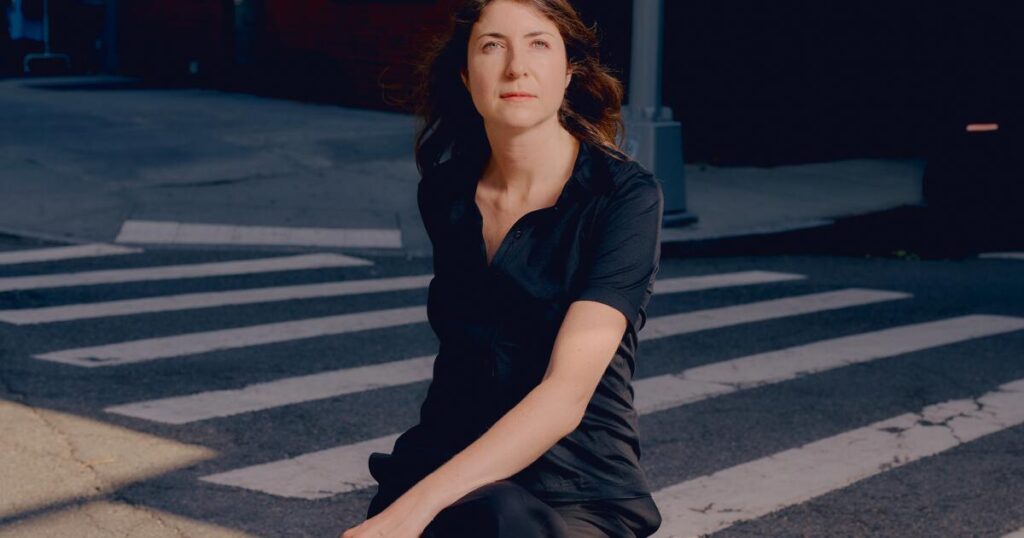
When Julia Weist applied for a New York private investigator’s license in 2022, she did not expect that the application would eventually form the basis for a play.
The New York-based artist has spent much of her career examining the institutions that shape public life: archives, databases, bureaucracies, surveillance systems, licensing regimes, and the often-invisible structures that determine who gets access to hard-to-find or nonpublic information. Her projects frequently blur the boundaries between artistic practice and civic inquiry.
During a 2019-20 artist residency with New York City’s Department of Records and Information Services, Weist mined municipal archives for records revealing how city government had defined, supported and monitored past artists. She then produced a series of compositions from her findings using city resources and personnel, allowing the artworks to enter the same archival system they were investigating as official public records. Weist has repeatedly gravitated toward systems that most people encounter only indirectly, transforming her research processes into subjects of aesthetic and political investigation.
“Artistic License,” her December 2024 project for the magazine Triple Canopy, pushed those concerns further. Part essay, part documentary archive, it chronicled the discoveries she made as a private investigator and her attempt to renew her PI license that fall.
Officials from New York state’s Division of Licensing Services reopened questions about her qualifications and summoned her to Albany for a formal interview on Nov. 4, just weeks before her license was to expire. What followed was an hour-and-47-minute conversation between Weist and two investigators attempting to determine whether the work she had described as artistic research truly constituted investigative experience.
Rather than simply endure the inquiry, Weist transformed it into a work of art.
The result is “Questioning,” a 55-minute theatrical production premiering July 10 at New Theater Hollywood before traveling to Art Basel Miami Beach in December and, eventually, museums and gallery spaces as a room-based installation. Built from a clandestine audio recording Weist made during the interview, the work occupies a niche between documentary theater, performance art and procedural drama. Stylistically, “Questioning” is what you might get if you combined a work like Tina Satter’s “Is This a Room” — a docu-play based on an FBI transcript of the interrogation of NSA contractor Reality Winner — and Lucas Hnath’s “Dana H,” which recounts, through a lip-synced interview, the abduction of the playwright’s mother.
The production also marks a new chapter in Weist’s career. Although she has collaborated extensively with artists, researchers, journalists and technical specialists, she had never directed actors before. Weist herself appears in a brief introductory clip before the performance proper. In a calm and measured tone, she tells the audience that in 2024 she was investigated by the N.Y. Department of State for using a private investigator license to make artwork and that the images on screen are taken from her case file. (Since New York is a one-party consent state, Weist was able to covertly record the conversation by slipping her phone into the pocket of her blazer; the audio used in the performance retains the sound of rustling fabric).
Speaking over tea at a coffee shop in Union Square on a sunny June day, Weist explained that, in a funny ouroboric way, the interrogation ultimately produced the very conversation she had hoped for when she first applied for the license.
“When I applied to become a private investigator, I had assumed that there would be a little bit more back-and-forth,” she told me. She anticipated that state officials would request additional documentation, reject her initial application, or even force her through an appeals process. Artists, she noted wryly, often prove difficult to categorize within bureaucratic systems. Instead, her license was approved without any kind of sustained scrutiny. It was only later, when the state reopened the inquiry into her qualifications, that the process took on the shape of the “complicated, nuanced, difficult-to-answer questions that I was interested in pursuing in the first place,” she reflected.
Initially, Weist treated her own recording as a backup; she expected to obtain and eventually exhibit the state’s official video recording of the interview. But after the investigation was dropped, repeated requests for that footage proved unsuccessful, and officials ultimately certified that it could not be located. The loss of the original recording forced Weist to rethink the project. What had begun as a contingency paved the way for “a profound artistic opportunity.”
“In the absence of the official video, there’s something special that happens, which is that I can demonstrate the case again,” Weist noted. “What I was doing was using my abilities as an artist to circumnavigate their attempt at exercising their power and preventing me from using this exchange as material in my practice.”
Actors in the production lip-sync the actual audio, reproducing every hesitation, interruption and verbal tic. Although one participant appeared remotely, on a large TV monitor, during the real interrogation, the theatrical version places all three figures in the same room. The set replicates the characteristics of the actual room in Albany, down to two heavily tasseled flags — one American, one New York state.
Weist found herself studying interrogation scenes from film and television while developing “Questioning,” particularly the ways that cinematic techniques like the tight close-up can “articulate some of the emotional reality while the content remains quite straightforward and professional.” For the filmed sequences, Weist worked with cinematographer and visual artist Abigail Raphael Collins, whose research has explored the role Hollywood has played in constructing public perceptions of American state power.
The exchange at the center of “Questioning” unfolds entirely through “Socratic” conversation. There are no explosive revelations, gotcha moments, dramatic confessions, or theatrical outbursts. Nobody pounds a fist on the table. Nobody raises their voice; Weist answers the investigators’ litany of questions in an unwaveringly patient, professorial tone, much like the ones she used in her interview with me.
The tension emerges from something subtler: the struggle to define terms. The first question is raised not by the investigators but by Weist. After being informed by Senior Investigator Jason Berent that the meeting would be recorded, she asks if it would be possible to receive a copy. “It was a very nerve-racking experience, of course, but it was also very exciting. You can tell I’m a little bit thrilled,” Weist told me.
As the interview unfolds, “Questioning” takes on the form of a Möbius strip. The N.Y. Department of State investigators are tasked with determining whether Weist’s artistic research qualifies as investigative work, yet in pursuing that answer they find themselves wrestling with the very conceptual distinctions that animated her project from the beginning. What separates a researcher from an investigator? Is gathering information fundamentally different from interpreting it? When does expertise become a credential? The officials are ostensibly questioning Weist, but they are also, in a sense, questioning their own categories.
“[The play] is about me, but it’s really about all artists, all researchers, all investigators, where they overlap, where they don’t, what their aims are, and what those different aims mean for their role in our society,” Weist said.
In the audio clip from the performance, we hear Deputy Chief Investigator John Goldman explaining to Weist that he is essentially constructing a résumé from her answers. Multiple references are made to an op-ed Weist wrote making a case for greater regulation of the private investigator industry. (The op-ed was published in The Times Union in Albany on Sept. 8, 2024; officials opened the investigation into her artistic use of the PI license the very next day.) Throughout the interview, both sides seem genuinely fascinated by the conversation they are having — the earnestness of their encounter lends it an unexpectedly comedic tone at times.
At one point, Weist describes uncovering that former New York City Mayor Rudy Giuliani maintained a fine-art photography practice while simultaneously waging a highly public censorship battle against the Brooklyn Museum. (In an additional bit of circularity, the museum later acquired Weist’s 2020 collage “Giuliani.”) The investigators ask whether this discovery falls within the scope of her project. Weist patiently explains why it does. Elsewhere, the conversation drifts into questions about public-records databases, investigative reporting, grant applications, and the ways institutions classify professional expertise.
Did working on the play make Weist think about her relationship to authority and power differently?
“I think it’s a question of access,” she told me. “If credentials were equally accessible to all humans on this planet, regardless of the circumstances that they face in their life, then possibly we could start to think about credentialing the way we think about expertise as a long-term devotion to a subject to become fluent enough to contribute something using that expertise.”
After eight months, the investigators dropped her case in 2025, renewed her private investigator’s license and approved another credential she had pursued as part of her artistic practice: a license as a document destruction contractor. (She is also a licensed notary public.)
The saga acquired yet another meta layer after the investigation concluded. Weist had invited both Goldman and Berent to “Questioning” — Goldman has since retired while Berent still works for the Department of State — and she mailed Berent a reproduction of his notes from their session. But the envelope made out to Berent was returned unopened by the Department of State’s Office of General Counsel in May of this year. According to the accompanying letter, state ethics rules prohibit employees from accepting gifts of value from individuals who had been subjects of investigations. (The document was itself a copy of a copy — a giclée, the high-resolution, archival-quality inkjet reproduction used for fine art and photography, the notes that the state had reproduced and supplied to Weist as part of her case file, altered only by her signature and its issuance as one of a limited edition of 100.)
For Weist, the irony could hardly have been more perfect. “Even though it’s functionally the same thing that they already have, the fact that I touched it, called it an artwork, separated it from them touching it and calling it a copy.”