

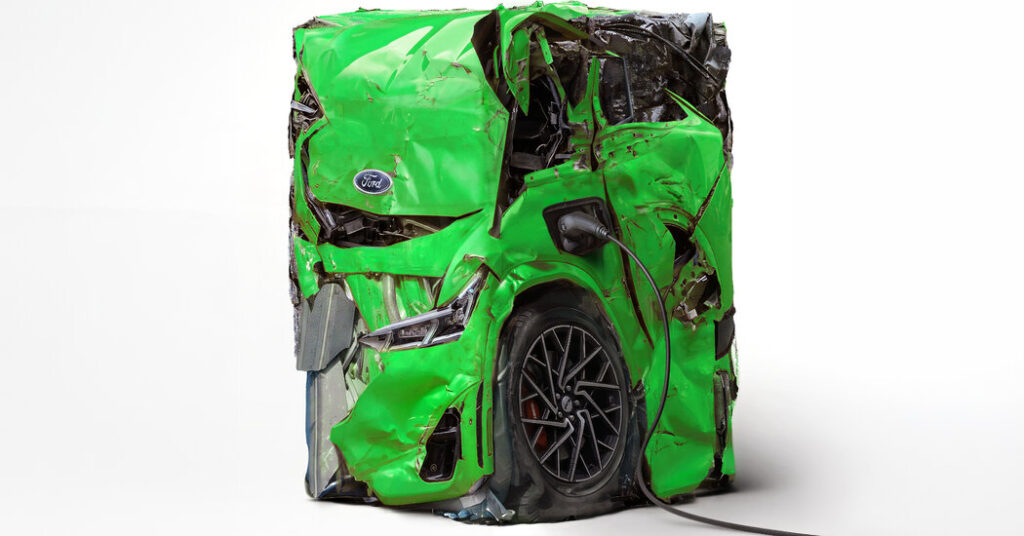
The first sign of real trouble arrived two years ago, in the guise of an electric S.U.V. so new it did not yet have an official name. Fast and capacious, sleek and quiet, with plenty of comfortable seating and enough juice to carry a family 350 miles on a single charge, the vehicle was unveiled in May 2023, at a Ford investor event in the Michigan factory town of Dearborn. “It’s beautiful,” Doug Field, the head of Ford’s E.V. unit, promised the audience. “And it’s unlike anything else in the segment so far.” A “personal bullet train,” he called it.
He had good reason to be optimistic. Buoyed by billions of dollars in federal investment in charging infrastructure and a generous $7,500 consumer tax credit, the electric vehicle market in the United States had recently hit historic highs, climbing from annual sales of roughly 490,000 in 2021 to more than 800,000 in 2022 — an increase of approximately 60 percent. Many experts believed that the United States was now poised to enter the fruitful second phase of what’s commonly known as an S-curve, in which early interest in an emerging technology gives way to widespread adoption. If they were right — and data from other parts of the globe suggested they were — the rollout of a long-range electric S.U.V. was more than savvy thinking. It was an investment in the future.
And yet the project seems to have been cursed from the outset. Unlike many of the earlier Ford E.V.s, the “bullet train” was not merely a retrofitted version of an existing vehicle with an internal combustion engine — ICE, in the industry parlance. It was an entirely new car, requiring a large and complicated battery to match the vehicle’s projected heft. In April 2024, Ford pushed back the sale of the “bullet train” by two years, to “enable Ford to take advantage of emerging battery technology”; that August, it confirmed it was killing it entirely. “These vehicles need to be profitable,” Ford’s chief financial officer, John Lawler, explained in a conference call with reporters. “If they’re not profitable, based on where the customer is and the market is, we will pivot and adjust and make those tough decisions.”
At the time, his comments went relatively unnoticed. But it soon became clear that Ford — which went on to retire the Lightning, an electric variant of its best-selling F-150 pickup — was not the only manufacturer to have suddenly developed a case of cold feet. In July 2024, General Motors said it was delaying the introduction of a Buick E.V. S.U.V., and the following September, Volvo dialed back plans for an all-electric lineup of vehicles that would have debuted in the United States. In 2025, Dodge followed suit, axing a battery-powered Charger and its long-anticipated E.V. Ram pickup truck. Two plug-in hybrid Jeeps were sent to the scrap heap in the sky, as were several e-sedans that Honda and Nissan had designed for the U.S. market. Acura pulled the plug on an electric S.U.V. built at a G.M. plant in Tennessee.
The cancellations accumulated at such a rapid clip that the industry press often struggled to keep up: Late last year, for example, MotorTrend published an effusive review of the BrightDrop, a cutting-edge electric van from Chevrolet. The cargo hold of the vehicle was “cavernous,” the magazine’s writers noted approvingly, and the pedal feel supple. As for visibility, it was akin to “looking out of a giant terrarium.” The only problem was that the BrightDrop was no longer available, having been discontinued by Chevy two weeks after its press team dropped the thing off at MotorTrend headquarters. (“Well, this is awkward,” the article begins.)
And the carnage was far from over: Under the second Trump administration, the E.V. tax credit was eliminated and tailpipe-emission standards were gutted, which more or less instantly drove down sales of new battery-powered vehicles and encouraged the so-called Big Three — Ford, G.M. and Stellantis North America, the maker of the Dodge, Chrysler, Ram and Jeep brands — to refocus their considerable resources on trucks and plus-size S.U.V.s. Assembly lines at E.V. plants went dormant, and the battery plants that had sprung up around the country in the Biden years were unceremoniously closed or repurposed for other tasks, like the manufacture of industrial battery storage units. Thousands of workers lost their jobs. One of them was Doug Field, the brain behind Ford’s three-row “bullet train,” who departed the company this spring as part of an internal restructuring.
In purely financial terms, the combined cost of this industry about-face remains nothing short of staggering: This year, Stellantis alone was forced to write down $26 billion in E.V.-related losses. (Ford reported a slightly less ghastly $19 billion loss.) But somehow, it’s the long-term repercussions that look worse. “The way I’d put it,” the auto journalist Martin Padgett told me recently, “is that we pulled a U-turn while the rest of the world was pushing forward.”
According to the International Energy Agency, a Paris-based policy group, one of every four vehicles sold globally in 2025 was battery-powered. Analysts with Bloomberg have predicted that in the next decade, that number will more than double, putting gas-powered cars — for the first time ever — in the minority of overall new vehicle sales. Overseas, Asian and European manufacturers have spent years preparing for this eventuality, dumping billions into the development of battery technology. With predictable results: China now makes 75 percent of all E.V.s sold anywhere on earth. (The United States makes around 5 percent.) Many of those vehicles are produced by BYD, a Chinese company that recently became the largest manufacturer of battery-powered cars in the world.
“Already, the technological gap is getting dangerously wide,” says Stephen Ezell, a senior economist with the Information Technology and Innovation Foundation, or I.T.I.F., a Washington-based nonprofit. “Today, China can get a new E.V. from blueprint to launch about 33 percent faster than a U.S. company, give or take. But that will accelerate, right? The speed of innovation, the speed of the production cycles at these foreign companies, is just going to get faster and faster. And at some point, the gap will get pretty close to fully impossible for American automakers to close.”
For Detroit, the timing could not be worse. Since the 1960s, the U.S. auto industry’s once-dominant stake in the domestic car business has been slowly chewed up by foreign manufacturers, sinking from a near monopoly of 92 percent in 1965 to 46 percent in 2015. As of 2024, Ezell estimates, only a third of new cars purchased in the United States were built by the Big Three. The E.V. revolution was seen by its proponents as a way to reverse that trend. It was an opportunity for Detroit to rediscover its capacity for ingenuity and to re-establish credibility in an industry it helped to create.
Instead, whipsawed back and forth by shifting political headwinds and afflicted by all manner of self-enforced error, it appears to be in the process of sealing its own doom — at the precise moment interest in E.V.s is surging in the United States. In April, the analytics firm JD Power conducted a survey showing that 26 percent of prospective buyers in the United States were “very likely” to consider an E.V. for their next car. And that was before the chaos in the Strait of Hormuz helped push the price of unleaded gasoline to a four-year high.
“We’ve reached a genuinely existential moment,” Ezell told me. In a best-case scenario, Detroit manages to meet it by crafting a viable, long-term E.V. strategy while also servicing the still dependably lucrative existing market for ICE trucks. In the worst, it retreats onto what the economist Susan Helper calls a “shrinking island of ICE,” churning out outlandishly large trucks and not much else. At which point, the obsolescence of the mighty U.S. automobile industry — a sector once inextricably associated with American know-how and economic might — would be all but guaranteed. As Ford’s chief executive, Jim Farley, recently acknowledged in a statement that could apply to any member of the Big Three, “If we don’t put our chips on the right number and the right color, Ford could maybe not exist.”
The Struggling American E.V.
A few of the electric offerings that the Big Three have killed.
“Is Detroit resigned to its fate? Has it accepted the role of subordinate in the world of cars?” Somewhat remarkably, these lines were not published this year but nearly half a century ago, in 1983, in the last chapter of a book called “The Decline and Fall of the American Automobile Industry.” Its author was the legendary journalist Brock Yates; the eerily resonant topic was the threat posed by a new breed of fuel-efficient Asian sedan — in this case, the Honda Accord, which would go on to become one of the most popular vehicles ever sold in the United States.
To Yates, there was little question that the Accord was deserving of its popularity. The vehicle was a “masterpiece,” he wrote, “the ne plus ultra of small cars.” But he was far more interested in the Big Three’s reaction to its release, which he characterized as alternately cocky and flat-footed. Trapped in their corner offices, coasting on the fumes of earlier successes, many executives had hoped that Americans would eventually go back to their preference for heavy gas guzzlers. By the time they realized their error, Yates argued, Detroit had found itself in a position analogous to today: lapped by outsiders, left flailing in the wake of technological advances and cultural currents that it should have anticipated — forced to play catch-up.
“I remember it as basically all the stages of grief,” says Helper, who wrote her 1987 doctoral dissertation at Harvard on the rise of the Japanese auto industry. Denial — how could the collective experience of Detroit come up short against an overseas rival? Then anger. Why would anyone in their right mind prefer a small car to a full-size one? Then bargaining, in the form of a few ill-considered sedans designed to compete with the Accord and subsequently rejected by consumers for being too pricey, too ugly and far too slow. Sales of imports, meanwhile, were rising every year, as Honda and another Japanese powerhouse, Toyota, established a bigger foothold in the U.S. market.
To the Big Three — and to the American public — this was unacceptable. Detroit had long been the defining force in American industry, contributing billions of dollars to the domestic economy and regularly making up close to 5 percent of the annual G.D.P. “When you think about it, it was the original American start-up,” Ezell says. “I mean, look at what it unleashed in our society: The Interstate highway system, the rise of the suburbs and so on. That’s the coming-of-age story of our entire country.” It was a machine that had remade cities and towns, lifted millions of Americans into the middle class and fueled an array of downstream industries, from steelwork to the manufacture of radial tires and antennas. It would have to be preserved, and the U.S. government would have to help.
In the early 1980s, under pressure from Detroit, President Ronald Reagan negotiated a “voluntary” quota that restricted the number of Japanese imports that could be sold in the United States; he also gave Toyota and Honda permission to build a few factories in America, providing they were staffed by local workers. In addition to stemming the loss of American jobs, these moves were designed to buy time for the domestic auto industry — to allow executives to study (and ideally, to ape) how the Japanese were able to produce their vehicles so efficiently.
But even with the assist from the White House, Detroit was never able to recover anything like its previous market clout. In the United States, unlike Asia, manufacturers had to contend with a layered corporate bureaucracy that hindered innovation. More than that, they had to contend with their own history. In a paper on the convulsions of the era, Helper noted that “problems of perception — or of the failure to recognize that the world is changing — flow from the fact that senior managers tend to become overly reliant on the mental models and beliefs that undergirded the firm’s success in the first place.” A well-grooved track can transform, with enough traffic, into a rut.
Through the 1990s, sales figures continued to slide, as more foreign automakers targeted U.S. consumers — Nissan, BMW, a Korean newcomer called Kia, all apparently more in tune with what Americans wanted than the American companies themselves.
What recovery there was for Detroit came in fits and starts. The Dodge Neon, introduced in 1994, was a smart and cheap clone of the top-selling Honda Civic subcompact and a certified hit, generating millions in revenue. (“The Japanese, then, had created a new American auto industry,” the authors Paul Ingrassia and Joseph B. White quipped in “Comeback: The Fall and Rise of the American Automobile Industry.” “In the end, Detroit decided to join in.”) And an investment in the growing market in pickups, along with a focus on “shared platform” vehicles — cars and trucks that used the same underlying architecture, thus reducing production costs — helped the Big Three hit record profits in 2000. Still, despite the stockpiles of cash it was accumulating, Detroit entered the new millennium in a defensive crouch, low on innovation and lower still on daring.
For every Ford Focus — a compact car that sold well both domestically and overseas, through a partnership with the Japanese company Mazda — there was an embarrassing stumble, like the Dodge Avenger, a cartoonishly proportioned, strangely underpowered pseudo-muscle car introduced in the European market in 2007 with predictable results. Rather than choosing to refine their export strategy or encouraging their engineers to think more creatively, the Big Three responded to these setbacks, as they would in 2024, by pouring more capital into trucks and S.U.V.s. “Basically, the paragons of the American vehicle — the sort of products that manage to persist even in the midst of financial messes and industry catastrophes,” says Martin Padgett, the auto reporter. “It was blinkered thinking, of course. It was an attempt to maximize profits.”
The downsides of the approach became abundantly clear in the mid-2000s, when a global energy crisis drove up the price of gas. To many American consumers, all those heavy trucks were no longer so appealing — not if they were going to cost a day’s pay to fill up. Sales of new S.U.V.s and pickups slid precipitously. And there was little diversification to offset the losses: Of the small handful of sedans and subcompacts that Detroit was still making, many had been plagued with wiring and engine issues, requiring sweeping, expensive recalls to rectify. (Today, the Big Three have all but fully ceded the category to foreign manufacturers.) The rest were blandly designed, their cabins lined with cheap and coarse plastics. “What we were seeing, I’d argue, was the ‘enshittification’ of American vehicles,” Padgett told me, referring to a term coined by the technologist Cory Doctorow to describe a purposeful, profit-minded degradation in product quality. “We were being told to expect and accept less.”
Still, it took the financial crisis of 2008, and the ensuing global recession, to truly push Detroit to the brink. Americans stopped spending; reasonable auto loans were close to impossible to find. In a single year, sales of new cars in the United States fell by an astonishing 40 percent. Facing the very real prospect of bankruptcy, the Big Three chief executives traveled to Washington to plead for federal assistance. (They opted to fly private, a tragicomic detail that did not go unignored by journalists or lawmakers.) Not everyone was in a listening mood. As the presidential hopeful Mitt Romney wrote in a now-famous editorial in The Times, there were plenty of good reasons to turn the executives away. Assenting to a bailout, argued Romney, the Michigan-born son of a former auto industry exec, was practically a guarantee that “automakers will stay the course — the suicidal course of declining market shares, insurmountable labor and retiree burdens, technology atrophy, product inferiority and never-ending job losses.”
To Romney, the solution was obvious: Allow the Big Three to go broke and push them to rebuild more wisely. “The federal government,” Romney wrote, “should invest substantially more in basic research — on new energy sources, fuel-economy technology, materials science and the like — that will ultimately benefit the automotive industry.”
But Romney wasn’t in Congress. He didn’t get a vote. And in late 2008, after months of pitched debate on Capitol Hill, President George W. Bush authorized the use of Troubled Asset Relief Program funds to bail out the automakers. G.M. and Chrysler were forced into a structured bankruptcy, and Washington allocated $17.4 billion to keep them afloat. (Ford was in better shape, having mortgaged its assets ahead of the financial crisis.) An estimated 1.5 million jobs were preserved; sales gradually rebounded as automakers were pushed to embrace more fuel-efficient options. “The auto industry has proved that any comeback is possible,” President Barack Obama, who tied ongoing federal support for the Big Three to a commitment to fuel efficiency, said in 2012. “And by the way, so has Motor City.” Unfortunately, the comeback proved short-lived.
In February 2008, several months before the Big Three chief executives threw themselves on the mercy of the federal government, a Silicon Valley start-up called Tesla unveiled its inaugural E.V., which it named the Roadster. Effectively a Lotus Elise sports coupe with an electric motor in place of the original four-cylinder engine, the car was far from the first E.V. to be built in America: As early as the late 19th century, inventors had been experimenting with battery-powered people carriers. But it was, as the car site Edmunds noted, “the first car to prove that electric power and high performance need not be mutually exclusive.”
The Roadster had a range of 220 miles and traveled from a standstill to 60 m.p.h. in about six seconds. The handling was supple, the torque neck-jerking. (Quite literally: Many of the early articles on the car likened the driving experience to being strapped into the cockpit of a fighter jet.) More important, it had curb appeal. If the Toyota Prius resembled a hyphen on wheels, the Roadster was Ferrari-pretty, with swooping curves, an aggressive stance and a removable targa top. You could picture yourself piloting it through the undulating switchbacks of a slot canyon.
No matter, as Elon Musk later admitted, that the car “didn’t really work.” (As with many first-generation E.V.s, the software was cantankerous, the reliability abysmal.) Nor that the price tag — $150,000 in today’s dollars — was out of reach for most consumers. The Roadster was a statement piece: an advertisement for the E.V. industry writ large. And in subsequent years, Tesla used what it learned in making the Roadster to develop the considerably more affordable Model S — a sedan, as the cognoscenti at Top Gear magazine had it, that “almost single-handedly forced mainstream manufacturers to embrace electricity.”
In 2012, Tesla sold fewer than 3,000 Model S sedans. In 2013, aided by a drumbeat of positive press — including the top prize in MotorTrend’s Car of the Year awards, a first for an E.V. — it sold more than 22,000. Other early E.V.s, like the Chevrolet Volt and the Nissan Leaf, proved more popular still, to the extent that G.M. had to revise its production capacity to keep up with demand. And the fuel-efficient Toyota Prius — a hybrid that paired an ICE powertrain with an electric motor — surpassed 200,000 in U.S. sales for the second year in the row.
Encouraged by the consumer response, the Obama administration proposed creating a $2 billion Energy Security Trust to fund the development of non-ICE vehicles. “With more research and incentives, we can break our dependence on oil,” said Obama, who predicted that by 2015, the United States would “become the first country to have a million electric vehicles on the road.”
During his second term in office, production and sales of E.V.s did indeed climb steadily, flattening temporarily when fuel prices stabilized and reaching a respectable 1 percent of the total U.S. new car market in 2016. But it wasn’t until 2018 that the millionth E.V. was finally sold in the United States — by which point the dynamics of the global market had been all but set. Even with the temporary boost engendered by the Biden administration’s $7,500 tax credit, American E.V. adoption, according to Pew, has repeatedly lagged behind the international average of 25 percent of new car sales — to say nothing of the 53 percent recorded by China, or the 68 percent in Nepal. Last year, 97 percent of all vehicles sold by dealers in Norway were electric. The United States has stalled out at 10 percent.
The most straightforward explanation for the discrepancy can be found in an innovative paper published in 2024 in Green Energy and Intelligent Transportation, a peer-reviewed journal. Titled “Barriers and Motivators to the Adoption of Electric Vehicles: A Global Review,” the meta-analysis illustrated what compels new-car buyers to go electric — and the fears, including “range anxiety,” that kept them away. Tellingly, regardless of region and nationality, consumers were far more likely to buy an E.V. if reliable incentive programs were in place. Hence the rates of adoption in a place like Norway, which has long offered E.V. subsidies — and the comparably pitiful numbers in the United States, which adopted its own federal incentive program only to retract it three years later, leaving both consumers and manufacturers in the lurch.
Executives are “essentially being asked to maneuver a giant warship in a space that changes every four years, if not every four days, in terms of tariffs,” says Helper, the economist. For an industry that thinks in specific increments of time, that’s a recipe for disaster. “Most legacy automakers put a business case together up to four years ahead of launch, based on how many cars they expect to sell and the price of goods and labor,” says Adam Bernard, a former G.M. strategist and the founder of AutoPerspectives, a Michigan-based consultancy. “You’re anticipating what everything will cost and where the vehicle will be assembled. The price of steel. The price of computer chips. You’re making a bet, but it’s an educated bet. You have to be able to gauge where things are headed to get it right.”
And you have to do it in an environment almost comically disadvantaged to widespread E.V. adoption. The United States comprises roughly four million square miles of forest, desert and farmland, strung together by 4.1 million miles of paved road and an uncountable number of winding dirt lanes, making the construction of a national charging network considerably more difficult than it would be in a smaller country.
“If you think the longest distance you’re going to drive on a regular basis is 50 miles,” Helper says, “you might not worry as much about that. But if you’re regularly commuting sizable distances, like a lot of Americans, your anxiety about battery life is going to be heightened.” Especially when the alternative — an ICE vehicle — can run on fuel that is often not only more readily available than a charging station but also deeply discounted courtesy of a variety of indirect governmental subsidies.
In general, Helper told me, “I think that sometimes people overlook what we’re up against here. If you’re an automaker, you’re basically starting out with one hand tied behind your back.”
This year, a group of researchers combed through new E.V. registrations in the United States and discovered that from 2012 to 2023, close to half of them had been logged in the 10 most Democratic counties in the country, while a third were made by buyers in ultraliberal enclaves like California’s Bay Area and Cambridge, Mass. “Here’s where my pessimism comes from,” says Nate Jensen, a University of Texas professor who studies the auto industry. “We had a rush of early adopters, right? They lived in cities. They were tech savvy. But now you’re asking: Well, OK, how do you get to the more marginal consumer, without any incentives? How do I persuade a person with range anxiety, or who’s worried about paying an electrician to rewire their house for the right charger?”
To a large degree, the answer may reside with cost: In 2026, many E.V.s sold in the United States are considerably pricier than the typical ICE car. But the more investment Detroit makes in battery technology, and the more it experiments with purpose-built E.V.s, rather than modified ICE cars, the cheaper those vehicles will become. If some sort of price parity can be achieved, as it has been in Asia and Europe — and if prices at the pump keep yo-yoing — the hesitancy of many holdouts is likely to erode.
“I talk to a lot of car dealers, a lot of automakers in the U.S.,” says Scott Case, the chief executive of Recurrent, an E.V. analytics company. “And I think all of them would agree with the statement that we’re headed toward a fully electric future.” Good E.V.s, he pointed out, are superior products to ICE cars in nearly every way: They accelerate faster; they’re quieter; maintenance costs are lower. “The debate isn’t about that,” he went on. “The debate is about the rate at which we’ll get there. The whole globe is aimed in one direction.” Which to Case demonstrates that market receptivity is less of a lasting problem than the quality of the cars themselves.
Next time you’re driving on the highway, take a tally of the E.V.s hurtling past you. Many will be built by Tesla. A few by Rivian, a California-based start up. But a surprising number will most likely carry the badge of Hyundai, a Korean automaker that last year sold twice as many E.V.s in the United States as Ford, thanks in large part to several reasonably priced offerings, like the $35,000 Ioniq 5 compact.
“It’s funny to me, because if you look at U.S. sales right now, the single hottest category in E.V.s is the three-row, full-size electric S.U.V.,” Case said, laughing, when I brought up the three-row “bullet train” unveiled by Doug Field at the Ford investor event in 2023. “The Kia EV9 is totally crushing it. Toyota and Subaru are both rushing out new three-row competitors. And the most desirable cars in the used E.V. market are the Tesla Model X and the three-row Model Y,” he said.
“Look, I don’t envy of the job of the planners for these manufacturers,” he continued. “But it just feels to me like the Big Three have been so overreactive to the government swings and overreactive to small demand shifts — when, really, if they had just picked a path and stuck with it, and hadn’t jammed the rudder to one side, they would have been a whole lot better off.”
Predicting the downfall (or resurgence) of the Big Three is practically a national sport. There should be a semiannual award devoted to it. In addition to Brock Yates’s “The Decline and Fall of the American Automobile Industry” (1983) and Paul Ingrassia and Joseph B. White’s “Comeback” (1994), there is Micheline Maynard’s “The End of Detroit: How the Big Three Lost Their Grip on the American Car Market” (2003), Kenneth Whyte’s “The Sack of Detroit: General Motors and the End of American Enterprise” (2021), as well as “Wrecked: How the American Automobile Industry Destroyed Its Capacity to Compete” (2019), by the sociologists Joshua Murray and Michael Schwartz. Throw in “American Icon: Alan Mulally and the Fight to Save Ford Motor Company” — the reporter Bryce G. Hoffman’s 2012 chronicle of the company’s efforts to recover from the bailouts — and the apparently endless stream of academic papers on the topic, and you’ve got enough reading material to last you years.
What kind of books will be written about the current crisis? And what will they be called? If history and the current industry headwinds are any indication, the answer is probably something along the lines of “Should Have Seen It Coming: How the United States Lost the Last of Its Automobile Industry to Asia.” As Stephen Ezell, the I.T.I.F. economist, noted in a trio of white papers published this year, manufacturers in Korea, Japan and China now dominate large parts of the global car business.
For the time being, China is being held back from the U.S. market courtesy of a 100 percent tariff on its E.V.s. But Mexico imposes no such tax on the Chinese, and new data indicates that around 15 percent of new cars sold in that country are made by the likes of BYD and Geely, another Beijing-based automotive powerhouse. (“If you see a new car on the road here now, it’s likely to be Chinese,” a Mexican analyst recently told The Financial Times. “We clearly haven’t reached the peak.”) This spring, 2,900 Chinese E.V.s landed at a port in Canada, where the government has lowered the tariff on the imports to 6.1 percent. In the next five years, the country could import as many as 70,000 more.
It may be true, as Musk once warned, that if “trade barriers” were not established against Chinese E.V.s, BYD and Geely would “pretty much demolish most other companies in the world.” But our neighbors seem less concerned, and it’s a short drive from Mexico to the United States, as evidenced by the flood of social media footage of influencers carting their sleek new BYD sedans over the border. Even if more restrictive measures, like a proposed bill in Congress that would fully ban Chinese imports in the United States, were to pass to the president’s desk for signing, China would still be able to exercise free rein in the rest of the globe. (In June, Polestar, an E.V. company owned by Geely, was informed by American regulators that it could no longer sell new cars in the United States.)
And as companies like BYD build more vehicles, refining battery life and efficacy, they would steadily improve on an economy of scale. “They’ll be able to innovate more rapidly and keep costs down,” Ezell told me. “Then there’d be us, over here in Fortress America,” warding off the Chinese but not other Asian manufacturers. “You also need to think about the side effects of protecting yourself from China,” says Jensen, the University of Texas professor. “Yeah, you preserve a bit of your market for now, but what happens to the products we make? Are you going to want to go out, in 10 years, and buy a new Ford or G.M. truck that has been completely shielded from real competition? Maybe not.”
The “fortress” approach would leave the American auto industry isolated in more ways than one. Left with masses of trucks and S.U.V.s unappealing to the rest of the world, and reliant on domestic sales of gas-powered vehicles, Detroit would inevitably be forced to shrink further. And this time around, Washington might not come riding to the rescue. “I don’t know exactly who is going to be part of Detroit 10 years from now,” Case says. “But I don’t think it’s going to be the same as the companies that are here now.”
It’s not necessarily too late to abandon hope: In the wake of the cancellation of the “bullet train” and the F-150 Lightning, Ford has put its weight behind a line of smaller, more affordable E.V.s that it hopes will prove more palatable to American buyers. (The first of those cars, a light pickup, will retail for around $30,000 and debut next year.) And in late June, Slate Auto, a start-up backed in part by Jeff Bezos, began taking preorders for its own bargain e-truck; prices start at less than $25,000. For that amount, says Slate’s chief executive, Peter Faricy, consumers will “get the most beautiful, simplified, E.V. pickup that’s ever been built. And it’s a game changer.”
But the vehicles would have to be phenomenally successful to have a truly transformative effect on a market that is no longer goosed by the federal tax credit — or supported in any meaningful way by the Trump administration. Even Tesla, which saw its European sales skyrocket in the early months of this year, has watched its U.S. presence dwindle. (The backlash to Musk’s politics didn’t help.)
To Helper, a coherent national strategy is needed — and fast. “Coming from a trailing position,” she and several colleagues note in a new paper, “America’s Retreat in E.V.s: Economic Security, Prosperity and the Industrial Future,” “we must establish a forward-looking agenda that invests in American innovation,” starting with battery research, private-public partnerships and joint ventures with Asian corporations.
In short, the United States will require the same type of incentive and investment programs that have paved the way for E.V. growth in other parts of the world.
“The precedent that comes to mind for me is semiconductor chips,” Ezell told me. From 1990 to 2020, he pointed out, China’s share of the global market increased substantially, compelling the U.S. government to pass the CHIPS Act — a 2022 package of incentives for manufacturers that allowed the industry to rebound. “We saved ourselves,” Ezell went on. “And I think something like that is the only thing that saves Detroit — Congress wakes up and realizes we’re about to lose this industry.”
Matthew Shaer is a contributing writer for the magazine based in Atlanta. He often writes about technology, politics and the American criminal justice system.
Geely EX5: Sun Weitong/Xinhua, via Getty Images; Hyundai Ioniq 5: Anatoliy Cherkasov/LightRocket, via Getty Images. All other car photos from the manufacturer.