

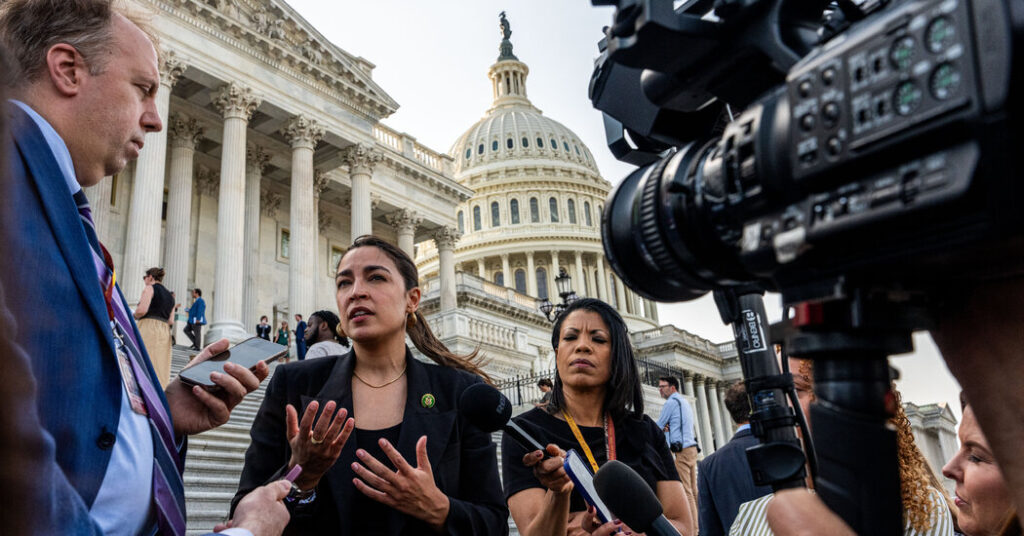
What might have felt like a pep rally for the Democratic Socialists of America — a meeting of the group’s national political committee to discuss the 2028 presidential election — turned instead into a bruising, acrimonious afternoon.
Some 320 members of the organization had gathered on Zoom on Sunday to decide on a process for a presidential endorsement. Members were fresh off a set of head-spinning victories for D.S.A.-backed candidates in New York, including in two House primaries and a handful of state legislative races. But the meeting, even by the standards of an organization known for infighting, was rancorous, according to several people who were on the call and spoke on the condition of anonymity to provide candid accounts.
Any hope of determining an immediate timeline for endorsing a candidate — most likely Representative Alexandria Ocasio-Cortez of New York, the highest-profile contender associated with the D.S.A. — fell by the wayside, they said. The idea of doing a nationwide nonbinding poll to gauge support was voted on and defeated.
The conflict illustrated the growing pains that D.S.A. chapters across the country, and particularly in New York, are experiencing as they swell in both numbers and influence and seek to translate their newfound heft into more electoral and policy wins. Leading the charge to back Ms. Ocasio-Cortez were some leaders of New York City’s D.S.A. chapter, which some members see as more focused than its national counterparts on political maneuvering as opposed to ideological purity.
“We have people with different political philosophies in the organization, and that is showing up in procedural decisions,” said Julie Swoope, a member of the chapter steering committee in New York City.
Gustavo Gordillo, a co-chair of the New York City chapter, called the move to block a national poll “a setback for the national organization,” but added that “local chapters will continue to lead D.S.A.”
Updated
Some of the organization’s farthest-left members have objected to the air of inevitability around Ms. Ocasio-Cortez, viewing her as having drifted too far from her roots. While the New York City chapter has continued to support her, the national leadership pulled its endorsement in 2024, arguing that she was insufficiently supportive of the Palestinian cause and efforts to end the war in Gaza.
Megan Romer, a national co-chair, acknowledged the tension, saying, “Massive growth means there’s always a little space for a reorienting of power, a little jockeying for holding ownership over new capacity.” Last month’s New York City races in particular underscored the strength of the insurgent left and its demand for generational change: Two democratic socialist candidates for Congress, Claire Valdez and Darializa Avila Chevalier, defeated more mainstream Democrats.
Ms. Ocasio-Cortez has not said publicly whether she plans to run in 2028. Her office declined to comment on Monday.
What is at stake in the endorsement debate, some members said, are bigger-picture questions about the D.S.A.’s future, including how much influence New York City’s chapter, the nation’s largest, should have given its recent electoral wins.
Some meeting attendees argued that a national poll was important because it would provide an accurate picture of the membership’s preferences, according to the people present. Others worried it could create a crisis of legitimacy for the organization if the members voted for one candidate and the leadership decided to go in a different direction.
After the meeting, some members pointed out on social media that the decision to endorse Bernie Sanders for president in 2020 had caused rifts among democratic socialists until a poll revealed widespread support for his candidacy.
The tense meeting was the second test for the group in recent days. On Friday, hundreds of members called on D.S.A.-backed candidates and elected officials to cut ties with the consultant Morris Katz and his firm Fight Agency because of their associations with the Senate campaign of Graham Platner in Maine, who withdrew from the race after a woman he had dated accused him of sexual assault.