

Arizona voters on Tuesday gave President Donald Trump the candidates he wanted in primary elections and sent a mixed message to the Democratic establishment, choosing candidates for governor and the U.S. House that set up key races this fall.
Two Republicans who attempted to overturn the results of the 2020 presidential contest won nominations for offices with influence over certifying 2028 election results in the pivotal swing state.
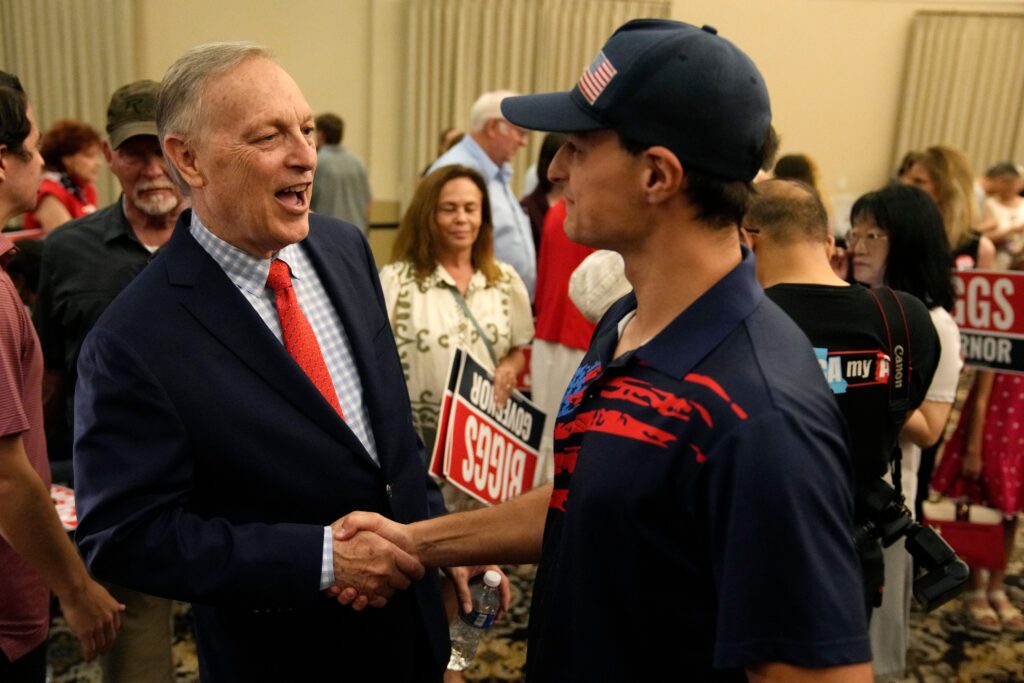
While Trump’s MAGA brand has stumbled in Arizona in recent years — as demonstrated by the failure of Kari Lake to win either governor or Senate races — voters went with the president’s choice of Rep. Andy Biggs for the GOP nomination for governor over the more traditional conservatism of Rep. David Schweikert.
On the Democratic side, one candidate favored by the national party held off a challenge from the left.
Here are some takeaways from the Arizona primaries, which tee up contests that could help determine control of the House in November’s midterms:
Trump-favored Biggs will carry Republican banner for governor
Biggs beat Schweikert for the chance to run this fall against Democratic incumbent Gov. Katie Hobbs, who was unopposed in her primary.
As chairman of the hard-right House Freedom Caucus from 2019 to 2022, Biggs has made a name as a prominent Trump supporter and MAGA activist who questioned the legitimacy of the 2020 presidential election. That hasn’t always played well in Arizona, and his staunch opposition to abortion sets up a stark contrast with Hobbs in the general election.
Arizona voters passed a constitutional amendment in 2024 that made abortion legal until the point of fetal viability, but many Republicans who control the state legislature continue to favor restrictions.
Hobbs, who promotes herself as a bipartisan politician, has said in interviews that she expects a close contest with Biggs. The nonpartisan Cook Political Report, the election analysis site, rates the state as leaning Democratic.
Election deniers win key spots
Election denial is on the Arizona ballot this fall with Republicans’ choice of Biggs for governor and state Rep. Alexander Kolodin for secretary of state.
Kolodin is a lawyer who was sanctioned by the State Bar of Arizona and placed on probation for his role in filing the “kraken” lawsuit in 2020 that sought to prevent the state’s presidential electors from casting their ballots for the victor, Democrat Joe Biden. The suit made false claims about election irregularities and was thrown out by a federal judge.
Kolodin has continued seeking to restrict voting in his role as a state lawmaker, introducing legislation to limit early voting. As secretary of state, he would be in charge of running Arizona’s elections, with the swing state poised to play a significant role in the 2028 presidential contest.
He defeated Gina Swoboda, former head of the state Republican Party, for the nomination and will challenge incumbent Democrat Adrian Fontes this fall.
Biggs was among Republicans in the House who voted against certifying the 2020 election, which Trump lost. Trump attempted to pressure Arizona’s governor at the time, Republican Doug Ducey, into overturning the state’s election results, but Ducey resisted.
Former NFL player could join the House
Jay Feely, a former NFL kicker for the Arizona Cardinals, won the Republican nomination for Arizona’s 1st Congressional District. If he wins this fall, Feely would join a select list of former NFL players who made the transition to Congress. Rep. Burgess Owens (R-Utah), a former safety who won a Super Bowl with the Oakland Raiders in 1981, is currently serving. Former congressman Colin Allred (D-Texas), once a linebacker for the Tennessee Titans, is seeking a comeback this fall after giving up his seat to run for Senate in 2024.
Feely played for seven teams over a career of some 13 years, then reported on NFL and college games as a television announcer until 2025. He earned Trump’s endorsement with a campaign based on what his website calls “faith, freedom and the fight to take back our country.”
Cook Political Report rates the open seat as a toss-up, though, and Democrats have the affluent Scottsdale-based district high on their list of possible flips to help them retake control of the House.
Challenger from the left fails to unseat incumbent Democrat
While left-wing challengers have had success against more centrist Democrats in some parts of the country, the trend didn’t hold in Arizona’s 4th Congressional District. Incumbent Rep. Greg Stanton easily won his primary against challenger Kai Newkirk, a self-described democratic socialist.
Newkirk won the endorsement of several national left-wing groups and attacked Stanton for supporting military aid to Israel, opposing Medicare-for-all and accepting corporate political donations.
Stanton, who has represented the district since 2019 and is a former mayor of Phoenix, far outraised Newkirk. The district includes parts of Phoenix, Tempe and Mesa, and has become more conservative since a 2022 redistricting.