

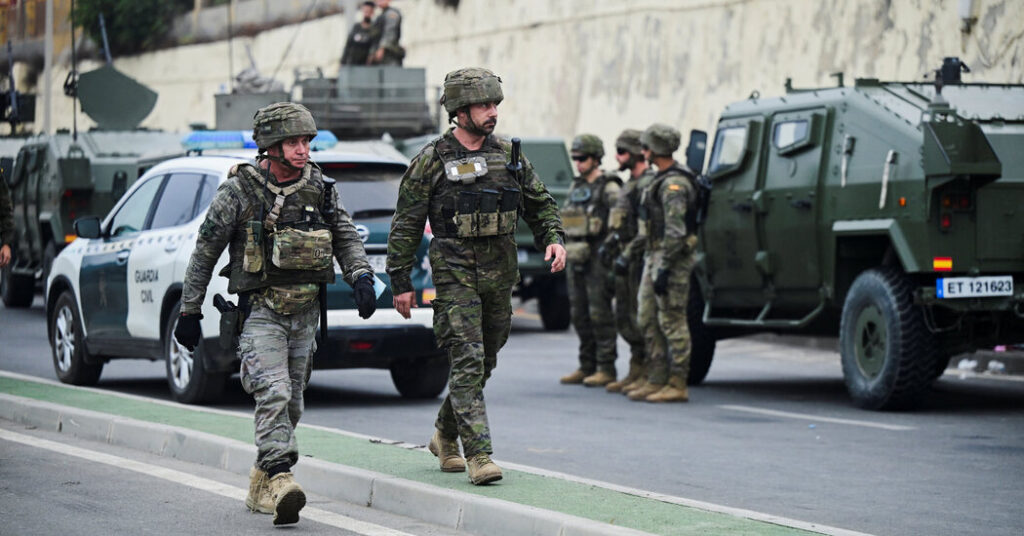
Prime Minister Pedro Sánchez of Spain was set to arrive Friday morning in Ceuta, a Spanish enclave in North Africa, a day after thousands of migrants surged into the territory from neighboring Morocco, leading Spain to mobilize the military and setting off a deep political crisis for the left-wing government in Madrid.
Mr. Sánchez was expected to address what his conservative opponents have called an invasion of Spanish territory after migrants crossed the border by climbing over Ceuta’s border fences or swimming, sometimes for hours, to its shores.
Mr. Sánchez has developed an image as a pro-immigration liberal and Europe’s most prominent critic of the Trump administration’s hard line against migrants. He made global headlines this year by allowing more than one million migrants to apply to formalize their status.
Across Europe, right-wing critics of immigration cited the scenes from Ceuta to support their arguments against free movement. Giorgia Meloni, the prime minister of Italy who has taken a hard line against immigration, said the images from Ceuta were “shocking and demonstrate, once again, that uncontrolled illegal immigration poses a real threat to the security of Europe’s borders.”
She said that Italy was preparing to suspend an agreement with Spain that permits free movement between the two countries. Her foreign minister, Antonio Tajani, blamed Mr. Sánchez’s regularization initiative for incentivizing migration to Ceuta — prompting the Spanish foreign minister, José Manuel Albares, to summon Italy’s ambassador to Madrid.
Throughout Spain, Mr. Sánchez’s supporters and critics alike were asking how and why the border was so easily breached.
Spain has governed Ceuta, a six-mile-long peninsula on the tip of Morocco’s northern coast, for centuries. In recent years, as Morocco became a key staging ground for migrants seeking to reach Europe, Spain has depended on Moroccan border guards to stem the flow of arrivals.
Tensions have spiked in the past when Morocco appeared to let more migrants move toward Ceuta, a small enclave of about 83,000, to exert political pressure on Spain. In 2021, more than 10,000 people crossed into Ceuta in just two days.
Mr. Sánchez’s government has repeatedly sought to improve relations with Morocco, calling the country a loyal ally.
But migrants from Morocco to Ceuta started arriving in higher numbers again earlier this week, according to the area’s president, Juan Jesús Vivas. Then, on Thursday, many thousands swept into Spain, climbing over the fence, ducking through holes cut in it or swimming across the maritime border. At least 18 people died attempting to enter the territory, a spokesman for the Spanish government said on Thursday.
The arrivals were so numerous — and the potential political and security ramifications so serious — that the Spanish government on Thursday evening said that it had mobilized the armed forces to reinforce the severely overwhelmed police in Ceuta.
Madrid said in a statement that military platoons would enforce border security, that air and naval support would increase and that diving teams would patrol the waters. The European Union offered to send Spain support from Frontex, the bloc’s border and coast guard agency, to reestablish order.
Mr. Vivas told a Spanish radio station on Thursday, “We are in a situation of total humanitarian and social emergency.”
On Friday morning, images and footage of what the local government estimated was tens of thousands of arrivals spread around Spain. The nation’s conservative news media seized on a situation they had been warning about for years.
“Ceuta, Invaded,” blared the front page of the conservative newspaper ABC, over an image of thousands of people, mostly young Moroccan men, marching across a beach toward the Spanish territory.
Elisabetta Povoledo contributed reporting from Rome.