

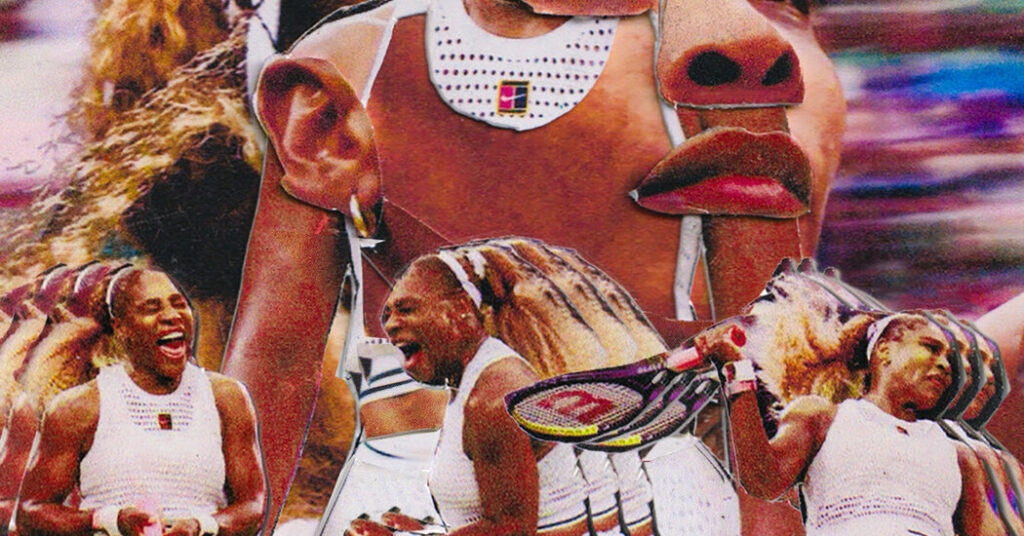
Late last month, Serena Williams, 44, played her first professional singles match in nearly four years. She took the court at Wimbledon against a 20-year-old Australian named Maya Joint and lost in three competitive sets. It was revealed in the days that followed that Williams had tweaked her right knee and was thus unable to play doubles with her sister Venus Williams later in the tournament. There are already expectations — hopes — that we’ll see Serena Williams back on the court again in this year’s final Grand Slam, the U.S. Open, in August and September.
I’m glad my algorithm knows to update me with every last detail of news concerning what comes next for Williams. It knows how much I need this.
Like many rabid tennis fans, I’d been following the bread crumbs of Williams’s possible comeback in the run-up to Wimbledon with obsessive attention. I’d watched Williams’s assorted news conferences and courtside interviews, each offering some version of the same willfully nonchalant explanation of why, having retired with 23 Grand Slam singles titles and a combined 319 weeks at No. 1, she’d be interested in casually dipping her toe back into professional tennis.
“Well, it’s summer. The kids aren’t in school, so it’s a perfect time to get out there — just have fun and, you know, see what happens,” she said. “I don’t have anything to prove.”
As thrilling as it’s been these past few months to be a New Yorker in Knicks land, Williams does something else for me, something more specific and personal: She makes me want to show up for myself. It wasn’t always like this between us. It’s been only in the past 10 years, as Williams played out what we all thought would be the final act of her career. It began around the time she went on maternity leave in 2017, after winning the Australian Open at two months pregnant, and spoke openly about how much she resented the cost she had to pay to start her family versus her male peers.
My affection for her built when she came back in the spring of 2018 and advocated, along with other boldface-name tennis moms, rule changes that have made it easier for players to return after giving birth. And it solidified when I heard her tell the world that all her heart desired before she retired was one final major title, allowing her to tie Margaret Court’s record of 24 Grand Slam women’s singles titles — and then I watched as she made consecutive Wimbledon and U.S. Open finals in 2018 and 2019, lost them both and finally began, as she put it, “evolving away” from tennis in 2022.
“Believe me, I never wanted to have to choose between tennis and a family. I don’t think it’s fair,” she wrote in a Vogue essay announcing her retirement (a word she dislikes, calling it not “modern”). “If I were a guy, I wouldn’t be writing this because I’d be out there playing and winning while my wife was doing the physical labor of expanding our family.” It seems absurd to say about a player as dominant and accomplished as Williams that she left something on the table, but it kind of felt that she did.
The Williams scene I replay in my mind most often is the one of her consoling her opponent, a distraught Naomi Osaka, who’d just won the 2018 U.S. Open in a controversial and harrowing match. Williams had been penalized a game for calling the umpire “a thief” after he docked her for a coaching violation (which she disputed) and racket abuse. Her postmatch speech gets me every time. It’s not just what Williams said — which is a master class in sportsmanship and class — it’s also the look on her face. It’s the look of a woman in the middle of her own emotional storm, which she’s willing herself to set aside so she can right the ship for this bewildered young woman, a burgeoning phenom who had just defeated her idol in front of a crowd now booing her. It’s the face of a woman who decided to show up even though she’d really, really rather not.
Showing up when you’d rather not seems to be a hallmark of adulthood.
The passing of time is a narrowing device. You’re not young anymore, so doors are closed that used to be open. I get it. I made choices. I’m living them, mostly contentedly. But do I have to be graceful about every element of this? Do I have to be measured and smooth and polite? Do I have to act as if I don’t miss it — all the possibility and the freedom and the permission to be reckless?
In the past few years, I’ve dealt with fertility anxiety, parental health issues and the death of my best friend to cancer. Typical stuff, really. I sometimes miss the levity of youth, but I don’t miss my actual younger self. She lived hard and well, and she had her time. I want to be me, now, but I don’t want to feel that — in embracing a certain (to be honest) grudging amount of accountability, responsibility and structure — it means surrendering my freedom and sense of possibility about the future.
What about the next 40 years? After all the sex and fun, is there just a long, melancholic, duty-bound middle stretch in which life slowly drains from your withering body until you get legit old and, finally, if you’re lucky, become a wise old woman like in a “fairy story,” as my fellow Gen X-er Zadie Smith laid out recently in an interview with NPR’s Rachel Martin?
No way, says Williams.
Almost as inspiring as seeing her on the court again, hitting 120-mile-per-hour serves and battling back to win a second-set tiebreaker, was observing her response to experiencing the thrill of competition once again before having it snatched away from her by injury. “Thank you to the fans for your incredible support and for making this comeback so meaningful,” she wrote in an Instagram post that included a gnarly photo of four syringes full of pale yellow fluid drained from her knee. “All I can say is stay tuned to a city near you.”
It’s easy to express unabashed desire when you’re young and you haven’t accomplished anything. It’s much harder when you’ve already done great things — or even just regular things — and the cost of trying something again or for the first time feels so much higher.
When Williams stepped onto the court at Wimbledon last month, she might have been “playing for fun,” as she put it, but she was also making a statement about what’s possible for her and for others, too. As she wrote in her Vogue essay, “My sister Venus once said that when someone out there says you can’t do something, it is because they can’t do it. But I did do it. And so can you.” Who am I to argue with the GOAT?
Lizzy Goodman, a contributing writer at The New York Times Magazine, is the author of “Meet Me in the Bathroom: Rebirth and Rock and Roll in New York City 2001-2011.”
Source photographs by Cameron Spencer/Getty Images, Andrew Couldridge and Matthew Childs/Reuters.
The Times is committed to publishing a diversity of letters to the editor. We’d like to hear what you think about this or any of our articles. Here are some tips. And here’s our email: [email protected].
Follow the New York Times Opinion section on Facebook, Instagram, TikTok, Bluesky, WhatsApp and Threads.