

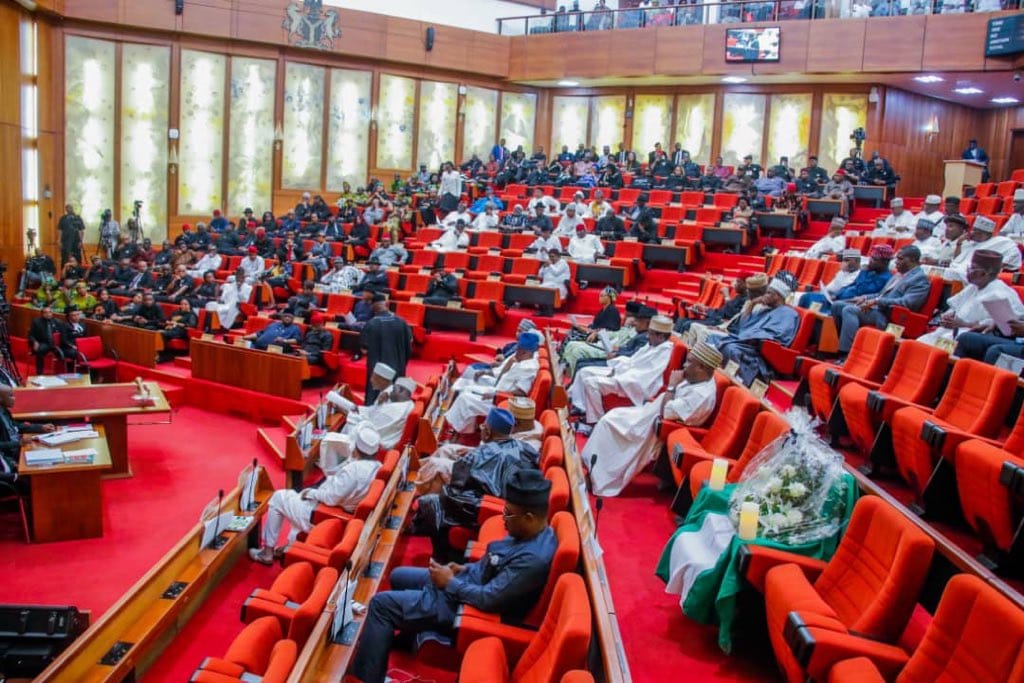
The Senate on Thursday escalated its confrontation with government-owned enterprises (GOEs) and Ministries, Departments and Agencies (MDAs), warning that any institution that refuses to honour its invitations or obstructs legislative oversight will face constitutional sanctions and enforcement measures.
In another related development, the House of Representatives Committee on Federal Character also condemned what it described as the persistent disregard for the constitutional powers and authority of the National Assembly by the Executive Chairman of the Nigeria Revenue Service (NRS), Dr. ZacchAdedeji.
The Reps committee also directed the immediate suspension of recruitment activities by the NRS, warning it would invoke Sections 88 and 89 of the 1999 Constitution to enforce its oversight mandate if the revenue service chairman continued to ignore its directives.
Section 88 empowers both chambers of the National Assembly to conduct investigations into alleged corruption, inefficiency and waste in government, while Section 89 gives the legislature the power to compel the attendance of witnesses, demand testimony and issue warrants where necessary.
Meanwhile, the Senate also directed all MDAs and GOEs to comply with summons issued by the Senate and its committees, appear whenever required and submit all records and documents needed for oversight, insisting that continued defiance would no longer be tolerated.
The resolution followed the adoption of a motion moved by the Chairman of the Senate Committee on Finance, Senator Sani Musa (APC, Niger East), who accused several revenue-generating agencies of persistently frustrating legislative oversight by refusing to appear before the committee or provide requested financial records.
As part of the resolution, the Senate mandated the Clerk of the National Assembly to formally communicate its decision to all affected agencies for immediate compliance.
It also called on the Secretary to the Government of the Federation (SGF), the Head of the Civil Service of the Federation and all ministers to ensure that agencies under their supervision honour Senate invitations and summonses without delay.
Leading the debate, Musa reminded lawmakers that Sections 88 and 89 of the 1999 Constitution (as amended) empower the National Assembly to investigate the administration and expenditure of public funds in order to expose corruption, inefficiency and waste, as well as ensure accountability in the management of government resources.
He further cited Order 97 of the Senate Standing Orders, 2023 (as amended), which authorises senate standing committees to conduct oversight of ministries, departments, agencies and government-owned enterprises within their jurisdictions.
According to him, the Senate Committee on Finance routinely conducts investigative hearings on the financial operations of public institutions, focusing on internally generated revenue, stamp duty collections, operating surpluses and deficits, statutory remittances into the Consolidated Revenue Fund (CRF), and compliance with the Fiscal Responsibility Act and successive Finance Acts.
Musa however lamented that several agencies had repeatedly ignored invitations issued by the committee despite their constitutional obligation to appear and provide relevant information.
He described the development as a direct challenge to the constitutional authority of the National Assembly.
“Despite duly issued invitations and notices, several government-owned enterprises and ministries, departments and agencies have persistently failed, neglected or outrightly refused to honour invitations extended by the Senate Committee on Finance in the exercise of its oversight functions,” he said.
He warned the continued refusal of public institutions to cooperate with the legislature undermined the doctrine of separation of powers, weakened accountability and transparency in public finance, and eroded confidence in democratic governance.
“In blatant disregard of the oversight powers vested in the National Assembly by the Constitution, such persistent non-compliance constitutes a direct affront to the constitutional authority of the Senate, undermines the doctrine of separation of powers and checks and balances, weakens legislative oversight, and impedes transparency and accountability in the management of public resources,” Musa stated.
He cautioned that failure to decisively address the trend could encourage institutional impunity, frustrate the effective discharge of the legislature’s oversight responsibilities and compromise prudent management of the nation’s finances.
Several senators who contributed to the debate backed the motion, reaffirming the constitutional powers of the National Assembly to investigate the finances and administration of all public institutions established by law.
Following the debate, the Senate resolved that all government-owned enterprises and ministries, departments and agencies must honour invitations issued by the Senate and its committees, appear whenever summoned and furnish all documents, records and information required for effective legislative oversight.
The Senate further declared that any agency or government-owned enterprise that deliberately refuses or fails to honour its invitations, or obstructs the constitutional oversight functions of the National Assembly, would be subjected to sanctions and enforcement measures in line with the Constitution, the Legislative Houses (Powers and Privileges) Act and the Senate Standing Orders.
The resolution came amid an ongoing probe by the Senate Committee on Finance into the financial operations of several revenue-generating agencies over their internally generated revenue, operating surpluses, stamp duty collections, statutory remittances to the Consolidated Revenue Fund and compliance with the Fiscal Responsibility Act and the Finance Acts.
Musa had informed the Senate that despite repeated invitations, several agencies either ignored the committee or claimed they were under no obligation to appear before it, a position the lawmakers unanimously rejected as inconsistent with the constitutional oversight powers of the National Assembly.
Meanwhile, the Reps committee chaired by Hon. Ahmed Idris Wase, issued the latest directive at its meeting held on Wednesday at the National Assembly Complex in Abuja.
It said the decision was prompted by what it described as the continued failure of the NRS chairman to respond to legislative summons and appear before the committee.
According to the committee, it had, in a letter dated July 15, 2026, with the title, “Request for Nominal Roll/Invitation to Meeting,” asked the NRS chairman to provide a comprehensive and current nominal roll of the service.
The committee also summoned Dr. Adedeji to appear before it at 2:30pm on Wednesday, July 22, 2026, at Meeting Room 247, Second Floor, New Extension, House of Representatives Wing of the National Assembly Complex.
Despite the invitation, the NRS chairman failed to attend the committee’s meeting on Wednesday.
The committee further disclosed that the same letter sent to the NRS chairman referenced seven earlier communications addressed to him, all of which had been duly acknowledged by his office.
The letters were dated October 13, 2023; November 7, 2023; March 14, 2024; July 3, 2024; July 16, 2024; and April 1, 2026, with reference number NASS/HR/CT.40/03/14.
The committee accused the NRS chairman of failing to adequately respond to the issues raised in the letters despite their receipt and acknowledgement by his office.
The disagreement between the legislature and the revenue service leadership is also connected to several issues, particularly the recruitment waivers reportedly granted to the NRS by the Federal Character Commission (FCC).
The committee recalled it had specifically instructed the FCC not to issue any further approvals or waivers to the NRS in relation to recruitment.
At Wednesday’s meeting, the Chairman of the Federal Character Commission, Hon. Hulayat Motunrayo Omidiran, was also not present.
In a message sent to the committee, the FCC chairman explained she was away on official duties and subsequently became ill, which prevented her from attending the meeting.
However, the committee observed that Omidiran’s latest absence came after several previous invitations and official communications from the House had allegedly gone unanswered.
It described the repeated failure to appear before the committee as unacceptable and contrary to the level of accountability expected from individuals occupying public offices.
The committee further said the decision by the FCC to grant recruitment waivers to the NRS chairman as a direct challenge to the constitutional oversight responsibilities of the House of Representatives.
It also characterised the action as a troubling disregard for the authority conferred on the National Assembly by the Nigerian people under the Constitution.
Consequently, the committee issued a fresh directive to the Federal Character Commission to immediately halt all recruitment exercises being undertaken by the Nigeria Revenue Service.
The suspension, according to the committee, will remain in place until the leadership of the NRS appears before it to explain its actions and submit itself to the constitutional oversight process.
Speaking on the development, Hon. Wase said the House of Representatives would not allow public institutions to selectively determine which constitutional directives they would comply with.
He stressed that legislative oversight was a constitutional responsibility and not something that heads of government agencies could choose to observe only when convenient.
“The National Assembly is the voice of the Nigerian people. Its constitutional oversight powers are not symbolic. They are binding instruments of accountability. No agency, commission, or public official is above the Constitution or beyond the reach of parliamentary oversight,” he said.
The committee further warned that the continued refusal of public officials to respond to invitations from the House could create dangerous precedents, weaken public confidence in democratic institutions and undermine the constitutional checks and balances designed to protect Nigeria’s democracy.
It reaffirmed its determination to employ every constitutional and legislative instrument at its disposal to compel compliance with its lawful directives and preserve the integrity of the oversight responsibilities entrusted to the committee by the Nigerian people.
Sunday Aborisade and Juliet Akoje
Follow us on: