


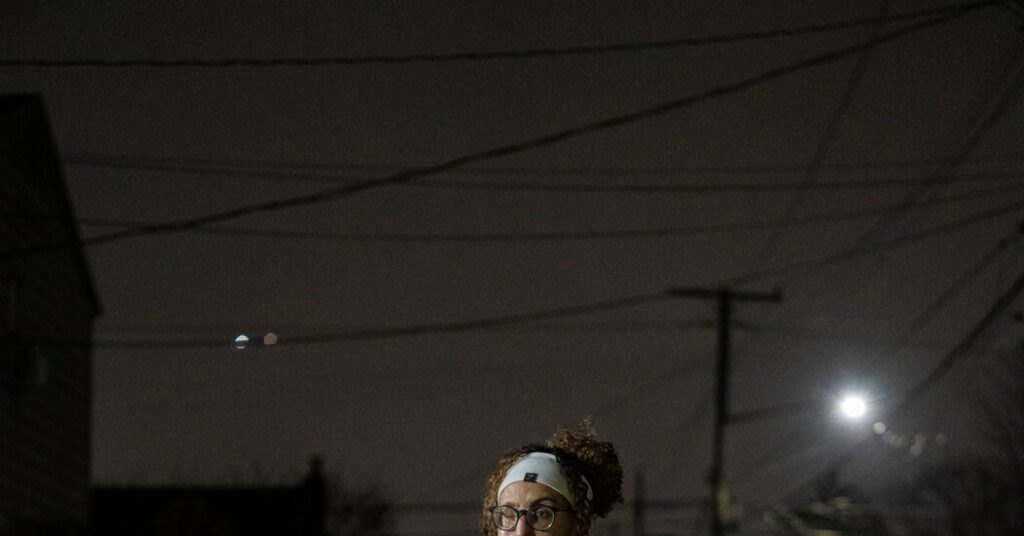
Nafiah Ikram walked into a Long Island nail salon for her monthly appointment, wearing a pink and white jogger suit. She had pink headphones to match. She wanted to feel pretty again and perhaps something much deeper.
The appointment is her ritual on a journey to restore a sense of normalcy, to conquer the “monster” in the mirror, as she has at times described her reflection. Five years ago, an assailant’s acid attack singed her smooth olive skin, leaving permanent facial scars.
“I’m trying my best to find my way back to the version of myself that I remember, because she was happy,” Ms. Ikram, 27, said.
That version of herself, she says, is all but gone. But the new her and the old her meet again on occasion inside the salon, sometimes in her bedroom mirror, sometimes in quiet moments of introspection and fleeting self-acceptance. Still, she says, the two of them are a long way from becoming one, if they ever do.
It traces back to the stranger, partially cloaked in a hoodie, who threw battery acid in her face as she walked to the door of her home after working at a CVS Pharmacy. The stranger’s face haunted her each night for years as the police in Nassau County investigated but came back with little.
Then, in February, the police and prosecutors said they had a name to go with the face: Terrell Campbell, who investigators said used the attack to further his rap career. He goes by the name “YungBasedPrince” and uploaded a music video to YouTube called “Obsidian” in 2023. In the video he rapped, “On the street in the night like a hit man assassin / try to run up and have your face burn in acid.” He has pleaded not guilty to assault and other charges.
The development was puzzling: Ms. Ikram said she had no connection to Mr. Campbell.
But, prosecutors said, her ex-boyfriend did.
‘Scary Like a Monster’
It was about 8 p.m. on St. Patrick’s Day in 2021 and Ms. Ikram had just pulled up to her family home in Elmont, Long Island, after spending the holiday at work. Her mother was with her in the car and hurried inside to use the bathroom.
Ms. Ikram stepped out of the driver’s seat and walked around to the passenger side to grab food from the back seat. Then, she said, she had an eerie feeling that someone was watching her.
She turned to her right and saw a man in a hoodie down the block, staring with his arms folded. Afraid, she began reciting a Muslim scripture of protection.
As she made her way toward the driveway, the man in the hoodie ran up and hurled liquid at her from a large cup. It splashed on her face, and she screamed as it trickled down her body and into her throat as it started to burn. She struggled to her home for help.
Paramedics rushed her to the hospital. She spent several weeks there, receiving treatment for second- and third-degree burns to her face, arms, right eye and esophagus. She has had a series of surgeries and skin grafts, and frequent treatments to help her eat and breathe because the acid burns caused shrinkage in her throat.
She now has to go for monthly treatments to examine her esophagus because it took her nearly two hours to eat chicken with rice and broccoli two weeks ago.
“I’m still going through this,” Ms. Ikram said. “It’s humiliating.”
Today, her skin has light and dark scars that travel from her face to behind her ears down to her shoulders, chest and the upper part of her arms. She lost sight in one eye because the acid seared her contact lens, leaving her eye partially closed.
“I looked physically, in my opinion, scary like a monster in my eyes,” she said. “In order for me to see something else, I need to fall in love with myself again.”
Sitting at a table in her bedroom in the attic, Ms. Ikram said, “I have no peace of mind.”
Every night she sees her attacker’s face. And sometimes, especially when she is recalling the memories, her face still burns.
‘Obsessed With the Girl’
On the concrete outside Ms. Ikram’s home, an acid stain still lingers.
“This is truly one of the most horrific and disturbing attacks I have seen in more than three decades as a prosecutor here in Nassau County,” said Anne T. Donnelly, the Nassau County district attorney.
Video from the scene captured a man getting into a red Nissan Altima and fleeing, but officials were unable to match the vehicle to an owner until late last year, prosecutors said. They found the Altima parked outside Mr. Campbell’s home and later learned of his rap song, whose lyrics “fit the narrative of the crime,” Ms. Donnelly said at a news conference in February.
Mr. Campbell could face 25 years in prison if found guilty. His lawyer, Gregory Zak, declined to comment.
When he was arrested, prosecutors said they were still trying to figure out what motivated him to attack Ms. Ikram. So was she.
Then on March 24 another break in the case came. Shaquille Coke, 31, a man with whom Ms. Ikram had a romantic relationship, was arrested in Brooklyn in connection with the attack.
Ms. Ikram walked into the courtroom for Mr. Coke’s arraignment in Nassau County. She looked over at him and her body began to shake as she burst into tears. The courtroom went silent.
Mr. Coke pleaded not guilty to assault and other charges. He, too, faces up to 25 years in prison if found guilty. His lawyer, Kenneth Montgomery, could not be reached for comment. An automated email response from Mr. Montgomery said that he would be in Mexico on a silent meditation for several weeks without access to technology.
Ms. Ikram said she met Mr. Coke in 2017 during her freshman year at Hofstra University, where she was on a pre-med track. He was in the student center promoting an on-campus event sponsored by the Black Student Union. He handed her a flier and asked for her Snapchat, she recalled. Over the next few years, he would occasionally respond to some of her stories in the app.
During the coronavirus pandemic, they began to communicate regularly by replying to each other’s Snap stories and direct messaging. Over winter break in January 2021, Mr. Coke asked Ms. Ikram to go on a date with him.
They had a good time on their first date at the Grand Lux Cafe, which led to a second date. But after a Valentine’s Day dinner at Seasons 52, the relationship began to sour. As they sat in the car, Ms. Ikram recalled, Mr. Coke said he had told his mother that he could see Ms. Ikram being his wife.
“This sounds like those people that get obsessed with the girl after like two weeks of knowing them,” Ms. Ikram said. “So that kind of scared me away.”
Ms. Ikram said she tried to slowly distance herself from Mr. Coke by speaking and interacting with him less and pulling back from their relationship. Things took a turn as he felt her pulling away, she said.
The police and district attorney’s office in Nassau County said they found that Mr. Coke created a fake Snapchat profile under the name “Wheezy Durel” to contact Ms. Ikram weeks before her attack that March to ask about her loyalty to him.
Two months after the attack, the district attorney’s office said, Mr. Coke sent vulgar text messages under a spoof number, calling her “Freddy Kreuger,” referring to her injuries. Using cellphone records, the police said they found that Mr. Coke met with Mr. Campbell — a friend and high school classmate — an hour before the assault.
In a statement, the Nassau County district attorney’s office said Mr. Coke told the police that he let Mr. Campbell know that he wanted something “devastating” to happen to Ms. Ikram and that “karma” would take care of her.
Always Pretty
“Whole life turned upside down,” Ms. Ikram wrote in pink ink in her journal on Aug. 19, 2021, five months after the attack. “It’s so sad at times.”
Before the assault, Ms. Ikram said she was a “girly girl” who expressed herself through makeup and nails. She wore several diamond studs in her ears and would doll her face up and even do some of her family members’ makeup for weddings and parties. Ms. Ikram, who is of Pakistani descent, said beauty in her culture is focused on physical appearance. For a while after she was burned, Ms. Ikram would look at herself in the mirror every night and cry.
After more than 13 surgical procedures in five years, her face and body have gone through multiple changes. Ms. Ikram said she lost feeling and mobility in her face, but doctors revived it by transferring nerves from her thigh to her face.
“I prayed that God would guide the hands of the surgeon on my face,” Ms. Ikram said. “My face now is looking a lot more like my old self.”
Rachel Madary, an advanced clinician social worker at NewYork-Presbyterian/Weill Cornell Medical Center, said facial burns are particularly difficult for women to deal with.
“It takes much more of a hit to their mental health,” Ms. Madary said. “Simply because of societal beauty standards.”
According to the American Burn Association, about one in three burn victims experience body image distress, which can lead to anxiety about being out in public.
During a recent trip to the mall, a little boy scrunched his face at Ms. Ikram in confusion. Ms. Ikram said his facial expression tugged at her emotions because she had always been pretty. She reminisced about being the young woman students on her college campus were attracted to.
Kelly McElligott, who has been a social worker for more than 25 years and is the burn outreach coordinator at Loyola Medicine’s Burn Center outside of Chicago in Maywood, said she tries to help female survivors move forward by rediscovering what beauty is.
“Is beauty just what you look like, but instead, is it really who you are?” Ms. McElligott said.
‘Create My Own Version’
Ms. Ikram sat in the dark in her garage, a place she goes to unwind and listen to music. She reflected on her life, using a phrase she often turns to: “purpose over pain.” A nurse once told her that she could only cry for so long. She remembered waking up in the morning hating her life, then fighting the negative thoughts with affirmations.
“No, happiness is a choice,” Ms. Ikram recalled telling herself. “I’m going to create my own version and love myself.”
She has reclaimed parts of her life by going back to work as a pharmacy technician, adding art to her vision board and indulging in weekly self-care sessions by punching a bag at the gym, stretching at Pilates or relaxing at the nail shop. One of her goals is to become a trauma surgeon to help burn survivors like herself.
Since Mr. Campbell’s arrest and the fifth anniversary of her assault, Ms. Ikram has battled depression. She has taken a short leave from her job to process her trauma and her road to recovery. She is refusing to allow her attacker to win.
“I know that’s what the person that did this to me wants: to look at your face and cry and be miserable,” she said.
Recently, she smiled at a portrait on a Nikon camera as she sat in a cushioned chair at nail salon with her feet soaking in preparation of a French pedicure — her go-to.
“I don’t see the scars anymore,” Ms. Ikram said. “I just see me.”