

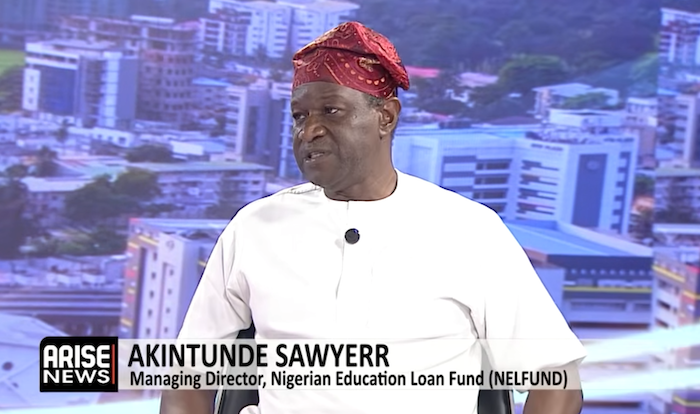
Managing Director, The Nigerian Education Loan Fund (NELFUND), Akintunde Sawyerr says the agency is investigating about 34 tertiary institutions over allegations that they failed to refund students whose tuition fees were paid twice under the federal government’s student loan scheme, following a surge in complaints and petitions from affected beneficiaries.
Speaking in an interview with ARISE NEWS on Sunday, Sawyerr said the agency had intensified investigations in collaboration with anti-corruption agencies, the National Association of Nigerian Students, internal auditors and other stakeholders to determine the extent of the alleged infractions while ensuring that students receive refunds owed to them.
“I can tell you that there are about 34 institutions that we are looking at at the moment to see what’s going on because the number of petitions we’ve received.”
He explained that the refund challenge arose because President Bola Tinubu directed that the scheme begin midway into the academic session rather than waiting for a new academic year. “Most students in this country are hard up. They don’t have enough money for themselves. So when they make payment for their education and then they take a loan for the same education, they expect their money to be refunded to them.”
Sawyerr said this led to some institutions receiving tuition fees twice once from students and later from NELFUND making it the responsibility of the institutions to refund the affected students. “What happened is that a lot of schools got double payment. Some from the students, some from us. The refund process is entirely out of our hands. It is the recipient of the double payments that are obliged to make refunds to the students.”
He explained that the issue had become significant because many beneficiaries depended on the refunds to repay money borrowed from relatives. “Most students in this country are hard up. They don’t have enough money for themselves. So when they make payment for their education and then they take a loan for the same education, they expect their money to be refunded to them. Some of them have borrowed the funds, their parents have borrowed the funds, and they need to repay those funds.”
While acknowledging that some institutions had promptly refunded affected students, Sawyerr said others had struggled. “Some have been very good at this. Others haven’t been so good at it. I reserve judgement on, you know, the intentionality around it because for some of them, they just didn’t have the process to make refunds.”
To prevent similar cases, he disclosed that NELFUND was upgrading its payment platform to introduce a tokenised payment system that would allow students to authorise tuition payments directly. “We’re looking at a tokenised system where the student has the funds effectively as a token on their telephone and when they go to the bursary, they can effectively push a button that makes the payment.”
Sawyerr explained that NELFUND deliberately chose not to transfer tuition fees directly into students bank accounts to prevent diversion of funds intended for education. “We chose in our setting up of this not to pay students directly for the loans because that would take us into an entirely new area Paying the funds to the students rather, quite significant, could really lead to the temptation for them to divert and do other things.”
He admitted that the agency lacks statutory powers to prosecute or compel institutions to refund students. “We don’t have the powers of arrest, we don’t have powers of prosecution. We really, our hands are tied in that regard.”
Sawyerr revealed that many of the petitions currently under investigation were submitted directly by students. “Students who are frustrated and unable to get their refunds write to us, but they also write to the EFCC, to the ICPC.”
According to him, one of the recent investigations involved a multi-agency team comprising NELFUND officials, internal auditors, anti-corruption personnel, representatives of the Economic and Financial Crimes Commission and the National Association of Nigerian Students.
“A five-person team have gone out to a specific institution that’s been accused of this to go and do an investigation.”
Addressing concerns over rising tuition fees, Sawyerr said some institutions increased their charges after realising NELFUND would pay approved tuition directly, but the agency refused to approve excessive increases. “Some schools, because they get paid easily startes to put up their fees, we refused, point blank, to pay institutions who had hiked their fees beyond a certain level.”
He, however, said the agency was cautious about attributing criminal intent to institutions.
“We tend to take the view that perhaps it’s not intentional. We institute many investigations, we generate many reports, any small hint of anything going wrong, we set up a small committee to look at it because we’re trying to learn.”
Erizia Rubyjeana
Follow us on: