

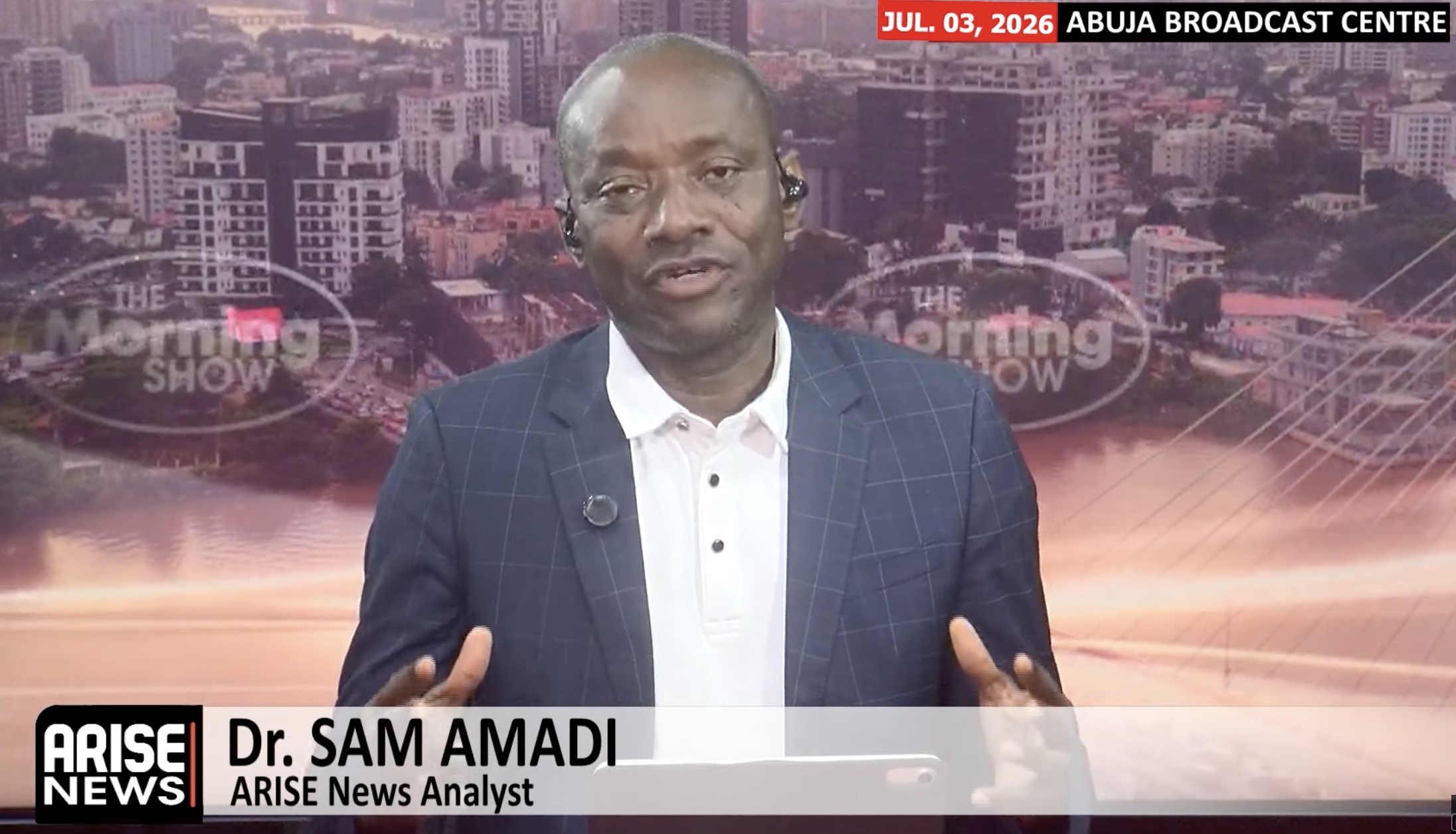
Public policy expert and ARISE News analyst, Sam Amadi, has called for a fundamental rethink of the National Youth Service Corps (NYSC), arguing that while the Federal Government’s proposed reforms are a step in the right direction, they do not go far enough to address the scheme’s core challenges.
Speaking during an interview with ARISE NEWS on Friday while reviewing the Federal Government’s proposed reforms to the NYSC, Amadi said the programme has failed to achieve its founding objectives of national integration, unity and human capital development, insisting that Nigeria should consider redesigning the scheme from the ground up.
Commenting on the proposal to replace the NYSC’s khaki uniform with adire fabric, Amadi said the suggestion should be viewed within the broader context of reforming the scheme.
“That’s the problem of when you’re a plural society and then you have that organising principle. But again, let’s be fair to the Minister. Maybe what the adire batik represents is his notion of cultural authenticity.”
“If you’re moving away from a military-oriented, paramilitary-oriented national service scheme and going to one that is more civil-oriented, focusing on skills and all that, then maybe we need to change the uniform. And what comes readily to him would be adire.”
He added that discussions over whether other indigenous fabrics such as Akwete, Aso Oke, Ishiagu or Babariga should also be represented were secondary.
“That conversation can happen, whether they’re going to have three uniforms or four, representing two or three ethnic groups. But the key point would be that there should be coherence. If this is now moving away from the paramilitary in the real sense and going to some kind of elite special youth leadership for the country, then the uniform would have to be adjusted appropriately.”
Amadi, however, said the larger issue is whether the NYSC still fulfils the vision upon which it was established after the Nigerian Civil War.
“Let’s not forget that this scheme came after the devastating civil war. It was also part of a global phenomenon, like the Peace Corps in the United States and elsewhere, where the ideas of state-building, national integration and state-led development were very common.”
He explained that the NYSC was founded on three principal objectives.
“The first objective was cultural integration. The notion was that we could harness our cultural diversity for development while also managing that diversity to avoid conflict.”
“The idea was that if we introduced young Nigerians to the ways other Nigerians lived, they would come to appreciate one another and build a common citizenship after the propaganda and misinformation that followed the civil war.”
“The second objective was national unity. From cultural integration, you build a common civic consciousness and national unity. The third objective was human capital development — harnessing graduates to address strategic national development.”
According to Amadi, those goals have largely remained unfulfilled.
“Unfortunately, this scheme did not achieve these results. Not necessarily because of the failure of its managers, but because of the wider failures of the Nigerian state and the macroeconomy.”
“Most of our nation-building projects have failed. The idea of building unity in diversity has not worked out well. So the NYSC has become more like a routine exercise.”
“You now have people participating half-heartedly. The military sees postings as career postings. Bureaucrats in ministries have their own interests. The programme no longer delivers the value it was originally designed to create.”
Amadi disclosed that he had previously raised similar concerns while delivering a keynote address at the Nigerian Army Futures Centre.
“I argued then that maybe it is time to fundamentally rethink this scheme. Do we still need it in its current form? What value does the Nigerian state actually derive from it?”
“Very often, the private sector gets cheap labour through the scheme. The states that benefit the most are not necessarily contributing enough to support it, and today the scheme itself lacks adequate funding.”
He said the country should begin asking more fundamental questions.
“Should we still have this scheme? If yes, should we have it in a different form? Should it remain compulsory or should it become voluntary?”
Drawing comparisons with countries such as Israel, Amadi argued that national service could become merit-based.
“Some countries target the best and the brightest, develop them and deploy them strategically, either in the military or in civic service. I acknowledge the value of what the President has put on the table, but perhaps we need a much deeper conversation.”
Addressing concerns over insecurity and the deployment of corps members to conflict-prone areas, Amadi said the government should not hesitate to suspend deployments to unsafe states.
“Nigeria sometimes has a problem with avoiding radical action.”
“Most elites already self-select. I cannot tell you how many people call me from my village saying, ‘My son is going for NYSC; I want him posted to Abuja or Lagos.’ Everybody is already self-selecting, and that defeats the original purpose of the scheme.”
He added that inadequate protection for corps members had worsened public confidence.
“The ministry overseeing the scheme is not just supposed to issue posting letters; it is also responsible for protecting these young people. We’ve seen stories of corps members dying, and that naturally creates resentment.”
“Most corps members are not happy. Many simply participate because there are no jobs.”
Amadi insisted that Nigeria’s challenges have evolved beyond what the NYSC was originally designed to solve.
“The scheme has fundamentally failed. It worked in the past because we got to know ourselves better. But Nigeria’s problem today is no longer about whether people know one another. We’ve had enough symbolism.”
“The issue now is statecraft and nation-building.”
He proposed suspending deployments to dangerous areas.
“I would argue that you suspend the scheme in some places, or at least exempt those states. If a state is unsafe, then you simply don’t deploy people there.”
“This is not about sharing the national cake. It is about protecting graduates while using national service to solve strategic national development challenges.”
Rather than deploying graduates indiscriminately across the country, Amadi said the programme should focus on addressing specific developmental needs.
“Years ago, I proposed converting many of these graduates into literacy volunteers.”
“Nigeria still struggles with literacy. Why can’t we train corps members to become teachers in underserved communities instead of posting everyone everywhere?”
“Government can identify five states with the greatest educational needs each year and deploy trained graduates specifically to those areas.”
He also questioned whether every graduate should automatically participate.
“The scheme was designed when Nigeria had a relatively small number of graduates. Today we’re producing far more graduates than the government can effectively support.”
“Perhaps not everyone should participate. Let students compete for it so that it becomes a national honour.”
“Participants should receive meaningful incentives, recognition, opportunities and prestige so that people aspire to join this elite youth corps because they know they are contributing something important to national development.”
Amadi criticised what he described as the superficial nature of current skill-acquisition programmes under the NYSC.
“The idea of teaching a little entrepreneurship today, a little computer training tomorrow and military drills for a few days lacks strategic thinking.”
“Countries like Korea, Taiwan, Japan and America did not develop by giving people two weeks of entrepreneurship training.”
“What we need is a scheme focused on making young people genuinely more productive.”
Responding to suggestions that suspending the programme would deprive states of corps members who contribute to elections and community development, Amadi maintained that reforms should instead make the programme more rigorous.”I would actually prefer a more paramilitary NYSC.”
“Train them properly. Don’t just give them one or two weeks of superficial drills.””Have periodic retraining where they return every few months for deeper instruction.”
“Development comes from intensity, coherence and alignment before and after deployment.”
“How do you prepare them? What exactly do they do? We spend all this money simply to create a feel-good experience because one person later becomes successful and attributes it to NYSC. That is not enough justification for maintaining the programme in its current form.”
Boluwatife Enome
Follow us on: