

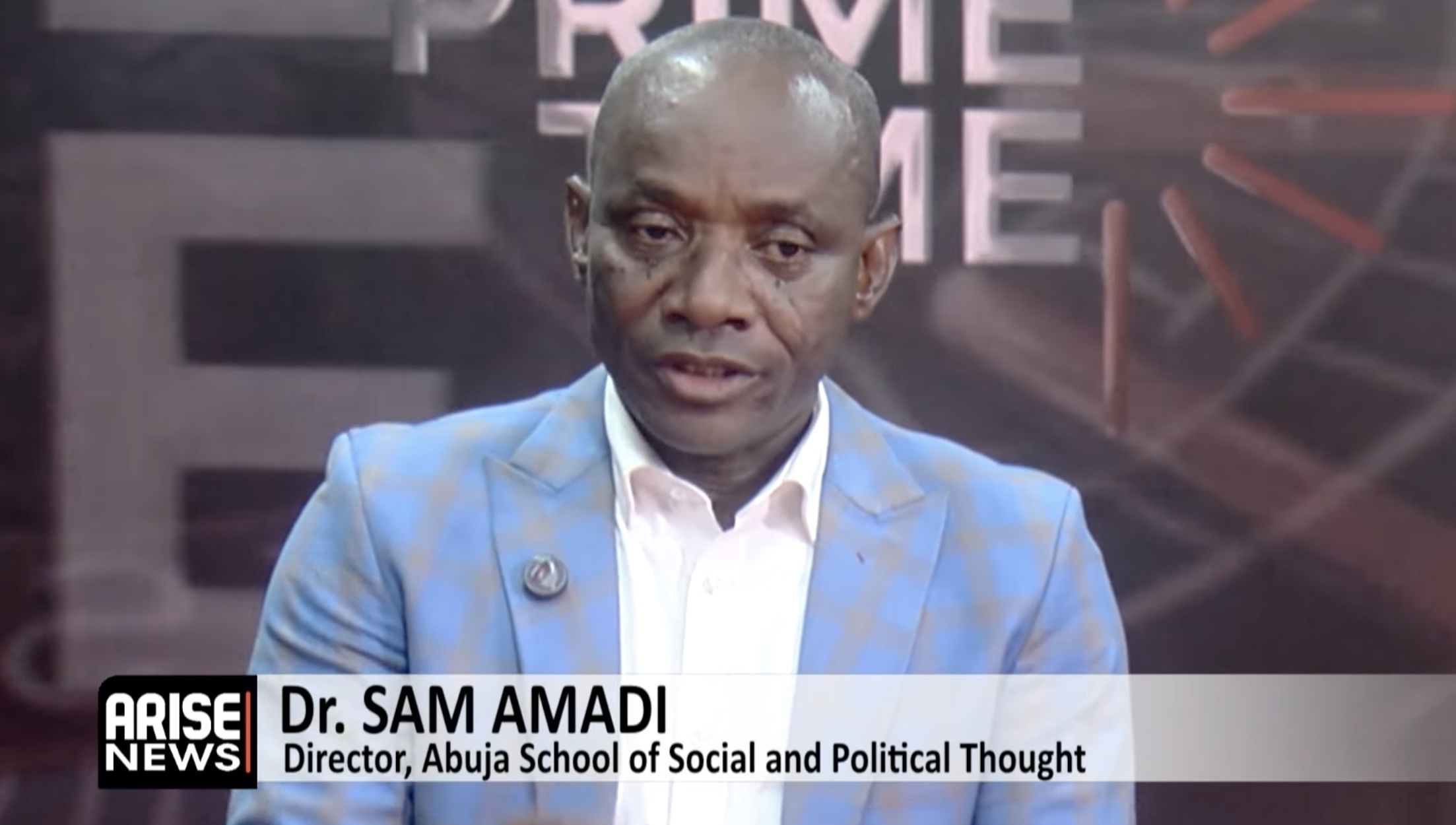
Political analyst and director of the Abuja School of Social and Political Thoughts, Dr Sam Amadi, has said ministers facing serious allegations should step aside, arguing that the President should demand accountability and allow transparent police investigations to take their course.
Following the controversy surrounding the death of Mary Habila, a nurse linked to Nigeria’s Minister of Works, David Umahi, Amadi described the situation as “both a PR disaster and an ethical disaster,” arguing that the minister should have first reported to the police and allowed investigators to lead public communication on the case.
“You have to balance it. First, they ought to step aside when the allegations are weighty. But even if they don’t, the boss—the President—ought to demand that,” he insisted.
“Let’s look at this case with Umahi; this is both a PR disaster and an ethical disaster. I’ve never seen a minister who doesn’t travel with nurses if they have personal medical needs, but a 26-year-old lady as a personal nurse who stays with you, travels with you, and stays in your house—and then passes away under these circumstances? That’s enough for you to go first to the police and make a statement. The police should depose you because you’re the prime suspect by virtue of proximity, whether you’re a good man or a bad man; that’s just what it is,” he said.
Dr Amadi also criticised Umahi for speaking publicly about the case instead of allowing investigators to take charge. He said the minister had been “running press conferences, talking about the case, precluding everything,” arguing that the police—not the minister—should be providing regular updates to reassure the public that a transparent investigation is underway.
“Instead, he has been on a show, running press conferences, talking about the case, precluding everything. And the affidavit the parents supposedly signed to say, ‘We don’t want anything, we don’t want a press check’—anybody looking at it will say this looks like a cover-up, that these people were pressured to do it.
“In these circumstances, what do you expect of the police first? The police have made no official statement. This is a case where the police public relations officer should be speaking, giving regular updates: That gives people confidence. Instead, they threaten warfare against everybody. That is recklessly irresponsible at the highest level.
“The fact that it appears to be tolerated is even more galling. But the point is, like I said before, this government has been proficient in disregarding public morality, proficient in cover-ups, and proficient in asserting diffidence against public ethics,” he stated.
Speaking on the anti-corruption campaign, Dr Amadi said recovering allegedly illicit assets should not replace criminal prosecution, arguing that the true measure of success is securing convictions against corrupt public officials.
“I think forfeiture is low-hanging fruit because essentially the Supreme Court has laid down clearly that if you cannot prove how you acquired the property reasonably, then it could be assumed to be a product of corruption. And so when people don’t want to step up to claim the property because they can’t prove perhaps how they acquired it, they save their skin, literally, by letting it go.
“But that’s not the policy of criminal justice. Criminal justice first dictates that criminals should go to jail, and subsequently government should recover revenue or property acquired. So if we are doing great on forfeiture, of course there are some properties we want to see forfeited—and the criminals are perhaps getting elected to the Senate or as governors, where they’ll keep on stealing to build more assets, that’s not criminal justice.
“It might look like you have to do well on the low-hanging fruit, but it doesn’t fight the root. The evidence is easy for us to win if you can’t prove how you acquired a building or property. The real test of fighting corruption is when these heavy guys get jailed, and that would have a deterrence effect. This has minimum. So perhaps we can say, kudos, let’s get those properties back, perhaps government gets some revenue. But essentially the object is still: let those who have committed themselves face prosecution, be successfully convicted, and jailed as a deterrence,” he maintained.
Amadi also called for greater transparency in the management of recovered assets, urging the government to publish details of seized properties, their valuations, disposal process and eventual buyers. He argued that making the process open to public scrutiny would strengthen accountability and prevent what he described as the “looting of the loot.”
“That’s what I was talking about: looting the loot. There must be asset managers that are open to the public, maybe a portal that’s accessible. When these 58 houses are seized, they should be published; we should know where they are, the current value, what is placed there, and then when there’s a bid, a national auction. The public service has an auctioning process.”
On the role of ethics in public appointments, Dr Amadi argued that legal requirements alone should not determine eligibility for high office, insisting that public morality and public confidence are equally important. He said that public office demands a higher ethical standard, particularly for officials representing Nigeria abroad.
“The issue is not about legality; the issue is perception, because you care about the character. Public office carries a certain degree of public morality… Public office requires a high degree of morality,” he said.
Favour Odima
Follow us on: