

Klaus Mäkelä first conducted an opera from the pit of a theater nine years ago, when the Finnish National Opera picked up an older production of “The Magic Flute.” He was 21, and about to become the whiplash-fast rising, starry maestro he is today.
Since then he has taken on more high-profile jobs than most conductors are lucky to have in a lifetime. Next year, he will take over the podiums of storied ensembles on both sides of the Atlantic: the Concertgebouw Orchestra in Amsterdam and the Chicago Symphony Orchestra in the United States. All this was set in motion before his 30th birthday.
Is it because he’s a force of nature, or because he’s a victim of the classical music industry at its most faddish and vampiric? You’re unlikely to get the same answer from two people, which is one reason his career has been fascinating to follow. Every milestone is an opportunity to hear whether he is worthy of the hype.
Mäkelä has returned to the orchestra pit for the first time since that “Flute,” now with global attention and the reputation-building task of conducting a new production from scratch. And he has taken on one of the most difficult titles in opera: Richard Strauss and Hugo von Hofmannsthal’s “Die Frau Ohne Schatten” (“The Woman Without a Shadow”), which opened on Friday at the Aix-en-Provence Festival in France.
This “Frau” is a triumph: for Mäkelä, yes, as he properly plants his flag in opera, but also for his colleagues. Barrie Kosky’s production confidently focuses Strauss and Hofmannsthal’s convoluted fairy tale into a moving portrait of what it means to be human, and the cast has a miraculous alignment of talent and committed vision. (Arte.tv will stream the show for a month beginning Thursday.)
Mäkelä had his share of skeptics ahead of the premiere. He’s experienced in Strauss’s tone poems, but his performances of those pieces tend to be richly detailed on the level of individual measures while shapeless on the level of broader phrases. And he is conducting the Orchestre de Paris, where he is the music director through next season; three summers ago at Aix, he led the ensemble in a triple bill of Stravinsky’s famous Ballets Russes scores that lacked perspective and technical assurance.
Perhaps Mäkelä has matured since then, or perhaps the luxurious rehearsal time of a new opera production suits him. Either way, his “Frau” had an impressive sense of shape, its interpretive thoughts traced over entire acts, and the Orchestre de Paris followed with narrative dynamism and eruptions of color.
Hofmannsthal once wrote to Strauss that he wanted “Frau” to be light and flowing. Many conductors have stomped their way through its dense late-Romanticism, but Mäkelä and the Parisians offered something refreshingly lean and sparkling. They also reveled in how unearthly the opera often is, with percussion instruments conjuring as many spells as musical sounds.
During the curtain call, Mäkelä and Kosky (whose “Flute” production was the one in Finland) exchanged hugs and bisous, but even before that there was a palpable reverence between them: Kosky’s maximally austere production makes room for the music, and Mäkelä’s conducting crystallizes the production’s ideas.
“Die Frau Ohne Schatten,” put simply, is about a mythical realm’s Empress needing to acquire a shadow before the Emperor turns to stone. She and her scheming Nurse descend to the mortal realm, where Barak, a dyer, and the Dyer’s Wife live in hostile poverty that is ripe for exploitation. When given the opportunity to steal the wife’s shadow, though, the Empress refuses, and her act of selflessness precipitates a happy ending for both couples.
Symbols and Freudian psychology abound, which creates pitfalls for anyone who directs “Frau”; Hofmannsthal wanted to be sure it didn’t result, he wrote to Strauss, in something “trivially operatic.” Kosky’s production is supernatural, yet it beats constantly with a human heart.
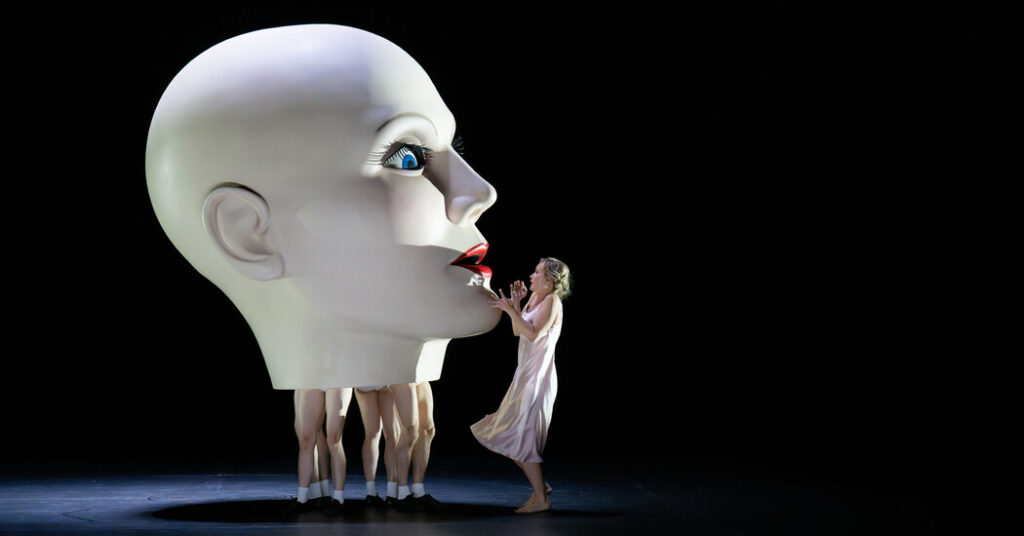
He nods to the fairy-tale nature of the opera, raising the curtain on the Nurse (the soprano Nina Stemme), staring forward with chilling focus as she rocks her chair on a bare stage, beckoning the audience for a kind of story time. This is the look of the mythical realm, a black expanse occasionally populated by dreamy figures like a towering hobby horse or a doll head, or a group of decapitated dancers wearing gowns that, in Victoria Behr’s costumes, seem to be cut from morsels of the universe.
The mortal realm, on the other hand, is a steamy tower made of pipes, the slums of Mumbai meet “Star Wars,” designed by Michael Levine. There are intrusions from the Empress’s world; Kosky renders a handsome young man sent to seduce the Dyer’s Wife as a dancer (Prince Mihai) who, coated in glitter, resembles a Greek statue by way of Damien Hirst. Everything gives way, by Act III, to a white void in which, because of Franck Evin’s clever lighting, none of the characters cast a shadow.
Kosky treats the opera as a story of becoming. Regardless of what realm the men and women of the two couples start from, they arrive at a shared humanity, poignantly staring down the same continuum of existence.
It’s a reading of “Frau” that relies on sympathetic performers, which this production has in abundance, above all in the soprano Ambur Braid as the Dyer’s Wife. She is a singer capable of extraordinarily fine emotional detail and explosive power; with a touch of artful unprettiness, she bends her musicality constantly in service of the drama.
As the Empress, Vida Mikneviciute complemented Braid’s voice with an otherworldly glassiness. Her sound was especially fragile next to Stemme’s intense expressivity, which was true Hofmannsthal’s description of the Nurse as “between the demonic and the grotesque.” Both husbands, Michael Spyres as the Emperor and Brian Mulligan as Barak, had tones rich with passion, but quick to turn and reveal a pained or pathetic core.
The other principal character, in any Strauss opera, is the orchestra. Long instrumental passages and solos in “Frau” are as important as arias, and Kosky leaves them mostly unstaged, teeing up Mäkelä and members of the Orchestre de Paris to carry the story forward from the pit alone. Which they did, repeatedly, dusting this fairy tale with musical magic.
Die Frau Ohne Schatten
Through July 21 in Aix-en-Provence, France, and streaming on Arte.tv for a month starting July 9; festival-aix.com.