


Tennessee Williams’s “Suddenly Last Summer” is like a courtroom drama without a courtroom. The only known fact is that a man is dead. And two women, his mother and cousin, each unreliable in their own way, are in a battle of storytelling to explain what happened.
In being adapted from a one-act play into a new opera, composed by Courtney Bryan to a libretto by Gideon Lester and Daniel Fish, that dueling nature is magnified, as things tend to be in opera. The two stories are not just different, but conveyed differently: The mother speaks, and the cousin sings.
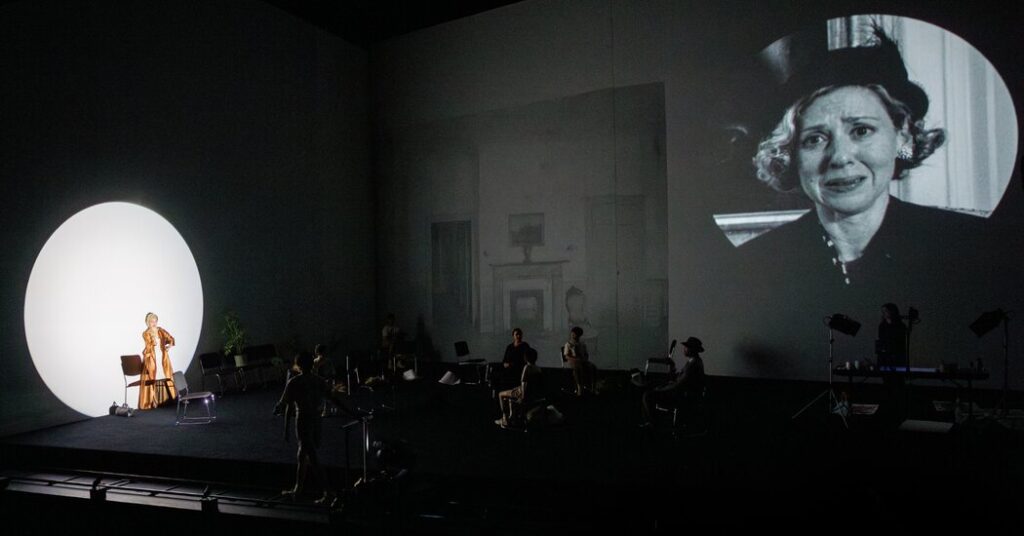
They are far from alone in competing for your attention in the teeming hour of this “Suddenly Last Summer,” directed by Fish. (Now at the Fisher Center at Bard in the Hudson Valley, it travels to Opera Philadelphia next season.) In his production, virtually everyone onstage has something to say, often at the same time, in a theatrical exploration of how stories are told: through speech and music, yes, but also through visual art, choreography and film.
All this shares a space, filling and emptying Marsha Ginsberg’s expansively spare set like a tide, more than it actually coheres. And it often competes with, even overshadows, the smooth eclecticism, emotional immediacy and comparative modesty of Bryan’s score.
As for what happened to the dead man, Sebastian Venable, last summer on the island of Cabeza de Lobo, Mrs. Venable (Tina Benko), a New Orleans grande dame allergic to truth, insists through melodiously Southern declamation that her son was a sensitive, chaste poet. And she’s willing to spend however much it takes to set the record straight, which includes paying for the private mental institution where Sebastian’s cousin Catherine (Mikaela Bennett) has been staying since she witnessed his death. With accumulating force and terror, Catherine sings not only about what she saw, but also about the ways Sebastian would fetishize young men and have her procure them for him.
Each woman gets her moment in the spotlight (or, rather, in the psychologically focused lighting of Stacey Derosier). But the libretto and score also layer them; neither can get through a monologue without the other interrupting. From the point of sympathy, you would think the deck is stacked in favor of Catherine, a clear victim who communicates through music, which is more naturally compelling and memorable than speech. But Mrs. Venable maintains the upper hand, not for a dramatic reason so much as a directorial one: clarity.
Fish’s production hides much of the music. Bennett, the only character who sings, and members of the Young People’s Chorus of New York City sometimes perform offstage. And the instrumentalists are out of sight. They are all amplified, which is not inherently problematic but muddles the text of, say, Catherine’s revelations. It may seem strange to ask for one more thing in a cluttered show, but “Suddenly Last Summer” would benefit from supertitles.
There are moments, to be fair, when the libretto is less narrative than textural, such as when Mrs. Venable’s opening lines are disrupted by Catherine singing the words “when,” “can” and “I,” stretched beyond recognition over suspended chords. Bryan, a composer who reveres musical traditions but presents them in entirely fresh ways, is making her opera debut, true to her artistry, by approaching the art form on nothing less than her own terms. This isn’t a score made of arias, but of brisk drama and tightly threaded elements that, miraculously, include room for improvisatory freedom.
She scores, for example, a collection of bird songs that are deployed as cues. Repeating vamps and directions like “freely” abound, and yet Bryan also has a keen sense of pacing. A spoken “yes” might be hinged to a sung echo, and a moment of accelerando tension might be followed by the release of a lento.
If the production doesn’t exactly conjure the sultriness of New Orleans, the music does. Chords build one note at a time, like sunlight emerging from around a corner; melodies melt with downward glissandos, and Bennett similarly bends pitches, soulfully scooping her way into a note. Bryan also gives voice to Sebastian, who spectrally appears and dissipates with his poetry and predatory language delivered by the children’s chorus.
Even without singing, Benko performs Mrs. Venable with operatic physicality and musical speech. She can’t say a word like “which” without blowing enough air to extinguish a candle. Through a trick of shadows, she is made to literally tower over Dr. Cukrowicz, whom she wants to lobotomize Catherine so they can “cut this hideous story out of her brain.” As played by Branden Lindsay, the doctor is so dispassionate, he ends up throwing the desperation of those around him into relief.
That extends to Catherine. Dr. Cukrowicz sits in a chair as she recounts last summer, at first with a kind of flatness and then with increasing pressure and complexity at the conclusion of her story: Sebastian, already in a state of depravity and decline, was mobbed by starving children who tore apart and ate his flesh, and left the rest for the birds. It’s a long line to trace, musically and dramatically, but Bennett shapes it confidently, with astounding payoff.
Her brother and mother, played by Nick Westrate and Miriam Silverman, are shown on prerecorded film that could have been cut from an old Hollywood adaptation of “Suddenly Last Summer.” (There was one, in 1959, starring Katharine Hepburn and Elizabeth Taylor.) Another performer, of a sort, is the artist Lucy Tarquinio, who paints at the side of the stage throughout, while her work, of expressive brush strokes and splatter, is stylistically projected by Joshua Thorson onto one of the set’s walls.
Occasionally, the children of the chorus invade or evacuate the stage, at first dressed like the nuns from Catherine’s institution, then wearing T-shirts printed with images of Saint Sebastian, adopted as a gay icon but also, in his virtuousness, how Mrs. Venable wants her son to be remembered. During one interlude, they “ooh” and “aah” in a breezy vocalise, then whistle, then growl like animals and run in a kind of postmodern dance by Beth Gill.
As they run, exhausting themselves in circles, you get a sense of just how big this stage is, and everything it can contain. Fish fills it with dance, film, painting, song, speech and more, piling storytelling onto storytelling in a way that only opera, a synthesis of all art forms, can.
Suddenly Last Summer
Through July 19 at the Fisher Center at Bard in Annandale-on-Hudson, N.Y.; fishercenter.bard.edu.