

Three years ago, a deluge overwhelmed Highland Falls, N.Y. A murky river rushed through Main Street, and one woman was swept away with the currents after leaving her home.
Now, the Hudson Valley village has to spend half a million dollars a year just to pay the interest on the money it borrowed for crucial repairs.
Damaging storms are nothing new to the New York City metropolitan area. This summer alone, heavy rains and winds have downed power lines in Connecticut, submerged cars in New Jersey and the Bronx and turned parts of New York City’s fashionable SoHo neighborhood into a wading pond. With climate change, these storms will become stronger and more frequent.
They will also become more expensive.
New York State is projected to surpass half a trillion dollars on infrastructure spending related to climate change by 2050, according to a new report.
Rebuild by Design, the nonprofit behind the analysis, was created after Hurricane Sandy to work with New York City agencies on flood-related protection initiatives. The group scoured public records across the state for plans to prepare for the impact of global warming, including government proposals awaiting funding, projects underway and those completed after Hurricane Sandy. It then compiled the costs of that work to arrive at the $519 billion tally.
And that doesn’t even include the cost of future disasters — a cost that can easily reach into the hundreds of millions of dollars.
Amy Chester, the director of Rebuild by Design, said paying for the work will fall on local and state governments, which could also mean higher taxes for residents. “The needs in this analysis far exceed the resources available,” she said.
James DiSalvo, the mayor of Highland Falls, which is part of the town of Highlands and is about 55 miles north of New York City, knows this truth all too well.
“I borrowed $6 million and played what I like to call Ironman football,” he said. “I would do some work, get paid back, do some more work, get paid back.”
And still the village needed more money. In 2024, its budget increased by more than 7 percent and its taxes by more than 5 percent, according to Mr. DiSalvo.
The report found more than 700 federal, state and local initiatives that governments had committed to paying for or were being planned. These projects addressed sea level rise, erosion, grid vulnerabilities, storm-water management, wind and storm damage and sewer upgrades.
In New York City, which faces significant infrastructure, flooding and extreme heat problems — and also has several plans in place to address these issues — the cost of climate change preparations breaks down to about $50,000 per resident. Smaller towns may not have plans on the books to protect their communities, so their projected costs are much smaller.
In Highland Falls, the work and the expenses are ongoing. The village’s water tanks were damaged and are still being repaired. “It takes forever,” Mr. DiSalvo said. “Again, if I had an unlimited supply of money, it’d be a different story.”
The village, which is built into the side of a large hill, has a brook that runs through it. The flooding was caused by the nine inches of rain that fell within hours and the downhill runoff it produced — not by the waterway overflowing. Roads and bridges were washed out. In front of Mr. DiSalvo’s childhood home, “fish were swimming on the street,” he said.
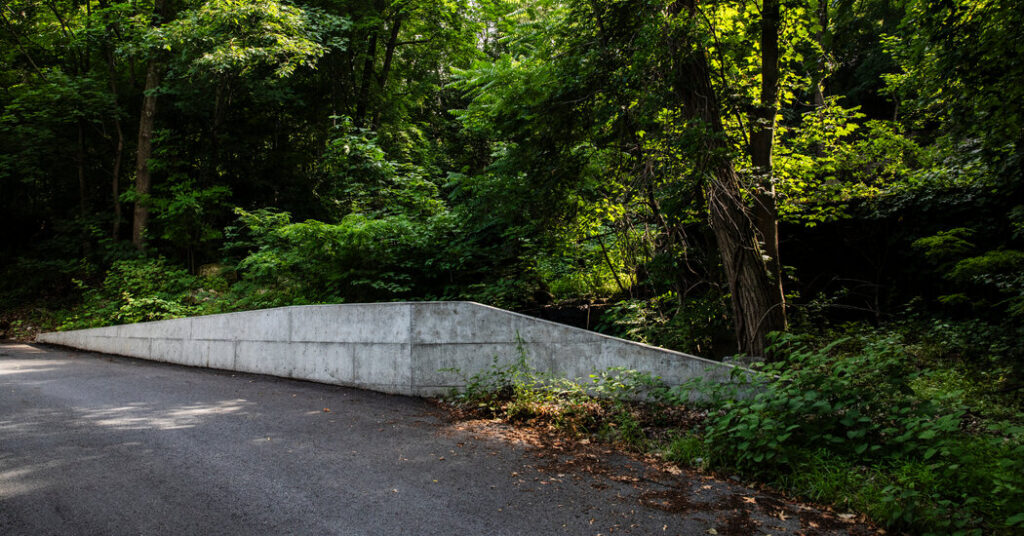
Notably, many of the village’s 100-year-old retaining walls crumbled, which proved to be the most expensive item to repair, the mayor said.
Some of those walls are on private property, but homeowners are experiencing difficulty being reimbursed by the Federal Emergency Management Agency or qualifying for flood insurance because the village does not sit in a flood plain. That scenario is becoming more common across the country.
FEMA also requires counties to accrue a certain amount of financial damagebefore the president can declare a disaster, which then qualifies them for federal aid. The storms earlier this summer did not even come close, which means residents and local governments will pay for any repairs. “These costs get passed on to families in the form of tax increases, insurance hikes, damages, home repairs and business losses,” Ms. Chester of Rebuild said.
In some cases, a state might surpass the FEMA threshold to receive aid, but the president still has the authority to deny help. In February, when a blizzard shut down most of New York, Gov. Kathy Hochul requested a major disaster declaration from President Trump. This month, he denied the governor’s request.
New York’s Homeland Security and Emergency Services agency said that New York State remains committed to helping residents after disasters.
But the money has to come from somewhere. The Rebuild by Design report calls for a comprehensive statewide plan for increasingly extreme weather and sea level rise. Without one, “communities are left to develop incomplete, uncoordinated and often under-resourced strategies for climate adaptation,” which results in uneven levels of protection, said Ríobart É. Breen, an environmental expert at the University of Albany.
Such a plan is especially important, the report says, given federal opposition to other sources of disaster funding. In late 2024, Ms. Hochul signed a law requiring major fossil fuel companies to help pay to repair damage caused by extreme weather. (Burning oil and gas warms the planet, which can supercharge storms and droughts).
Called the Climate Change Superfund Act, it requires those companies to pay $75 billion over 25 years into an account for infrastructure repairs and upgrades, as well as recovery efforts after disasters. But in early 2025, the law was challenged in court, with 22 states, led by West Virginia, arguing that individual states should not dictate federal energy policy.
This summer, New Yorkers could learn the fate of those billions, with a judge in Syracuse expected to rule on the case.
Grace Ashford contributed reporting.