

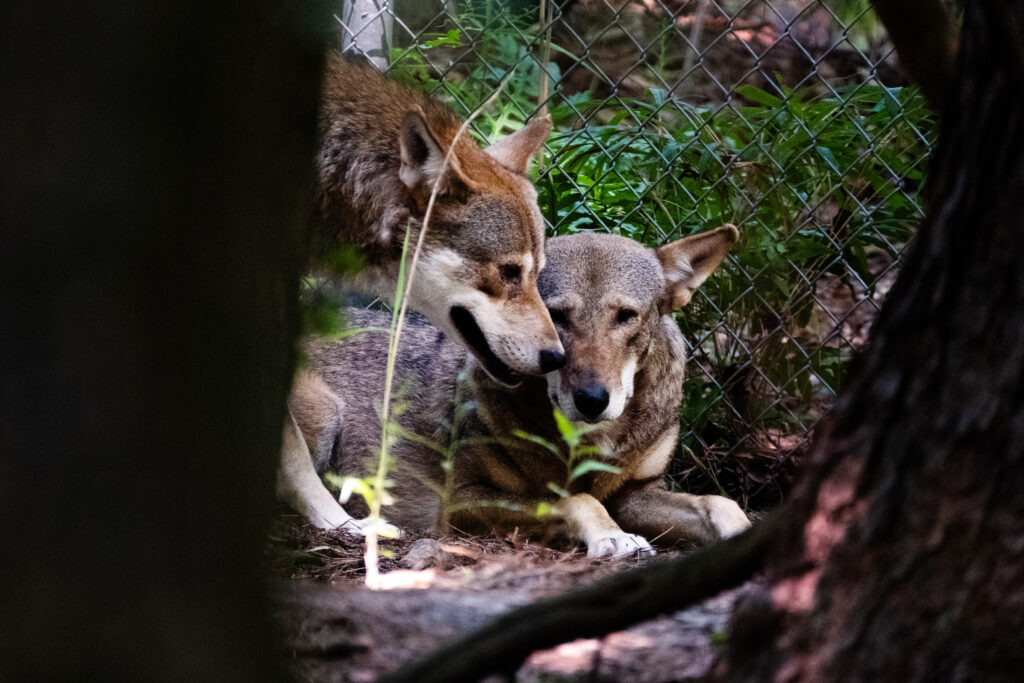
Nearly two dozen red wolf pups were born in the wild this spring in eastern North Carolina, giving a remarkable boost to one of the most endangered species on the planet.
“It’s inspiring to see these underdogs making another incredible comeback,” said Will Harlan, southeast director for the Center for Biological Diversity, in an statement about the births.
The 23 pups born in the wild this year marked the most since 2013. While not all the pups ultimately survived, their arrival briefly doubled the number of red wolves living on the landscape.
There are only 22 known adult or adolescent red wolves living on or near the Alligator River and Pocosin Lakes national wildlife refuges, according to the U.S. Fish and Wildlife Service, which oversees the decades-long effort to restore a native animal that once roamed widely throughout the southeastern United States.
The number of wild adult red wolves had dipped perilously into the singledigits in the not-so-distant past, but the modest population growth of recent years remains far below the number needed for red wolves to sustain themselves over time.
That makes this year’s births a joyous and encouraging moment for those invested in resurrecting a species that has long stood on the brink of extinction.
“This is such a huge improvement over the disastrous years of 2019 to 2021, when no pups were born in the wild at all for four years straight — a trend that was rapidly becoming a death knell for a species that typically only lives for three to six years in the wild,” said Ron Sutherland, chief scientist for the Wildlands Network, who has long worked on red wolf issues.
Federal officials said four litters of red wolf pups were born to breeding pairs in the wild earlier this spring. Some died early on — survival of red wolf pups in the wild is typically around 50 percent — but a significant number remain.
“With the mortalities of some of the young pups detected during our monitoring, we know there are a minimum of 12 pups remaining in the wild and possibly up to 16,” the agency wrote in a recent update.
“The other four pups do not have transmitters, but we confirmed their presence on the landscape as recently as late May. We will continue to monitor the pups using radio telemetry and remote sensing cameras,” the statement added.
The push to save red wolves in the wild has experienced dramatic ups and downs over the past four decades on North Carolina’s Albemarle Peninsula, with its massive swamp forests, farmland and marshes.
Red wolves had been hunted to near-extinction in the 1970s and were reintroduced to eastern North Carolina in 1987. By 2011, more than 120 roamed the wild. But that growth did not last, and their numbers eventually plummeted.
Among the most significant threats facing red wolves over time were unnatural deaths at the hands of humans. Vehicle strikes along Highway 64, a popular route to the Outer Banks, and other roads have become the largest cause of mortality for red wolves. Others have died of gunshots.
The fate of the species also has risen and fallen alongside shifting priorities of the federal government, conflict with nearby landowners, scientific disputes and legal challenges.
Changes in federal policy and personnel, as well as legal challenges from conservation and environmental groups, have led to a recommitment to the recovery program.
While officials have outlined plans to strategically release some of the nearly 300 captive-bred wolves into the wild over time, the ongoing birth — and survival — of new pups in the wild is an essential element to reestablish the species across its native region.
“We’ve still got a long way to go,” Joe Madison, the red wolf recovery program manager in North Carolina for the U.S. Fish and Wildlife Service, told The Washington Post one morning in 2024 as he drove through the Alligator River refuge. “I don’t think anybody thinks it’s going to be easy or short.”
He spoke at the time about how the work of restoring endangered red wolves is slow and tumultuous, but very much worth it.
“They are a missing piece of the ecosystem out here,” he said. “And without that, things are out of whack.”
Sutherland said that while this spring’s surge of births is promising, one key will be to make sure the world’s most endangered wolves, young and adult, have the best chance to survive and thrive on the landscape.
A key piece of that is unfolding now, as state and federal officials have committed tens of millions of dollars toward building wildlife crossings over the next several years in an effort to reduce traffic-related deaths near the refuges where red wolves roam. Environmental groups have helped to raise millions more.
“Wolves can grow their population quickly when they are protected from mortality,” Sutherland said, “and when there are enough unrelated animals out there to form pairs, and we could see some remarkable growth over the next few years.”