

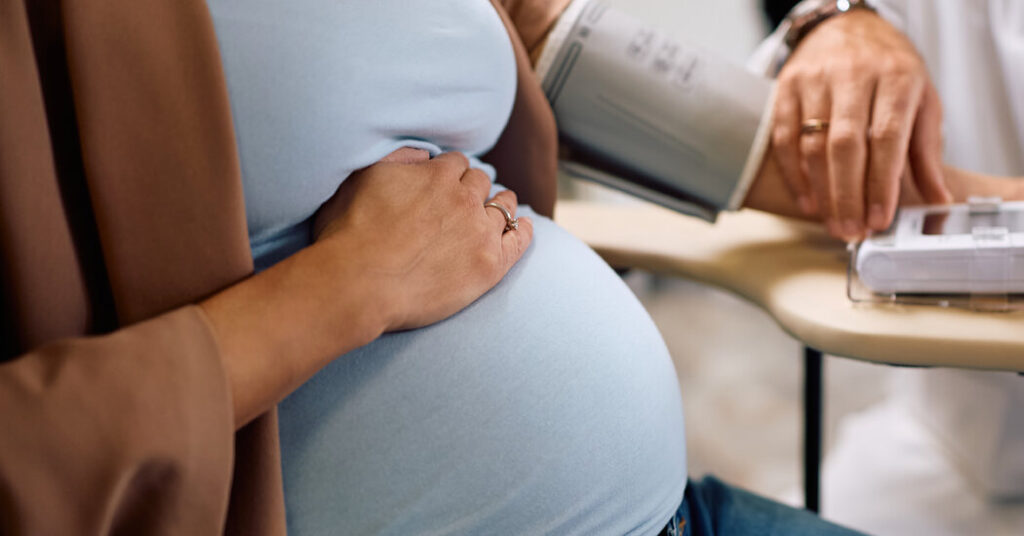
Rates of high blood pressure among pregnant women nationwide rose significantly between 2016 and 2024, according to a new report published Wednesday by the Centers for Disease Control and Prevention.
One in 10 pregnant women in the United States had high blood pressure in 2024, up from about one in 17 in 2016, a 73 percent increase over that period.
The maternal mortality rate in the United States exceeds that of other wealthy nations, and hypertensive disorders during pregnancy are among the leading causes of pregnancy-related death and disease. High blood pressure during pregnancy increases the risk of serious complications, including preterm birth, low birth weight and stillbirth, as well as placental abruption and organ failure in mothers. It also raises a woman’s risk of heart disease over her lifetime.
The new figures, reported by the C.D.C.’s National Center for Health Statistics, were drawn from birth certificates completed by hospitals, which contain information on a mother’s health. The figures do not include high blood pressure that was diagnosed before pregnancy, which is called chronic hypertension. But that condition has also been rising and affects some 3.7 percent of pregnancies.
“This is a substantial rise, and the author notes that this is probably under-reported on birth certificates, so the true rates may be even higher,” said Dr. Elizabeth K. Cherot, an obstetrician-gynecologist who served recently as president and chief executive officer of the March of Dimes, a maternal and infant health nonprofit organization.
“Clinicians are absolutely seeing this, and seeing it across the board — across every race, age and geographic region,” said Dr. Cherot, who is now chief medical officer at Unified Women’s Healthcare.
The birth certificate data can only show who is being diagnosed with high blood pressure in pregnancy, not why it is increasing, said Elizabeth C.W. Gregory, a health statistician at the National Center for Health Statistics and the author of the new report.
Some of the increase may reflect 2018 guidance issued by the American College of Obstetricians and Gynecologists that called for earlier identification of high blood pressure in pregnancy and better management of the condition, Dr. Cherot said. And in 2023, the U.S. Preventive Services Task Force urged health care providers to regularly check patients’ blood pressure, starting early on and continuing throughout pregnancy.
It’s possible that health issues could be at play, including obesity, which is closely linked to hypertension. The report found that the higher a woman’s body mass index or weight before pregnancy, the more likely she was to develop high blood pressure in pregnancy. .
Increases in the average age of mothers in the United States could also play a part, since blood vessels stiffen with age. That requires the heart to pump with more force, making blood pressure go up. High blood pressure was most common among pregnant women who were 40 and older.
Rates were also almost two times higher for mothers carrying twins or more than for mothers carrying a single baby.
Researchers also identified racial disparities in the prevalence of high blood pressure. The new report found that rates were as high as 13 percent in non-Hispanic American Indian and Alaska Native mothers, and as low as 7 percent for non-Hispanic Asian mothers.
While there were differences in prevalence across these various groups, the researchers saw that high blood pressure increased among women of all ages, races and weights. Even in underweight women, for example, the rate more than doubled, rising to more than 5 percent in 2024, up from just under 3 percent in 2016. The prevalence of high blood pressure also doubled among pregnant Asian women, even though they had the lowest rate of any ethnic group.
Experts said that more research is needed to better understand what is driving the rapid increase in high blood pressure among such a broad swath of pregnant women, and to explore the potential role played by environmental exposures. Studies have shown that exposure to air pollution, forever chemicals, heavy metals and even noise may be risk factors for hypertension.