

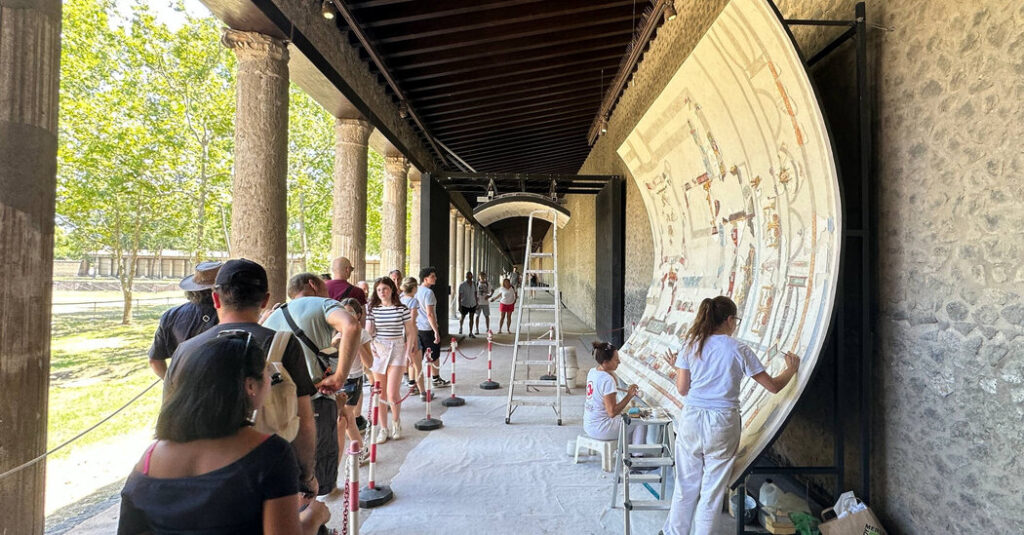
Working with hundreds of fragments of plaster recovered from the ruins of Pompeii, archaeologists this week presented a restored frescoed vault from an ancient home that the park’s director described as a “magnificent” puzzle depicting the god of revelry and the princess who helped navigate Crete’s labyrinth.
The restoration has been years in the making, the director, Gabriel Zuchtriegel, said in a video message. The pieces have been gradually collected since excavations began in 2023 in what is known as the House with the Bakery. On this site, researchers have recently found what they call a “bakery-prison” and evidence of the Pompeian taste for a pizza-like pie.
The vault is a rare artifact from Pompeii, said Alessandro Russo, an archaeologist at the site, who explained that although many wall frescoes have been excavated, only some 20 ceilings have survived.
Ceilings were typically “false-vaults” made from wooden structures and lined with closely bound reeds; those were then covered in plaster that provided a base for the frescoes. Over time, the organic parts disintegrated, so few have survived, he explained.
As puzzles go, the full reconstruction of the vault, which covered a banquet room on the first floor, is bound to be tricky. Though some 1,000 fragments have been found so far, only about a fourth of the ceiling has been recomposed. Other pieces remain missing or have yet to be identified.
Buried by an eruption of Mount Vesuvius in 79 A.D. under tons of ash, rock and lapilli, Pompeii has over the centuries become a powerful symbol of the transience of life and human impotence when nature unleashes its power. Since excavations began in the 18th century, Pompeii has provided precious insights into the lives and habits of its ancient denizens.
The central image of the vault was decorated with a mythological scene, but only a few fragments remain. By comparing existing fragments in the decorative border, especially numerous references to the god of wine, Dionysus, with other ancient works, archaeologists managed to identify the depiction of the popular love story of Dionysus and Ariadne, the princess who helped Theseus escape the minotaur’s maze, Mr. Russo said.
The banquet room was part of a villa that belonged to Aulus Rustius Verus, a Pompeian magistrate. Its excavation in recent years has already made headlines. Some areas, specifically what archaeologists called the “bakery-prison,” exposed the bleak existence of enslaved people two millenniums ago.
The fragments of the banquet room vault have been inserted in a curved support structure replicating its original shape, “the most innovative element of the entire project,” according to a statement from the archaeologists.
The structure allows new fragments to be added seamlessly as they emerge, “transforming the restoration into an open and updatable process,” the statement said. Visitors can see the vault in Pompeii’s Palestra Grande, or large gymnasium, it added.