

At the Ankara gathering itself, delegates from the Baltic states and Poland proudly wore badges proclaiming themselves members of the “five percent club”, the only nations in the NATO alliance to have already reached the spending target set at last year’s meeting in The Hague – a status they had believed until recently would secure them lasting US military backing.
Also Read: Ukraine PM Serhii Koretskyi takes charge amid war, energy crisis and political turmoil
Despite some of the most outspoken behaviour yet by US President Donald Trump at a major international gathering, NATO officials including Secretary General Mark Rutte claimed it as a victory, pointing to a string of new defence deals, increases in European spending and an “ironclad” commitment to mutual assistance.
However, many of those commitments – including a nine-nation defence bank led by Canada and a long-range strike missile consortium worth $50 billion and involving a dozen countries – will take years to deliver.
In public, even Trump-sceptic leaders such as Canadian Prime Minister Mark Carney praised the US president for putting pressure on NATO members to increase their spending.
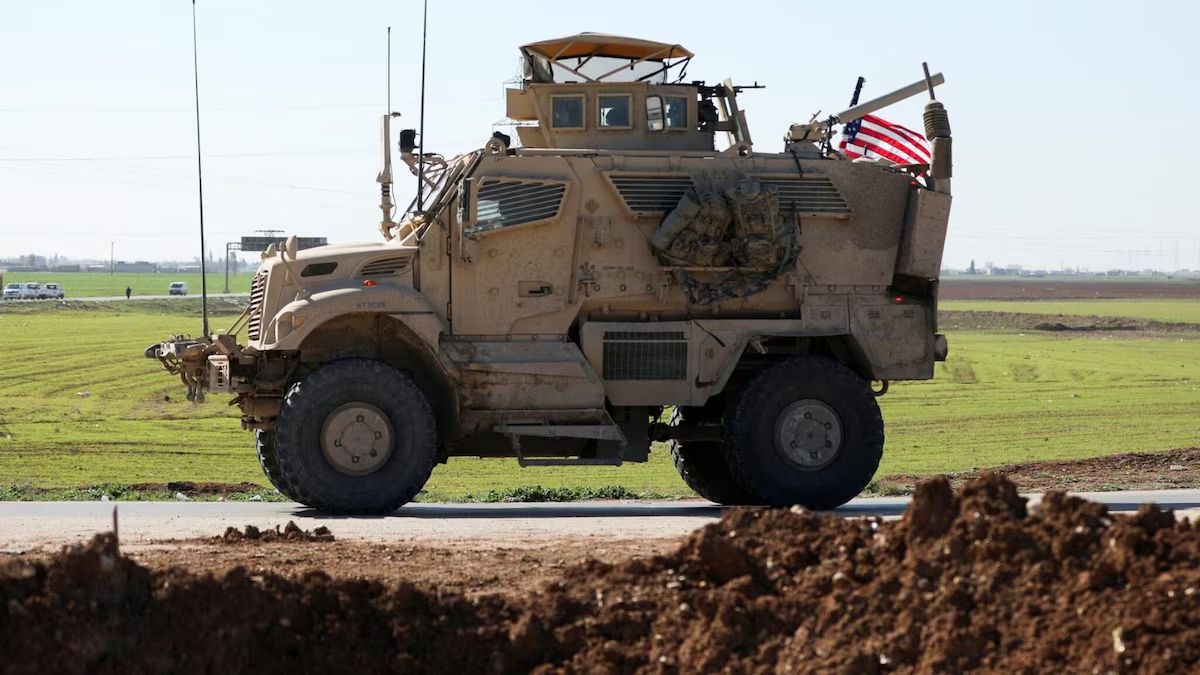
Meanwhile, what is actually happening on the ground this summer is that the US has now pulled back its forces from some of the most vulnerable areas in Eastern Europe just as worries grow that a Kremlin increasingly publicly humiliated by Ukraine’s long-range drone and missile strikes deep into Russian territory might be tempted to lash out.
Analysis of European headlines by AI monitoring and predictive data firm Omniforecaster suggests an 18% chance of a lethal clash between Russia and NATO member states by the end of 2026. That points to an environment risky enough to have governments taking notice – particularly with Washington quietly cutting back its troop numbers.
Speaking at the annual Chatham House conference last week, former UK Armed Forces Minister Al Carns suggested the strategic situation was the riskiest since the Cuban missile crisis in 1962.
Still, for now, most analysts and officials believe Russia is more likely to continue its “hybrid warfare” campaign of disruption and sabotage rather than direct military action.
The risk of messy escalation, however, is not limited to Europe. The US now looks as enmeshed as ever in conflict in the Gulf, with Trump suggesting in Ankara he might further step up strikes against Iran’s essential infrastructure – much to the alarm of Washington’s allies in the Gulf who fear they may take the brunt of Tehran’s retaliation.
In the Middle East, the US began withdrawing personnel from forward bases in mid-January as a precaution amid rising tensions with Iran. Most observers doubt the US will ever again keep significant numbers of non-air defence personnel or equipment in countries such as Qatar or Kuwait, building on a complete withdrawal from Syria and pullback from Iraq.
In some cases, functions have been pulled back to the US – including most of the coordination work by the Coalition Air Operations Centre (CAOC) at Qatar’s Al Udeid air base. In other cases, the U.S. would now rather base aircraft and drones in perceived safer locations, including Jordan, Israel and Turkey – as well as mainland Europe.
UNCERTAINTY AND NERVES
Decision-making in Washington is sufficiently restricted to Trump and his inner circle that most foreign officials believe any further such decisions may be made with little warning.
As recently as May, Estonia’s Pevkur had been reassuring local media that “US forces are in Estonia and will remain there”, although he acknowledged that “nothing can be ruled out”, given recent uncertainties when it came to US policies.
Now he said the number of US forces had dropped to below 100 personnel, barely a sixth of their level last winter when a detachment of US tanks was based in southern Estonia.
Top US commanders in Europe had told him another detachment should arrive later in the summer, he said – but this might well be subject to an ongoing review.
Also Read: US, Russia agree to re-establish military-to-military dialogue after Ukraine talks
According to Baltic, Polish and US defence officials, those Baltic withdrawals came as a direct consequence of the Trump administration’s unexpected decision last month to cancel a long-planned movement of some 5,000 troops to Poland.
That decision surprised the government in Warsaw and many of the troops themselves – some were literally just about to board flights to Europe.
The cancellation of the rotation then had a knock-on effect on the movement of some of those soldiers through the Baltic states, with another 1,000 troops reportedly leaving Lithuania in June without being replaced.
Both Defense Secretary Pete Hegseth and Pentagon policy chief Elbridge Colby have spoken repeatedly of the importance of prioritising confronting a rising China, pushing a “NATO 3.0”, in which Europe does much more to defend itself.
But in the Pacific, too, the dynamics are shifting, with most traditional US allies, including Japan, Australia, South Korea, Taiwan and the Philippines, increasingly nervous that the much longer-term trajectory in that region may be towards at least a partial US pullback.
Some Ukrainian commentators have suggested the US pullback from the Baltic states might be aimed at placating Russia: some pro-Kremlin voices and occasionally President Vladimir Putin himself have suggested that US or wider NATO troop withdrawals from Eastern Europe should be part of any peace deal in Ukraine.
BASING QUESTIONS
But there is another potential parallel explanation – that the US is looking to ensure that if conflict does escalate in Eastern Europe with attacks on NATO territory, it has fewer forces in harm’s way.
That would be a major shift in US strategy – and one that may not be that clearly signalled in advance. In Washington, some voices – including the Defense Priorities think-tank which pushes hard for a further pullback of US forces – have argued for several years that the US should keep far more limited forces in risky locations overseas, pulling back not just from the Middle East and Europe but exposed locations in the Pacific.
Those include the Japanese island of Okinawa as well as US bases in Guam, which some strategists argue would simply be too exposed to Chinese attack in the event of any conflict.
Where US forces are deployed, they argue that they should be highly mobile units often operating long-range missiles such as ATACMS that could threaten Beijing’s ships as well as the Chinese mainland.
Some of those systems were deployed for the first time in US-led drills in Japan and the Philippines in exercises earlier this summer.
Worries over long-term US commitment are already driving multiple allies in both Europe and the Pacific to attempt to coordinate more closely together, including for procurement – but not without a backlash from some US officials.
Pentagon policy chief Colby this week wrote that without the US such efforts would simply waste resources.
“The simple fact of the matter is that no alternative country or countries can compete with the US defence industrial base either in quantity or quality,” he wrote.
Also Read: EU seals deal for drone production with Ukraine
Last week, the head of the German air force, Holger Neumann, told Politico that Europe did indeed need to step up its purchases of US weapons. “Developing our own capabilities takes time,” he said. “Right now, we do not have time.”
German officials believe the threat will be greatest in 2029. Some believe it may come much quicker. But either way, those who hoped that having US troops on the ground as a “tripwire” would maintain deterrence may well be disappointed.