

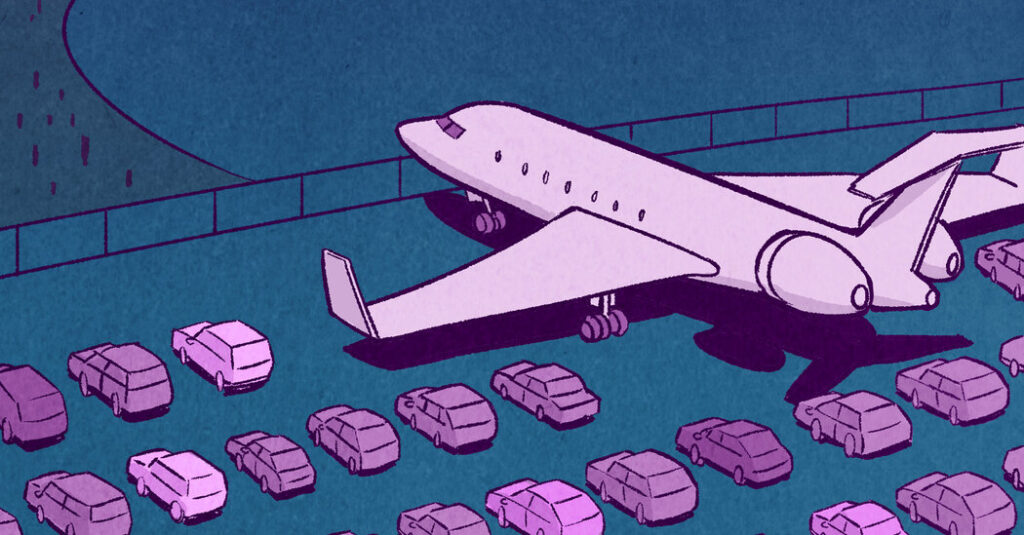
For the ordinary fútbol fan, the nine-mile journey from Manhattan to the World Cup stadium in New Jersey is as appealing as a trip to the dentist.
There are hours waiting in sunbaked security switchbacks outside Penn Station before squeezing onto yellow school buses or NJ Transit trains with sweaty strangers for the ride to the Meadowlands.
But while the masses jostled around the station one afternoon, a more civilized scene unfolded under the shaded entryway to the Solow Building, the famously pricey office tower off Fifth Avenue.
Four men in matching maroon suits and spotless white hats and tennis shoes stood on the sidewalk, guarding a pair of Mercedes-Benz Sprinter vans. The only visible hints of the crew’s purpose were faint text embroidery over their chests that read “FIFA World Cup 2026” and a mysterious “Q” that had been affixed to the vehicles’ windshields.
The men, according to three people briefed on their roles and an invitation viewed by The New York Times, were private security permitted by FIFA — soccer’s global governing body — to whisk the top executives and clients of Qatar’s $600 billion sovereign wealth fund to the stadium to watch Ecuador play Germany.
The men delivered the group past security stops on the winding roads around the stadium to a private suite and then reversed that route for the return trip, in air-conditioned, discreet comfort.
Democratic socialists are winning elections across the nation, billionaires are facing the first-ever potential state tax on their wealth and seemingly every tech magnate with an imagination is building a private end-of-days bunker.
But at the World Cup, the superwealthy can just be themselves again. This summer’s tournament is a reprieve for the multimillionaire in need, a place where money can still buy a good time, though maybe not a trophy. Look no further than Team U.S.A., whose coach’s salary was subsidized by several million dollars from Kenneth Griffin, the billionaire hedge funder. His trading firm, Citadel Securities, has a suite in New Jersey and he personally has spent an untold sum separately on tickets elsewhere for employees. He himself was in attendance last Monday in Seattle — just in time to watch his investment get crushed by Belgium in the round of 16.
“It’s the Super Bowl for the ultraprivileged,” said Hans D. Rearick, a private investor who acquired a taste for soccer after a Middle Eastern royal family gifted him a seat in a suite for the last World Cup final. This time, he has been flying between the United States and Mexico to attend games. “Inequality is taking it right in the face right now.”
In interviews, more than a dozen World Cup enthusiasts on Wall Street, mostly speaking anonymously given the wider cultural temperature around extreme wealth, described a behind-the-scenes game to get the best seats and maximally convenient transportation by air, land or sea.
Much of the action centers on Teterboro, the private airport in northern New Jersey that’s a favorite of the finance set and just a six-mile drive from the stadium. For $6,000 total, Blade Air will ferry six people there on a four-minute helicopter flight from Manhattan. That has been a favorite route for soccer fans at Bank of America and Goldman Sachs going to games directly from the trading floor, two employees said.
Alas, you’ll still need a private car — with FIFA tags, which start at thousands of dollars — to make the second half of the journey in style and be dropped off next to stadium. Uber and other car services cannot get closer than a mile.
For $10,000, you can get a larger helicopter to fly to Teterboro all the way from the Hamptons — a trip that has sold out on game days, according to Blade Air.
Those prices are triple the cost outside of the World Cup, said Rob Wiesenthal, Blade Air’s chief executive, who attributed them to higher fees during the tournament. A spokeswoman for Teterboro declined to comment.
One top mergers-and-acquisitions lawyer has been capitalizing on the moment, charging $10,000 to rent out his own hangar at Teterboro to his firm’s clients who fly in for the games. The lawyer, who spoke anonymously to avoid upsetting his employer with public talk of his personal deal making, parked his plane in Massachusetts for the month.
For all that, you still have to get tickets to the match.
The most expensive suite at the New Jersey stadium, on the second level at midfield, costs $8 million. If you filled every seat in the suite for all eight games, you would wind up paying about $19,230 for each.
Hemant Taneja, a billionaire venture capitalist, paid more than $50,000 for 26 tickets to a game in Santa Clara, Calif. His purchase was charity, of sorts, he wrote in an email.
“We gifted them to many people who work for us and love soccer but wouldn’t be able to go on their own; it’s a life experience for them,” he said.
His guests got to watch the action from the ninth row. But they did have to buy their own beers at $24 a pop.
For the World Cup final in New Jersey, where the best seats approach $100,000 each on secondary ticketing platforms, Mr. Taneja bought just two, he said.
He is taking his wife.
Such is the competition among high-finance employees for seats that one investment banker had to write a lengthy memo to persuade her bosses to let her use some of the company’s tickets to an early-round game.
In the end, she found herself with an extra ticket after an international client’s compliance department concluded that the seats — 11 rows up from the field — were so pricey that they could run afoul of their organization’s foreign anti-bribery rules.
Paul Weiss, the prestigious New York law firm, received numerous free tickets for doing pro bono work for local tournament host committees, two people with knowledge of the firm’s inner workings said. A spokeswoman for the firm did not respond to requests for comment on the tickets.
Pro bono work has been a lightning rod for Paul Weiss, which was criticized in some legal circles last year for cutting a deal with the Trump administration requiring that the firm perform free legal work for Trump-aligned causes.
The pro bono assignment for the World Cup, at least, resulted in what one Paul Weiss partner called “really good” seats.