

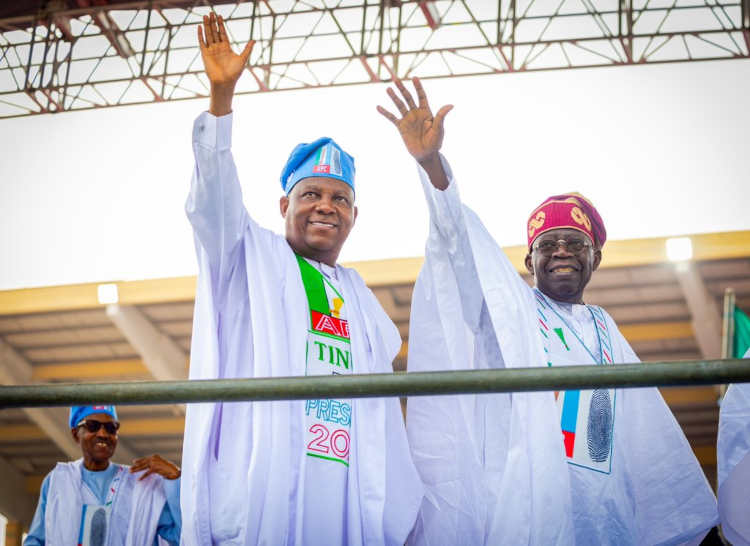
The All Progressives Congress’ Muslim-Muslim ticket has come under renewed scrutiny after President Bola Tinubu decided to keep Vice President Kashim Shettima as his running mate for the 2027 presidential election.
Shettima’s confirmation for the 2027 presidential election has reopened debate over the APC’s Muslim-Muslim ticket, with political parties and stakeholders divided over whether religion or competence should shape leadership choices.
The APC’s decision ended months of speculation that Tinubu could replace Shettima with a northern Christian, while reviving arguments that dominated the build-up to the 2023 election.
Although critics had argued that the same-faith ticket undermined Nigeria’s religious balance, Tinubu and Shettima won the presidency, and the ruling party has now opted to retain the combination for a second term.
While some opposition parties, including the All Progressives Grand Alliance and the Young Progressives Party, have downplayed concerns over the same-faith ticket, others have warned that religious balance remains an important factor in Nigeria’s politics.
The renewed debate followed the APC’s confirmation on Friday that Tinubu would contest the 2027 election with Shettima, a move that effectively ended months of speculation that the President could pick a Northern Christian as his running mate.
Ahead of the announcement, several names had been linked to the position, including the Minister of Defence, Gen Christopher Musa (retd.); the Catholic Bishop of Sokoto Diocese, Most Rev Hassan Kukah; and former Speaker of the House of Representatives, Yakubu Dogara.
Sponsored
The APC’s decision has revived arguments that dominated the 2023 election after Tinubu, a Muslim from the South-West, selected Shettima, also a Muslim from the North-East, as his running mate.
Critics had argued that the ticket broke with Nigeria’s tradition of balancing presidential tickets along religious lines to reflect the country’s diversity. However, Tinubu and Shettima went on to win the election, defeating candidates of the Peoples Democratic Party, Atiku Abubakar; the Labour Party, Peter Obi; and the New Nigeria Peoples Party, Rabiu Kwankwaso.
Reacting to the development, APGA said the focus of elections should be on leadership capacity rather than religion.
The party’s National Publicity Secretary, Ejimofor Opara, said Nigeria must move beyond identity politics and judge leaders by their performance.
“Competence should remain the defining issue in 2027, not whether candidates are Muslims or Christians,” he said.
The Young Progressives Party also argued that character, competence and integrity should outweigh religious or ethnic considerations in leadership selection.
Its spokesman, Wale Egbeola-Martins, said Nigeria’s major challenge had been poor leadership rather than the religious identities of those in power.
SPONSORED