

Pete Hegseth wants us to watch him sweat. Videos of the secretary of defense in a T-shirt and shorts working out alongside military personnel have become a trademark of his tenure. He has been filmed running on Omaha Beach, swinging a kettlebell on a university campus, and doing jumping jacks on an amphibious assault ship. In one clip, Hegseth pumps iron with troops at the Guantánamo Bay naval base—or, as a Defense Department X account put it, “America’s @SECWAR CRUSHED 44 reps on the bench after a morning run.”
But did he really crush those reps? Each time a new episode of Boot Camp Pete drops, critics skewer his form and mock his endurance. They insist that he’s all flex and no fundamentals. In that bench-press clip, for example, he doesn’t fully extend his arms, making the exercise far easier and inflating his total. A few seconds into the clip, you can hear someone yell, “All the way down, all the way up!” Hegseth fails to heed that helpful cue.
Such nitpicking would be uncharitable if Hegseth were just another 40-something dad getting a lift in at Planet Fitness. But these are highlight reels, posted by the Pentagon. Plus, the former Fox News host isn’t exactly known for withholding judgment himself: Recall how, last September, he gathered the nation’s generals and admirals together so that he could upbraid them for being overweight. He told them that leaders set the standard and that when “you let the small stuff go, the big stuff eventually goes.”
With Hegseth’s wisdom in mind, let’s examine what the United States military’s training manuals have to say about proper exercise form. Short answer: a lot. You’ll find hundreds of pages spelling out precisely how to perform all manner of movements, including how to stretch your thighs (“grasp the left ankle and pull toward the left buttock”), how to plank (“forearms flat on the ground, forming a triangle”), and how to throw a four-pound ball from a seated position (“do not throw the medicine ball like shooting a basketball”). These manuals are replete with charts, bullet points, and illustrations. The Army’s Holistic Health and Fitness Testing manual provides detailed instructions, accompanied by photographs, on the bench press, warning that you must not “jerk or shrug the shoulders, arch the back, or allow the hips to rise off the bench” (note to Secretary Hegseth: p. 65, Appendix B).
Standards vary across branches, even for basic exercises. Take the push-up. For the Army’s fitness test, soldiers must do what’s known as a hand-release push-up, requiring them to stick their arms straight out to the side after each repetition. The Marine guide devotes several hundred words to describing how to do a traditional push-up, specifying that the chest may not rest on the deck “except as required to ensure that the upper arms are at least parallel to the deck.” In the Air Force, your feet cannot be more than 12 inches apart, and you must maintain a “rigid head to heel form.” These are directives rather than suggestions. Failure to meet the standard results in a “no-go,” in military parlance, meaning you haven’t passed that portion of the test.
Hegseth’s push-ups wouldn’t pass muster in any branch. Last summer, Hegseth and Health Secretary Robert F. Kennedy Jr. kicked off the “Pete & Bobby Challenge,” in which participants attempt to do 50 pull-ups and 100 push-ups in less than 10 minutes. Hegseth’s push-ups are more like half-ups: In the ones captured on video, he doesn’t go through the full range of motion. His substandard technique is ironic because he’s on record ridiculing others for their lack of push-up prowess. In his 2024 book, The War on Warriors, Hegseth mocks women soldiers who can do only “ten push-ups at a pop” and refers to a transgender woman as a “ten-push-up kind of guy.”
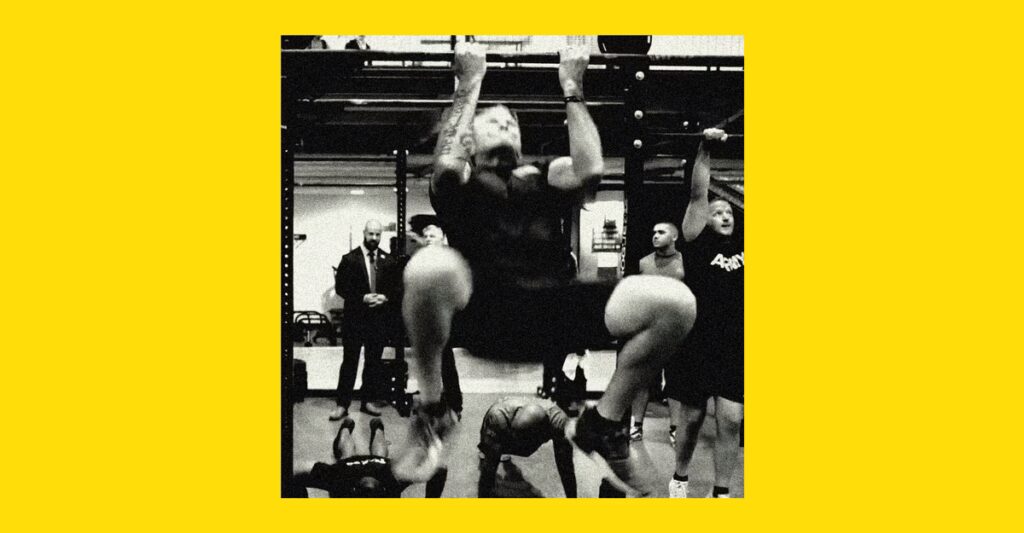
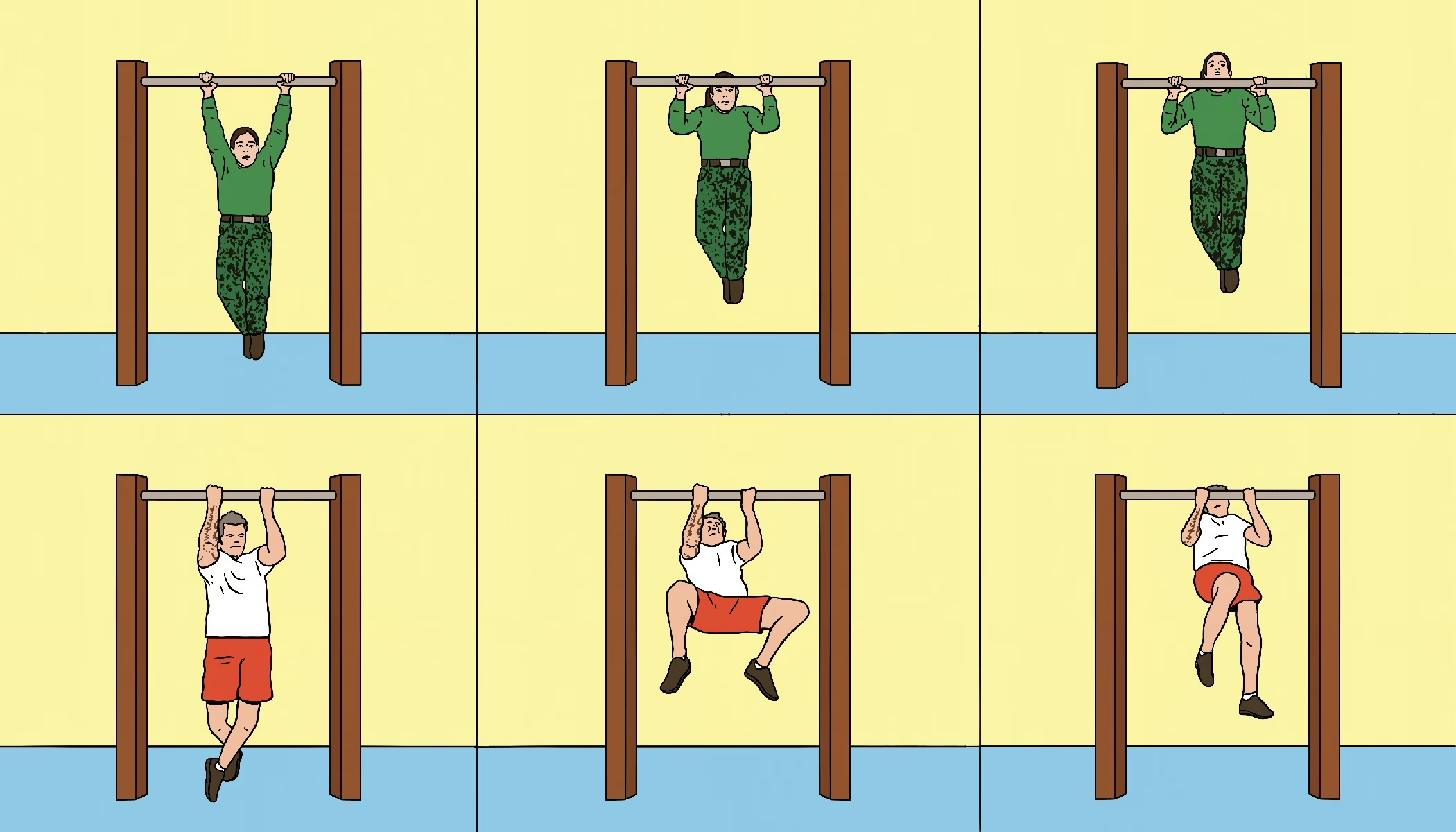
To be fair, Hegseth’s pull-up form, at times, is more or less textbook. The issue is consistency: Hegseth can’t seem to maintain the standard for the duration of the competition, and raises his knees to his chest to give himself additional oomph. This is known as “kipping” and is forbidden in an eight-page pull-up guide published by the Marines. In one clip, Hegseth kips while using an underhand grip, which technically makes what he’s doing a chin-up—an exercise often considered less challenging than a pull-up. (The Marine guide permits both, though kipping is always forbidden.) According to the guide: “Poor quality work will prevent you from getting the most from your workout and can lead to injury.” Hegseth’s work is, by Marine standards, poor.
Hegseth claims at the end of the video that he finished in less than six minutes, which would be impressive if he weren’t flouting the rules and sacrificing form for speed. What’s more, he’s doing these exercises incorrectly during a challenge that bears his name. Given all of this, it’s impossible to have confidence in the validity of Hegseth’s self-reported feat.
Granted, I am not a trained grader of military exercises. Prior to perusing these manuals, I wasn’t aware that your arms need to be at a 45-degree angle in relation to your trunk for the modified bent-leg body twist, or that it is imperative to point your toes to the rear for the prone row. I was entirely unfamiliar with the squat bender and the quadraplex. Nor did I know, before watching an Army instructional video, how to swing a kettlebell.
As it happens, neither does Hegseth, who, in January, was filmed swinging a kettlebell with recruits at UCLA. You’re supposed to keep the kettlebell near your body and generate momentum with your legs and hips. Instead, Hegseth squats, as if doing deep knee bends, and brings the weight far too close to the ground, putting strain on his shoulders and back. This is wrong, according to Joel Del Rosario, a retired Marine and a kettlebell coach. Del Rosario told me he’s glad to see Hegseth encouraging better fitness in the military, and he noted that, in his experience, pretty much everyone who gives the kettlebell a whirl fails at first. He said he’d be honored if asked to show Hegseth how to do the exercise properly.
I consulted other military exercise experts too. Among them was Stew Smith, a former Navy SEAL and the author of a series of books about prepping to qualify for the Special Forces, including one on the Ranger Physical Assessment. A former Army National Guard infantry officer, Hegseth has bemoaned slipping standards across the military, including at the Ranger School—even though he never completed the famously grueling 61-day leadership and fitness course. Smith said he doesn’t evaluate the performance of people unless they ask, and so wouldn’t comment specifically on Hegseth’s approach and abilities. But he said he stresses to his students the importance of going all the way up and all the way down, whether it’s a pull-up, push-up, or bench press.
I also asked Maureen LeBoeuf what she made of the “Pete & Bobby Challenge” video. LeBoeuf is a retired brigadier general and the first and only woman to head the physical-education department at West Point, a position known as “master of the sword.” She said that nothing she saw from the defense secretary in that video would have counted if she had been the grader, and she has graded thousands of such tests. “His pull-ups or chin-ups and the kicking that he does—you would never allow that. You’d stop somebody; you’d say, ‘Okay, you’re done,’ ” LeBoeuf said. “He just keeps kicking, and it’s not a good look.” She allowed that he might have been exhausted in those clips, but the Army doesn’t usually recognize fatigue as an excuse. And it’s hard to forgive such lapses and corner-cutting from someone who, as LeBoeuf put it, is “real big on standards.”
In response to an inquiry about the criticism of Hegseth’s workouts, Joel Valdez, the acting Pentagon press secretary, insisted that Hegseth was being unfairly singled out. “Have you ever seen Lloyd Austin’s form? Did the Atlantic ever ask about it?” he wrote. “The answer to both of those questions is no.” That’s true, but Austin, the previous secretary of defense, was not known for posting self-promotional exercise content on social media. He did, however, complete Ranger School and Airborne School, command the 10th Mountain Division in Afghanistan, lead the fight against the Islamic State, and earn a Silver Star.
This article appears in the September 2026 print edition with the headline “You Call That a Pull-Up?”