

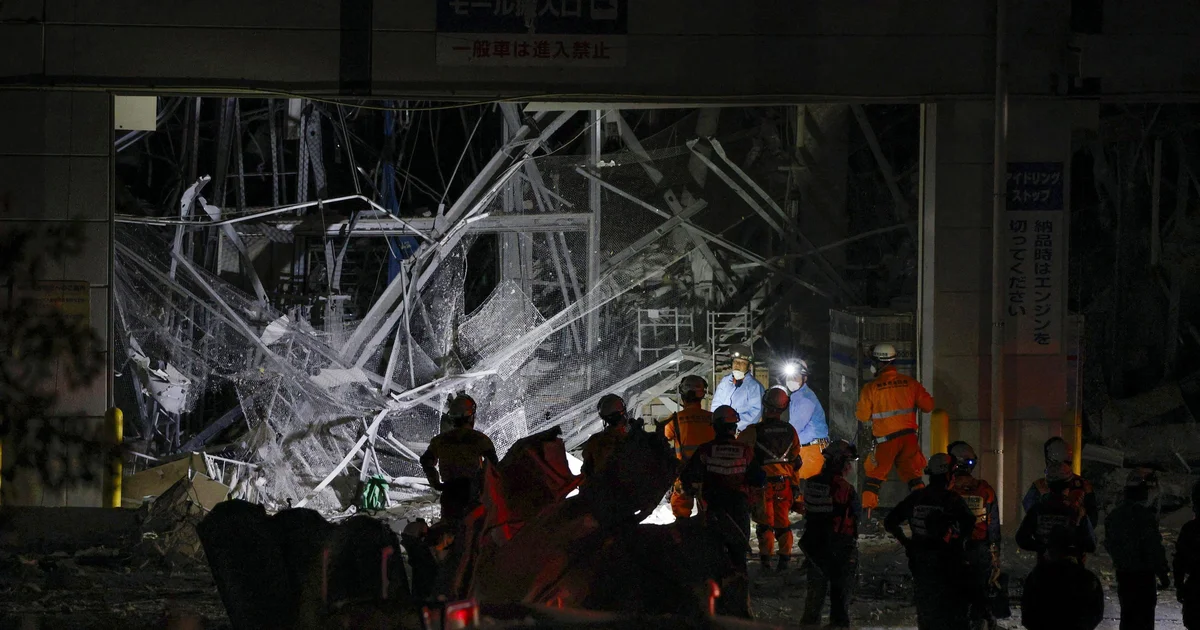
Tokyo — A major earthquake collapsed buildings and sparked fires in Japan’s southwest, Prime Minister Sanae Takaichi said Tuesday, with authorities in the hard-hit Kumamoto region saying at least nine people remained missing in a heavily damaged shopping mall.
Public broadcaster NHK said at least 50 people were taken to hospitals and local emergency services, and BREAKING NEWS’ Japanese partner network TBS cited the regional Kumamoto government as saying five people had been rescued from the Aeon Mall in Kashima city but nine remained unaccounted for. Police in the city earlier told TBS that there were “a lot of deaths” in the mall, but that it would “take time to confirm the exact number.”
Video aired by NHK showed several blazes, damaged bridges, a derailed cargo train and cracked roads after the temblor struck at the far southern end of Japan’s main Kyushu island. NHK said at least 12 houses had collapsed, and the national Kyodo news agency said one person was killed in a damaged home.
The quake at 4:27 p.m. (2:27 a.m. Eastern) had a magnitude of 7.1, according to the Japan Meteorological Agency, but reached the highest possible level of seven on Japan’s Shindo scale of shaking. The U.S. Geological Survey measured the quake — one of hundreds that strike Japan every year — at 6.8. The vast majority cause little damage.
There were 11 people trapped inside the Nippon Paper Industries Yatsushiro Plant in Kumamoto Prefecture after a chimney collapsed during the quake, though two had been rescued, TBS reported.
“We are still assessing the extent of injuries and property damage, but I have been informed that there have already been several injuries,” Takaichi said. “Power outages and fires are happening in some areas, and roads and bridges have been damaged and buildings collapsed.”
Kyodo/REUTERS 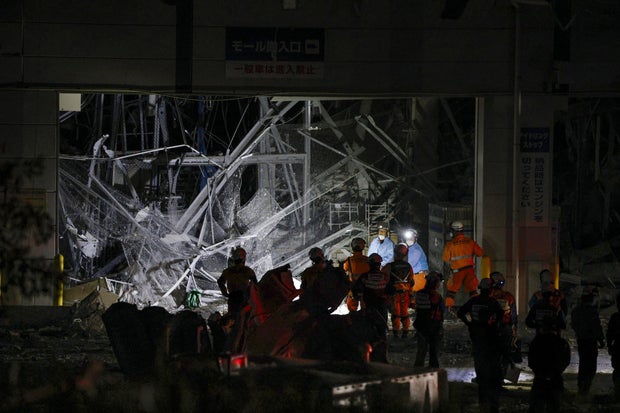
In “Kashima town, a shopping complex’s second floor collapsed, leaving many people trapped inside,” the fire department said in a statement.
Police said earlier they had received reports of what sounded like an explosion at the Aeon Mall, but they did not publicly confirm the TBS report of multiple fatalities at the damaged retail outlet in Kashima.
The Japan Meteorological Agency initially issued an alert for a possible tsunami of up to three feet, but withdrew the warning after a couple hours.
Reuters/Nippon TV 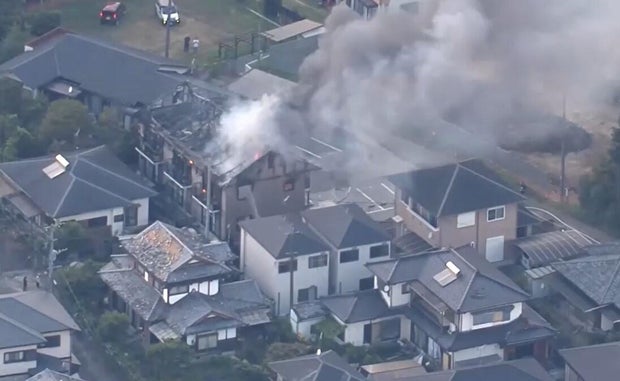
No immediate abnormalities were recorded at nuclear power plants, the Nuclear Regulation Authority said.
About 45,000 households and facilities have no power in the Kumamoto region, according to local utility Kyushu Electric Power.
The firm added that three nuclear reactors operating in the region at the time were functioning normally.
JIJI Press/AFP/Getty 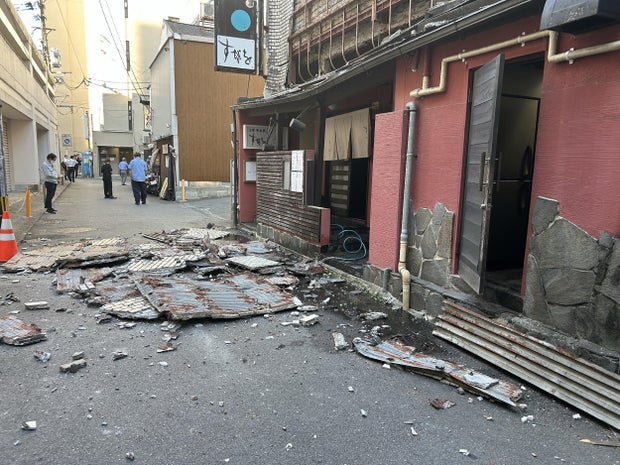
A local NHK staffer wearing a helmet reported live on air that the shaking was continuing around half an hour after the quake, with the newsroom rocking so violently that it was difficult to remain standing.
“Shaking is continuing as I speak. Including myself, there may be some people who feel their hearts racing,” the staffer said.
“When the quake struck, the shaking was so big that I could not stand up. Please be aware of possibility that shaking might continue after this.”
Mehmet Yaren Bozgun/Anadolu/Getty 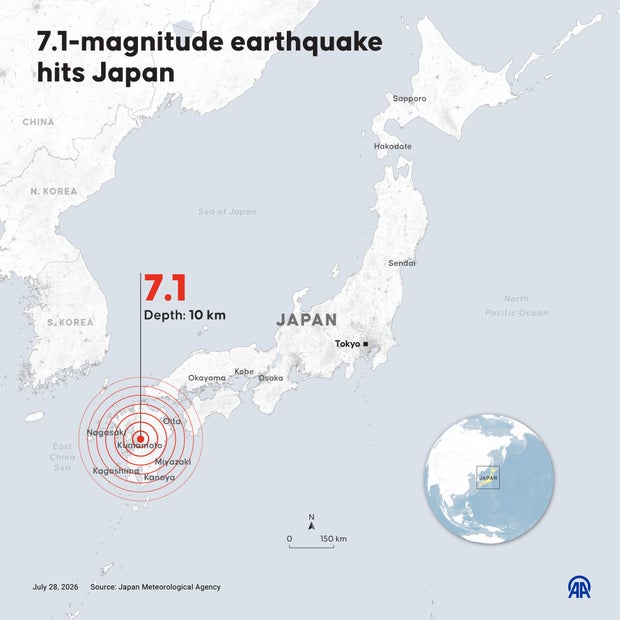
Kumamoto was hit by two devastating earthquakes in 2016 — one of magnitude 6.5, followed two days later by one of magnitude 7.3 — which killed 273 people and injured more than 2,800.
A quake with a magnitude of 7.2 hit northern Japan on June 25 but caused no deaths or major damage.
Japan is one of the world’s most seismically active countries, sitting on top of four major tectonic plates along the western edge of the Pacific “Ring of Fire.”
The archipelago, home to around 125 million people, typically experiences hundreds of jolts every year and accounts for about 18% of the world’s earthquakes. The vast majority are mild, although the damage they cause varies according to their location and the depth below the Earth’s surface at which they strike.
BREAKING NEWS 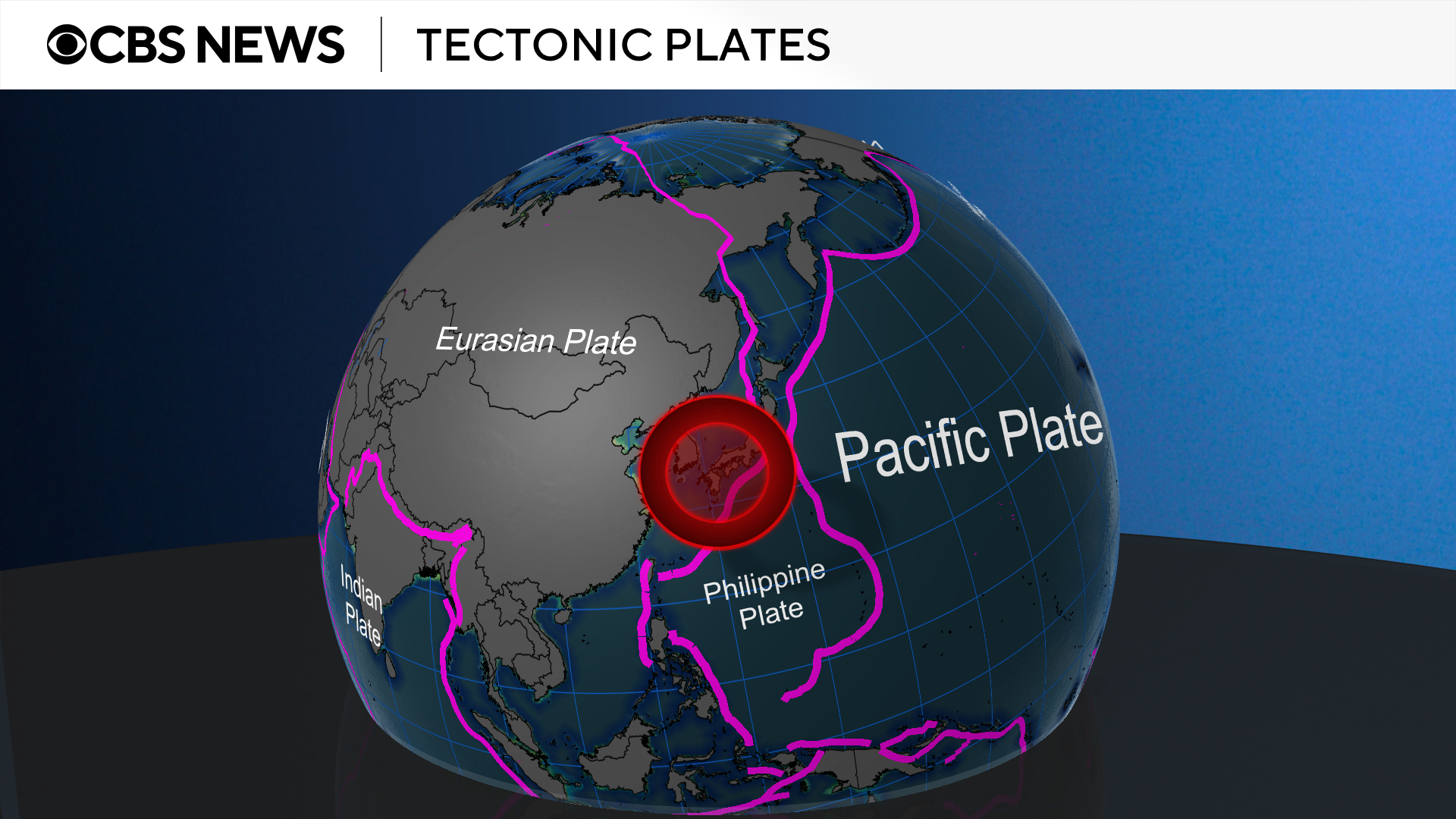
Japan is haunted by the memory of a massive 9.0-magnitude undersea quake in 2011, which triggered a tsunami that killed or left missing around 18,500 people and wrecked the Fukushima nuclear plant.
A tremor measuring 7.7 hit the country’s north on April 20 this year, injuring at least 10 people and shaking large buildings in Tokyo.
That prompted authorities to issue a special advisory warning of an increased risk of earthquakes of magnitude 8.0 or stronger.
The advisory was lifted after a week.