

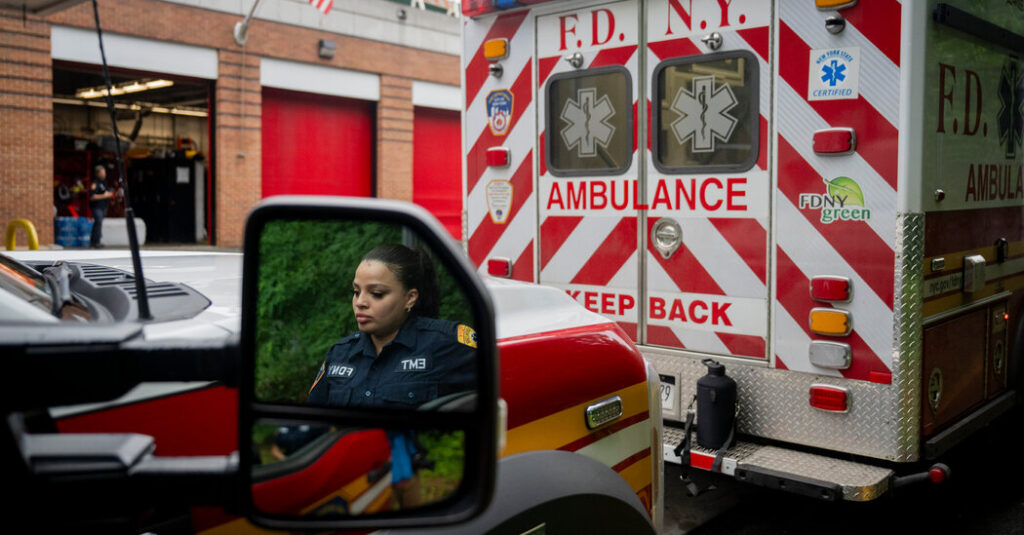
Taysha Soto has scaled a wall to reach a man who was struggling to breathe, then watched in horror as his heart stopped. She has helped deliver a baby whose mother couldn’t make it to the hospital in time. She has learned to recognize the specific stench of a decomposing body.
Being an emergency medical technician in New York City is hard, and that’s why she likes it. She wanted to help people who are scared and suffering, but now, two years in, she’s planning to leave the city’s corps of emergency workers — not because she can’t take the intensity of the job, she says, but because she can’t afford to live on what the city pays her.
Ms. Soto, 29, said she earns a little more than $56,000 a year with “tons and tons” overtime and takes home about $1,500 every two weeks — hardly enough to support her family of three. And the more she works, the more she owes the babysitter who looks after her two toddlers — sometimes from 6:30 in the morning until 11 at night. She occasionally cleans homes for extra money on her days off.
“It shouldn’t be like that,” said Ms. Soto, who lives in affordable housing on Staten Island for $932 a month. “You shouldn’t have to be overworking yourself at one job — and then, even doing overtime, you have to go and still do something else to make money.”
Her poor pay, burnout and impending departure are common among New York City’s 3,500 emergency medical technicians and paramedics. Their plight represents a problem for their boss, Mayor Zohran Mamdani, one of the most conspicuously pro-worker leaders in the city’s recent history, who has pledged to make New York more affordable while delivering the best public services in the country.
Mr. Mamdani has joined nurses on a picket line and rallied with doormen threatening to strike. Now, the unions representing emergency medical service workers want to see Mr. Mamdani take action for their members, whose wages he actually helps set.
The city is currently negotiating a new contract with the unions representing E.M.S. workers, said Kenneth Londono, a spokesman for the Mayor’s Office of Labor Relations. They have not had a contract in four years, and new one most likely would include retroactive pay raises.
But in New York City, if one union gets a raise, it can cause a domino effect where other union leaders demand higher pay for their own members. The city may not be able to afford to give its hundreds of thousands of employees raises at the same time.
“I’ve heard this line from the city: ‘Well, if we give it to you, other people, other unions are going to say, what about me?’” said Vincent Variale, who represents about 600 E.M.S. captains and sergeants.
The mayor has said he will lower the price of housing and child care and groceries, but making New York affordable will also require a focus on jobs and wages that Mr. Mamdani has not yet prioritized. For those who respond to 911 calls for as little as $18 an hour, the cost of living in the city has long felt urgent.
“He didn’t create this problem,” said Michael Greco, president of the union representing the rank-and-file emergency workers. “But he’s the one who’s left with it.”
Mr. Mamdani’s approach to dealing with labor unions — which have bedeviled generations of Democratic mayors — will help determine whether he can fulfill his promise of making New York more livable for the middle class.
That’s true both for the people who work for the city, and for the much larger group of New Yorkers whose tax dollars pay their salaries.
“The Mamdani administration values the vital, lifesaving work that our E.M.S. members perform for New Yorkers every single day,” Mr. Londono said in a statement. “We look forward to continuing our productive discussions to reach a fair and sustainable outcome that supports these dedicated first responders while remaining fair to City taxpayers.”
‘Make the Job Attractive to Enough People’
If Ms. Soto leaves the corps, she’ll be one of roughly 900 E.M.S. workers that the unions expect will leave the force this year — many of them seeking higher pay and better benefits as firefighters. Ms. Soto’s plan is to join the Police Department, where she will earn more during her training than she makes now as a full-time street medic.
Although E.M.T.s and paramedics are part of the Fire Department, firefighters’ salaries start around $54,000 a year, while many E.M.T.s top out at about $60,000. Some E.M.S. workers have ended up in homeless shelters or sleeping in their cars.
The tendency of workers to leave for higher-paying jobs has contributed to turnover: About half of the 3,500 E.M.T.s and paramedics have less than four years on the job, union officials said. And the city’s struggle to keep them has prompted questions about what kind of response New Yorkers can expect when they call 911.
Tyler Weaver knows from his own experience as a volunteer E.M.T. on Long Island that a failing heart typically needs to be shocked within six or seven minutes to give it a chance of surviving.
It’s something he’s thought about a lot since his stepson, Nick Costello, died after going into cardiac arrest in 2023. Mr. Costello, who was 24, was returning from a night out with friends in the Bronx when smoke from a nearby fire began to irritate his lungs. It triggered his asthma, and soon he said he felt like there was water in his chest. Then he stopped breathing and collapsed. After his friends called 911, it took paramedics around 20 minutes to arrive, Mr. Weaver said.
“I cannot tell you Nick would have survived if the ambulance had gotten there in two, five, 10 minutes. I don’t know that. Only God knows” what would have happened, he said. “But what I do know is that they didn’t give him his full chance.”
The average ambulance response time for life-threatening emergencies was 11 minutes and 21 seconds in 2025, up from eight minutes and 58 seconds in 2018. This year, that figure is on track to exceed 12 minutes.
There are several possible reasons: There have been fewer ambulances on the street, while the number of serious medical emergencies has ticked up over time, according to city statistics.
And then there’s staffing, which the city has also cited as part of the problem.
Better pay for E.M.S. workers would not necessarily mean that ambulances get to critically ill patients faster. But Mr. Weaver thinks keeping more emergency workers could make a difference.
“They need to pay enough money to make the job attractive to enough people,” he said. “Pay enough money to have enough people to staff the ambulances, so that the ambulances can get there in time to save people like my son.”
‘We Know This System Is Ripe for Change’
An ambulance was not the first emergency vehicle that showed up to try to revive Mr. Costello. A fire truck had arrived about three minutes earlier, according to records. But it didn’t have the same tools the paramedics used to restart Mr. Costello’s heart.
That wasn’t unusual. A fire engine is often the first vehicle on the scene of a medical emergency, even though fire trucks lack the same medical equipment and trained staff that ambulances have. That’s because there are many more firefighters than E.M.S. workers, and many more fire trucks than ambulances — even though the vast majority of 911 calls are for medical emergencies, not fires.
Those are some of the head-scratching facts assembled by the Citizens Budget Commission, a budget watchdog group, about what happens when a New Yorker calls 911.
“We know this system is ripe for change,” said Andrew Rein, who runs that organization.
Mr. Rein said he believes the city has a rare opportunity to better respond to 911 calls — while also keeping more E.M.S. workers. Shifting Fire Department money over time from the fire side of the department’s budget to the E.M.S. side could be used to help boost E.M.S. workers’ pay, he said.
City officials seem to be moving in the opposite direction. The City Council is pushing a bill that would add an additional firefighter to some engine companies — for $91 million a year — which firefighters say would help speed up their own response times. Some E.M.S. workers have criticized the move as serving the interests of the firefighters’ unions, which are much larger than the E.M.S. unions, rather than New Yorkers who need an improved 911 system.
There is no clear opponent to raising the pay of E.M.S. workers. The biggest obstacle appears to be finding a way to give those city workers raises without triggering a longer, more financially and politically complex negotiation with other public-sector unions. There are ways for the city to work outside the collective bargaining process, but it will require some creativity.
If the city does end up finding a way to increase pay for its emergency workers, it will most likely be too late to keep Ms. Soto.
She decided to look for a new job after she went into credit card debt trying to keep up with bills, then took out a pension loan to pay her card. The stress of calculating how many overtime hours she has to work to make rent — while also finding time to spend time with her children — became too overwhelming.
“I’m trying to do the right things, and everything I’m doing is just pushing me back,” Ms. Soto said. “I feel like I’m not living.”