
Ottawa’s hasty steps hurt diplomats’ credibility, says ex-envoy Sanjay Kumar Verma on row over Nijjar killing

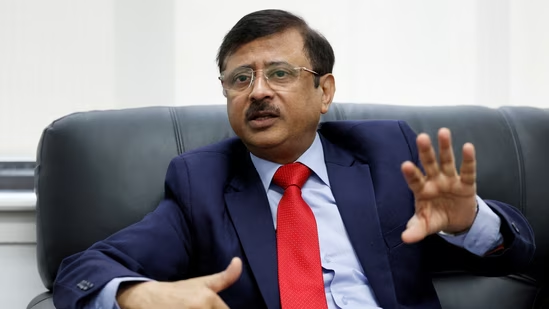
India’s former high commissioner to Canada Sanjay Kumar Verma, on Wednesday called on Ottawa to introspect over its handling of the investigation into the 2023 killing of Hardeep Singh Nijjar, a Sikh separatist leader, underlining that Canada levelled grave accusations against New Delhi at the time without a solid evidentiary foundation.
Verma’s statement comes a day after the US Department of Justice and the Royal Canadian Mounted Police (RCMP) linked gangster Lawrence Bishnoi and his deputy Goldy Brar to Nijjar’s killing.
“There is no evidence to suggest through this organised crime investigation and the charges and indictment laid forward, that Indian officials were charged or involved in this,” RCMP deputy commissioner Lisa Moreland told CBC News on Tuesday.
The assertion was in sharp contrast to the position adopted by then Canadian Prime Minister Justin Trudeau on September 18, 2023 when he first claimed in the House of Commons that there were “credible allegations” of a potential link between Indian agents and the killing three months earlier in Surrey, British Columbia.
Prior to Trudeau’s statement, Canadian investigators had been treating the case as a fallout of gang rivalries.
India immediately dismissed the assertions as “absurd” and politically motivated. But Trudeau did not back down.
India finally withdrew Sanjay Kumar Verma as high commissioner, along with five other officials, in October 2024, after Canada asked New Delhi to waive their diplomatic immunity so they could be questioned in relation to violent criminal activity in the country.
In retaliation, India also expelled six Canadian diplomats, including its then-acting high commissioner Stewart Wheeler.
In a statement sent to HT, Verma recalled that the case had “triggered an unprecedented rupture” in a relationship that had been patiently built over decades.
“At the highest political level in Canada, allegations of Indian state involvement were made publicly before any evidentiary basis for so grave a charge had been established,” he added.
Verma also alluded to the impact that the allegations had on the diplomats concerned.
“Careers built over decades and professional reputations painstakingly earned were placed under a cloud. For career diplomats, credibility is not merely a professional asset—it is the foundation of their effectiveness,” He said, adding that not just the individuals but their families also bore the “emotional burden”
“As the investigation continues to evolve, it is reasonable to ask whether diplomatic measures of such consequence should have preceded the establishment of a publicly demonstrable evidentiary foundation,” he said. He pointed out that while diplomatic engagement can be restored, doing the same for reputations was far more difficult.
Verma said it was encouraging that the two countries were engaging constructively again. He hoped the “enduring lesson” from this difficult chapter would be that “relations between democratic partners must be guided by restraint, due process and evidence.”
He added, “Allegations may shape headlines. Only facts should shape history.”