

At least one Saudi oil tanker has been attacked in the Red Sea, widening the risks to energy supplies already disrupted by a near-halt to shipping in the Strait of Hormuz.
The price of Brent Crude, the international benchmark, rose 5 percent to over $98 a barrel as the violence raised fears of greater supply disruptions.
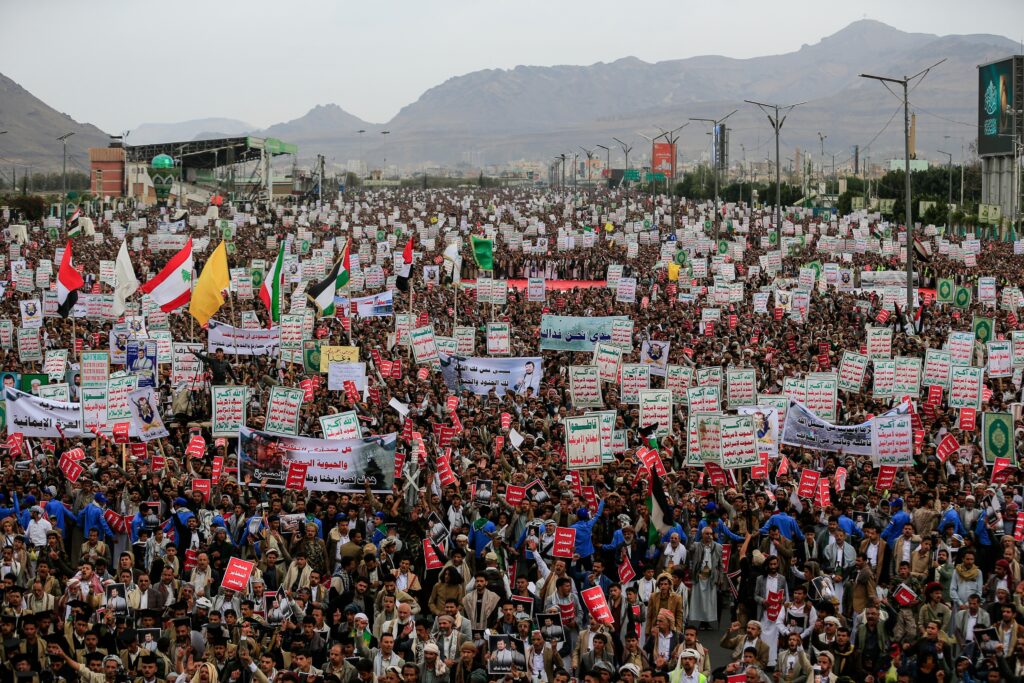
Iran’s Houthi allies in Yemen said the group had attacked two vessels to enforce the maritime blockade it announced on Monday against Saudi Arabia.
Secretary of State Marco Rubio told reporters in the Philippines on Thursday that the Houthis were making a mistake by menacing shipping in the Red Sea and joining the fighting in the Middle East on behalf of Iran. “I hope that they’ll stop,” Rubio said. “They got suckered into this by the Iranians.”
The Houthis had largely stayed out of the U.S.-Israel war on Iran during the opening months of the conflict, and Rubio said they had been “smart” to do so. Rubio said that one of the ships struck had actually been “flagged Chinese,” which risked angering another major world power.
Rubio said he hoped the Houthis will de-escalate the situation, which threatens to further spike energy prices amid an already severe energy crunch due to the closure of the Strait of Hormuz.
The apparent attacks off the coast of Saudi Arabia come as the U.S. and Iran battle for control over the Strait of Hormuz. They imperil a second critical shipping route through the Bab el-Mandeb Strait, a narrow channel connecting the Red Sea with the Gulf of Aden, which carries around 7 percent of global oil supply.
The scope of the Houthi blockade remains unclear. Even before Wednesday’s attacks, several vessels had already reversed course following the announcement of the Houthi blockade, according to ship-tracking data and analysis.
A statement issued by the Houthis identified the tankers as the Encelia and the Layla, which are listed as Saudi vessels by Kpler, a maritime monitoring agency.
The Saudi news agency and a British monitoring group reported Thursday that one vessel had been struck, but did not confirm who carried out the attack. A second attack has not been corroborated by maritime monitoring agencies.
The targeting of the Encelia resulted in a fire at the bow of the ship, but all crew members remained safe, Saudi Arabia’s press agency reported, citing the country’s Transport General Authority.
The U.K. Maritime Trade Operations — a monitoring agency that is part of Britain’s royal navy — reported an attack on a tanker off the coast of Al Shuqaiq, Saudi Arabia, with a ship struck by an “unknown projectile” causing a fire on board. It did not disclose the identity of the vessel.
The Encelia departed the Saudi Arabia’s Yanbu port on Monday and sailed south through the Red Sea, according to ship tracking data. After a short stop near Jeddah on Tuesday, the vessel continued southward toward the Bab el-Mandeb Strait.
At around 10 p.m. local time on Wednesday, around 500 miles into its voyage, the vessel appeared to make a sudden alteration of its course near Saudi Arabia’s Farasan islands. Just over an hour later, ship tracking data shows the vessel’s navigational status changed to “not under command,” signaling an emergency or breakdown. The vessel then appeared to come to a halt around 100 miles from Yemen’s shores.
Maritime intelligence agency Lloyd’s List said in a research note Thursday the attacks on Layla are yet to be corroborated, but a “double blockade” on the Strait of Hormuz and the Red Sea could see Asian oil importers could suffer as they are highly dependent on Middle East crude oil and derivative products.
The Strait of Hormuz saw around 20 percent of oil and gas supplies flow through before the U.S. and Israel launched joint strikes against Iran in February. It has been largely shut by Iranian attacks on commercial ships and mines in the five-month war. Overnight, the two sides continued to exchange strikes for the 12th day following the collapse of a preliminary peace agreement signed in June.
The economic insecurity brought on by the Iran war has dominated this year’s annual gathering of Southeast Asian nations known as ASEAN. At the start of the gathering, foreign ministers representing the bloc issued a statement saying they were “deeply concerned” about the impact of blockades of key maritime trade routes in the Middle East.
Southeast Asian nations have been especially vulnerable to energy shortages caused by the Iran war. The strategic region is important to major powers including China, Russia and the United States, which all sent their top diplomats to the meeting.
Rubio expressed sympathy for the impact the war was having on Iran but accused Tehran of breaking the U.S.-Iran memorandum of understanding designed to open the strait. He said the U.S. nevertheless remain open to a diplomatic solution.