
NOG 2026: Stakeholders seek stronger collaboration in building capacity, strengthening supply chains

Oil & Gas
THE Stakeholders in the Nigerian oil and gas industry have called for stronger collaboration among operators, regulators, training institutions and service companies to ensure that the country develops the capacity and supply chains needed to deliver upcoming energy projects.
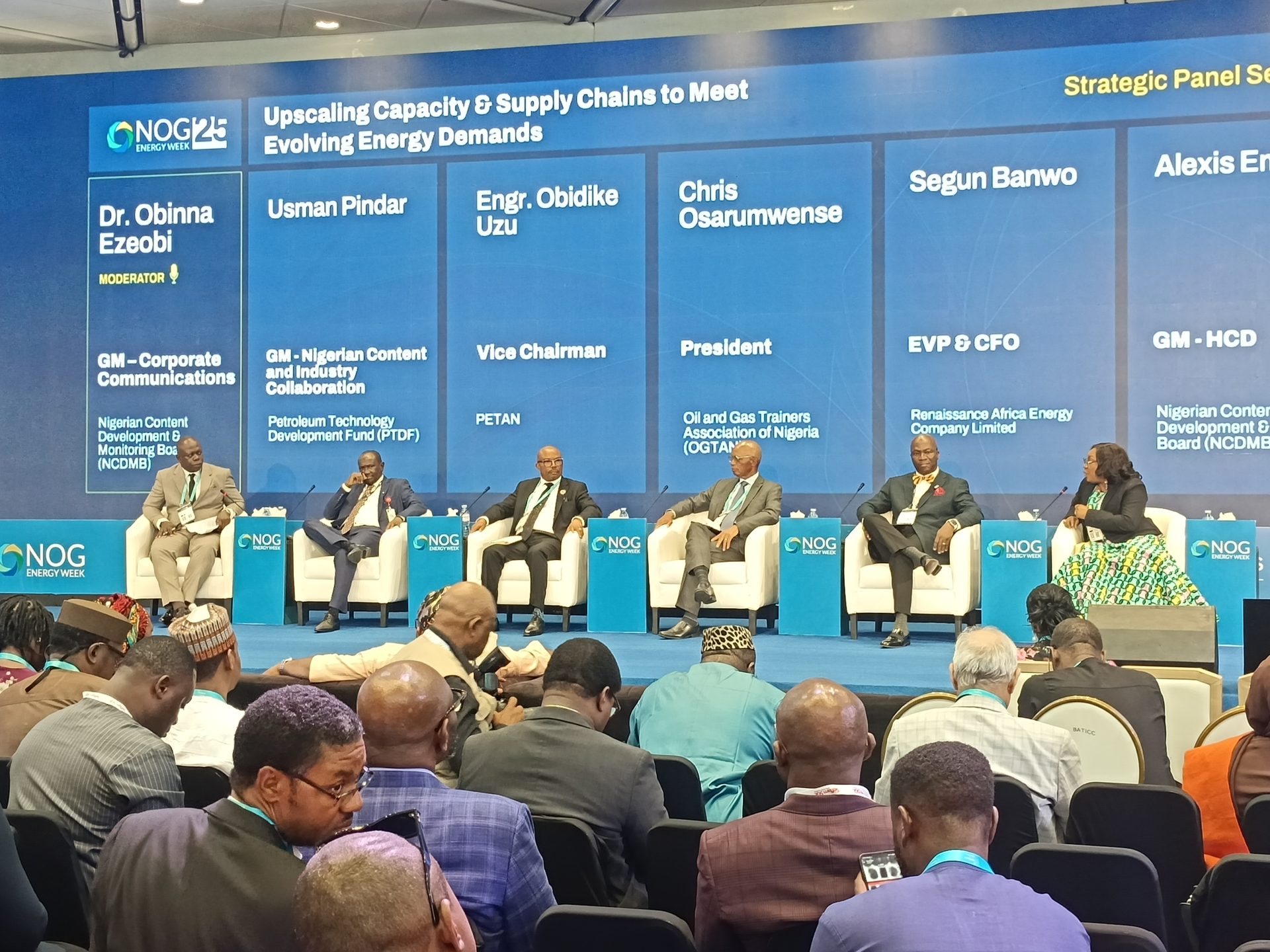
The call was made during the third strategic panel session at the 2026 Nigeria Oil and Gas, NOG Conference and Exhibition.
The session themed “Upscaling Capacity & Supply Chains to Meet Evolving Energy Demands.” was moderated by Obinna Ezeobi, General Manager, Corporate Communications, Nigerian Content Development and Monitoring Board, NCDMB, and featured Usman Pindar, General Manager, Nigerian Content and Industry Collaboration, Petroleum Technology Development Fund, PTDF, Obidike Uzu, Vice Chairman of the Petroleum Technology Association of Nigeria, PETAN; Chris Osarumwense, President of the Oil and Gas Trainers Association of Nigeria, OGTAN, Segun Banwo, Executive Vice President and Chief Financial Officer of Renaissance Africa Energy Company Limited; and Alexis Emelle, General Manager, Human Capacity Development, NCDMB.
Opening the discussion, Ezeobi noted that Nigeria accounts for nearly 70 per cent of Final Investment Decisions, FIDs, announced in Africa’s oil and gas industry, underscoring the need for indigenous companies to position themselves to execute more of the projects locally and deepen their economic impact.
Uzu said that building sustainable capacity requires investment in technology, infrastructure, skilled manpower and strong corporate systems rather than relying solely on local content policies.
He urged Nigerian service companies to embrace international partnerships that would facilitate technology transfer and competence development, citing his company’s deployment of robotics for tank cleaning and inspection, automation of business processes and artificial intelligence to improve efficiency and reduce operational risks.
He explauned that Nigerian firms are increasingly exporting technologies to other African countries, demonstrating the maturity of local capabilities.
According to him, companies must also invest deliberately in workforce development and corporate governance, including succession planning to ensure long-term sustainability.
Speaking on industry bottlenecks, Uzu stated that PETAN’s 120 member companies have created a platform for collaboration, healthy competition and knowledge sharing that has strengthened indigenous capacity.
He welcomed NCDMB’s plan to promote performance-based contract awards instead of awarding jobs primarily to the lowest bidders, arguing that the current practice often allows companies without the required competence or equipment to secure contracts, leading to project delays, cost overruns and poor execution.
He also called for greater incentives to attract global manufacturers to Nigeria and develop stronger industrial ecosystems around the oil and gas sector.
Using the automotive industry as an example, he noted that manufacturers thrive because they are supported by thousands of component suppliers, adding that similar industrial clusters are needed to support Nigeria’s energy industry.
Uzu further identified limited access to long-term financing as a major obstacle to indigenous participation, particularly in deepwater projects that require substantial capital investments.
Emelle said that the NCDMB’s Field Readiness Training Programme was developed in response to identified industry skills shortages.
He explained that the programme focuses on priority disciplines, including subsea engineering, quality assurance and quality control, drilling engineering, aviation, automation and other specialised fields identified through consultations with operators and analysis of expatriate quota requests.
According to him, the Board plans to train 10,000 Nigerians over five years, with 2,000 trainees targeted annually. Since implementation began following the programme’s launch in October 2025, about 773 Nigerians have commenced specialised training programmes across the country.
According to Emelle, the Board uses multiple tools to identify skills gaps, including the Nigerian Oil and Gas Industry Content Joint Qualification System, NOGIC JQS, expatriate quota applications, compliance monitoring and periodic industry skills gap surveys.
He explained that the NOGIC JQS serves as a national database linking Nigerian professionals with employment opportunities, while helping regulators identify shortages requiring targeted intervention.
He added that the Field Readiness Training Programme combines classroom instruction with six months of practical on-the-job training undertaken in collaboration with operators, service companies and training organisations to ensure graduates acquire industry-relevant experience.
According to him, findings from industry skills gap assessments and expatriate quota requests enable the Board to continually adjust its training programmes to meet evolving workforce requirements.
Banwo said that the industry’s biggest challenge was not simply producing trained personnel, but ensuring that training reflects future workforce requirements.
He noted that rapid advances in digitalisation, artificial intelligence and data analytics are transforming operations across the energy industry, making closer alignment between operators, regulators, educational institutions and training providers essential.
According to Banwo, many graduates possess qualifications that do not match emerging industry needs because training is often developed independently of future workforce requirements.
He said that all stakeholders should work towards a shared understanding of the industry’s future skills requirements to improve employability and ensure Nigeria has the talent needed to deliver upcoming investments.
Osarumwense disclosed that training providers are redesigning their curricula to reflect technological changes across the oil and gas industry.
He said traditional classroom teaching was increasingly being complemented by virtual reality, augmented reality, digital simulations and training in artificial intelligence, automation, blockchain and the Internet of Things.
According to him, OGTAN is encouraging its members to work more closely with operators, regulators and equipment manufacturers so that training programmes remain aligned with current and future industry requirements.
He added that professional development should be continuous throughout workers’ careers rather than ending after certification.
Representing PTDF, Pindar stated that the Fund’s mandate extends beyond scholarship awards to broader capacity development through research, institutional strengthening and project-based training.
He acknowledged that PTDF has faced challenges securing sustained collaboration with industry despite repeated efforts to engage operators and other stakeholders in designing programmes that address actual manpower needs.
Pindar appealed to companies to engage more actively with the Fund by identifying project-specific training requirements that PTDF can support.
He said scholarships remained the foundation of capacity development because specialised project training could only succeed when beneficiaries first possess sound educational qualifications.
According to him, PTDF is strengthening collaboration with NCDMB, PETAN, OGTAN and other industry stakeholders to undertake a comprehensive industry-wide skills gap assessment that will guide future training interventions.
He maintained that stronger collaboration across the industry remains the most effective way to build the workforce required to support Nigeria’s expanding oil and gas sector.
A.I
July 7, 2026
Tags: Alexis Emelle NCDMB Obidike Uzu Obinna Ezeobi OGTAN PTDF Segun Banwo Usman Pindar