

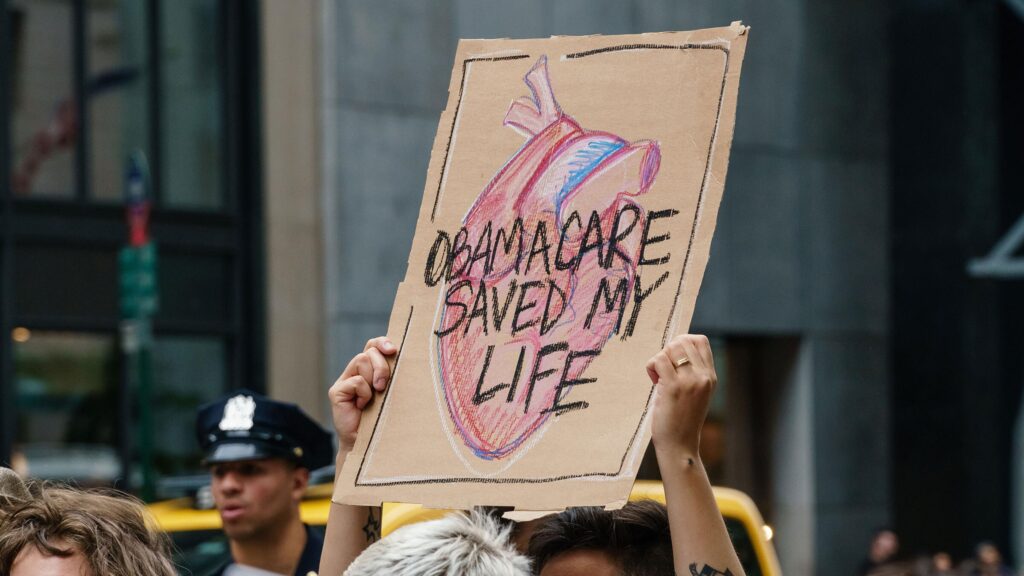
Nearly 450,000 New Yorkers are losing health coverage on July 1. They are among the millions of people expected to become uninsured over the next year because of federal changes to Medicaid funding and the expiration of subsidies that made plans on the Affordable Care Act marketplace less expensive.
The New Yorkers losing coverage were on what’s called the Essential Plan, a New York-specific, taxpayer-subsidized health care plan established in 2015 under the Affordable Care Act for people who earn too much to qualify for Medicaid but not enough to be able to pay for private health insurance. The plan had used Affordable Care Act tax credits to offer extremely low-cost health insurance to more than a million New Yorkers, but those who earn 200% to 250% of the federal poverty level will now lose their coverage. Some are expected to go on the Affordable Care Act marketplace to find new plans, but those can cost hundreds of dollars a month.
The changes are coming because of HR 1, known as the “Big Beautiful Bill” passed a year ago and signed into law on July 4, 2025. As part of HR 1, the federal government withdrew the funding that had allowed New York state to receive tax credits that paid for the health plans of certain legally present immigrants, says Bill Hammond, a senior fellow at the Empire Center, a nonprofit think tank that studies New York public policy. To help make up for that funding gap, the state of New York changed who is eligible for the Essential Plan.
“They’re low-income people, and they’ll have to find a lot of money to pay for insurance,” says Hammond. “It goes on the list of things they have to spend money on, like rent, utilities, and food.”
Other changes stemming from HR 1 are expected to limit the number of people receiving Medicaid across the country.
For instance, 41 states (including D.C.) have expanded Medicaid since 2014 under the Affordable Care Act, allowing adults with incomes up to 138% of the federal poverty level to gain coverage. But HR 1 requires that as of Jan. 1, 2027, adults enrolled in Medicaid in states that have expanded the program must meet an 80 hours per monthwork requirement. The law also requires that states must verify program recipients’ eligibility every six months instead of every year.
The Congressional Budget Office, a federal agency, has estimated that the Medicaid program changes would result in 7.8 million more people in the U.S. without health insurance by 2034. The Urban Institute, a nonprofit think tank, projected that the number would be higher, sooner: up to 10.1 million fewer people enrolled in Medicaid by 2028.
Congress also allowed federal subsidies for Affordable Care Act plans to expire this year, meaning that households earning more than 400% of the federal poverty level no longer qualify for premium subsidies. These Americans saw a huge increase in premiums starting in 2026, and many families decided to drop coverage rather than pay hundreds or thousands of dollars a month for health insurance. The federal government released data on June 26, 2026 showing that 19.2 million people enrolled in ACA Exchange plans in 2026—down about three million from the 22.1 million people who enrolled in 2025.
The impacts of people losing health coverage are expected to extend beyond families, to hospitals and health centers. For instance, a federal law requires that hospitals that participate in Medicare screen and stabilize anyone arriving in their emergency rooms, regardless of their ability to pay. When patients can’t pay, hospitals absorb the costs and pass them onto people with insurance by increasing prices, studies show.
“I would not be surprised if just the overarching cost of health care goes up, because if you have massive amounts of uncompensated care, they have to make up the dollar somewhere,” says says Amanda Pears Kelly, CEO of Advocates for Community Health, a national membership organization for federally qualified health centers.
Federally qualified health centers—essentially primary care hubs that treat both insured and uninsured patients—and public hospitals are worried that their uninsured patient numbers will rise to unsustainable levels, increasing their costs at a time when their budgets are already stretched thin.
“It’s very likely that we are going to see a pretty significant influx in the number of uninsured patients,” Pears Kelly says. “There are no additional dollars to help with that.”
The National Association of Community Health Centers estimates that HR 1 will lead to 1,800 community health center closures across the country and will cost community health centers around $7 billion a year in uncompensated care.
Federally qualified health centers are already struggling because many of their patients are on Medicaid, and Medicaid often compensates them at a lower rate than it costs to provide care, Pears Kelly says. Now, as more people get kicked off of Medicaid, these centers won’t even get that compensation.
“There are zero resources coming in to support health centers to make sure that people can continue to access care,” she says.