

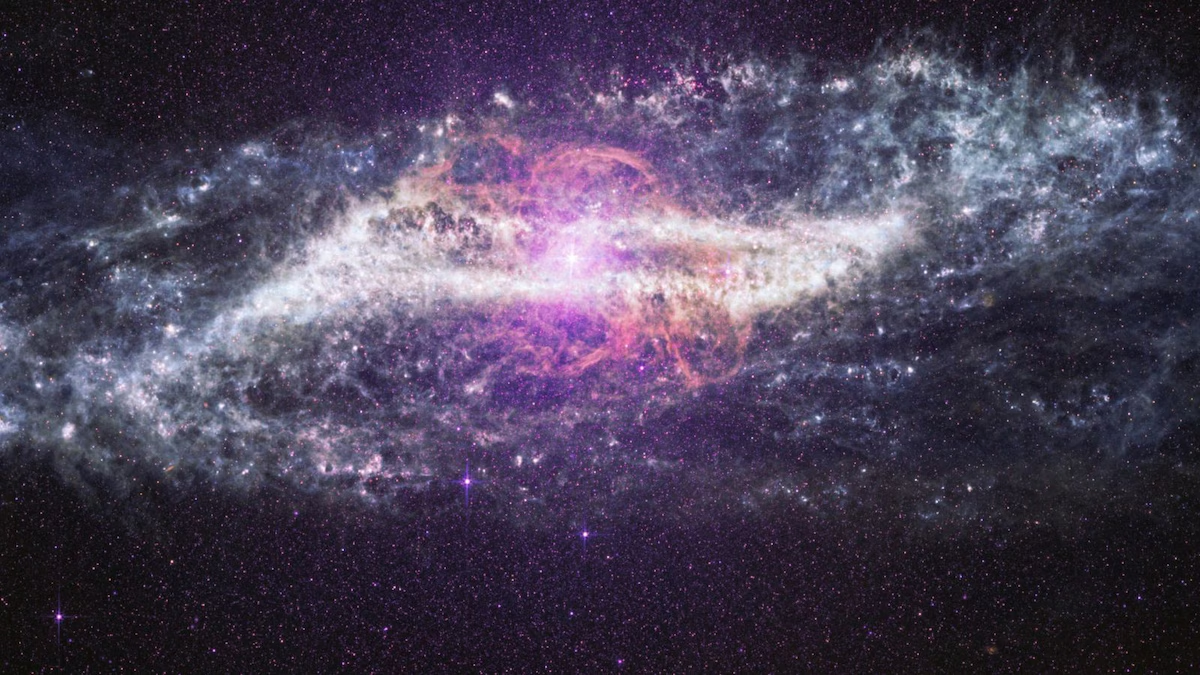
Scientists say this star system is only 20 million years old, which makes it much younger than our own Solar System and an ideal place to study how planets are formed.
Until now, astronomers had already confirmed two giant planets orbiting this star. With the discovery of Beta Pictoris d, the system has become only the second known planetary system where scientists have directly found and observed three planets.
What makes this discovery even more special is the way it was made. Instead of finding the planet by its light, scientists discovered it by studying the chemicals in its atmosphere. They believe this new method can help them find many more hidden planets around distant stars in the future.
Aidan Gibbs, a postdoctoral researcher at the University of California, San Diego, stated, “This discovery adds another piece to an already fascinating planetary system. Beta Pictoris has long served as a laboratory for understanding how planetary systems form and evolve, and now we have another planet helping us tell that story.”
Also Read: Covid-19: 12 infections, 4 deaths in Andhra between Jun 26-Jul 16
According to NASA, scientists were not trying to find a new planet during this study. Their main goal was to use James Webb’s NIRSpec instrument to examine the atmosphere of Beta Pictoris b. While studying the data, they unexpectedly noticed another planet, later named Beta Pictoris d.
“We weren’t looking for a new planet. We were trying to understand one we already knew existed. Then, this telltale signal appeared in the data where we didn’t expect it,” Aidan Gibbs added.
The team carefully studied the object’s speed, location and movement and found that it was orbiting Beta Pictoris. This showed that it was not a distant background star or brown dwarf.
At first, scientists were cautious because bright spots in space images do not always mean a new planet has been found. Sometimes they are caused by the telescope or by material in the star’s debris.
To make sure, the team analysed both the image and the light coming from the object at the same time. This helped them confirm that the bright object was indeed a new planet, Beta Pictoris d.
(Edited by : Juviraj Anchil)