

After he lost the 2020 election, President Trump and his allies promoted a series of conspiracy theories about the integrity of the vote, claiming that the election was stolen from him through widespread voter fraud.
They alleged that China hacked voting machines through thermostats. They floated the notion that Italian satellites were directed to flip votes. They accused election officials of smuggling in votes for Joseph R. Biden Jr. in suitcases.
Each of these fantastical claims was debunked.
In fact, there were dozens of investigations, audits, recounts and court proceedings at the local, state and federal levels that examined the 2020 election, which experts said may have been the most scrutinized election in U.S. history. None uncovered the extensive voter fraud that Mr. Trump alleged had tilted the outcome of the election.
The Department of Justice and Mr. Trump’s own attorney general, William P. Barr, found the claims lacking. Cybersecurity agencies declared the 2020 election the most secure in history. States undertook audits and hand recounts, with none finding what Mr. Trump was alleging.
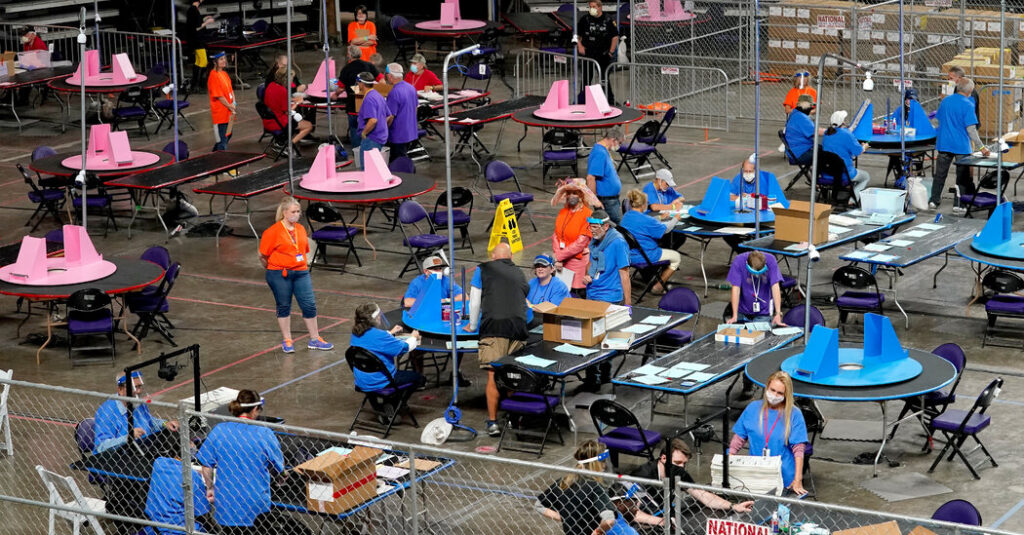
A review in Arizona, for instance, found even more votes for Mr. Biden and fewer for Mr. Trump than the original count.
Georgia conducted a full hand recount, a machine recount, signature reviews and an investigation by the secretary of state. At every turn, officials found, Mr. Trump’s claims of voter fraud were exaggerated or based on faulty data.
In one episode, Mr. Trump tried to pressure Brad Raffensperger, the Republican secretary of state in Georgia, to find enough votes to allow him to win the election. Among Mr. Trump’s claims: that 5,000 dead people voted. Mr. Raffensperger said the number was closer to two, and he pushed back against the president’s assertions.
“Well, Mr. President, the challenge that you have is the data you have is wrong,” he told Mr. Trump, according to a tape of their call.
Christopher Krebs, who served as the first director of the Cybersecurity and Infrastructure Security Agency under Mr. Trump, faced the president’s wrath because he refused to go along with his false claims.
“One scenario that required our attention was the possibility — even if unlikely — of a direct hack of voting machines,” Mr. Krebs testified before the Senate in 2020. “To be clear, based on my experience and understanding, no adversary has yet developed the ability to manipulate a single vote cast in a U.S. election. Furthermore, even if such a hack were conducted, it would be incredibly difficult to carry out such an operation on a scale that could change the outcome of a national election.”