

A man stumbled down a flight of steps in Bologna. He lay on the ground and repeatedly called for help, according to witnesses and video. After arriving, officers spoke to him and later accompanied him down an alley, where, after an apparent scuffle with another civilian, they pinned him to the ground.
Within an hour, the man, Abderrahim Fakir, 42, a Moroccan who had lived most of his life in Italy, was dead, for reasons that still remain unexplained.
Prosecutors are investigating the conduct of the police officers and nearby emergency workers from the Red Cross, which said it was cooperating with the investigation. Both police officers were acting according to protocol, according to their lawyer, who described their background as “simply Italian.”
The death of Mr. Fakir earlier last week is reverberating across the country he had called home since childhood. Some Italians have presented Mr. Fakir, the owner of a logistics and construction business, as the victim of a system stacked against immigrants. Others have seized on his drug-dealing convictions from the 2000s, as well as probation violations.
More broadly, the discussion has evolved into a wider standoff over the police treatment and role of foreigners in Italy, a country with high immigration rates that is dependent on migrant labor but whose government has moved to expel asylum-seekers and undocumented workers. Italians of opposing political factions have seized on Mr. Fakir’s death — and the unrest that followed it — to duel over immigration and racism, police brutality and crowd violence.
“While I watched the video” of Mr. Fakir’s arrest, “the debate had already shifted elsewhere,” wrote Paolo Giordano, a novelist and commentator, in a column in Corriere della Sera, a centrist daily newspaper. “The incident itself had already been shattered, scattered into countless tangential discussions,” he added.
Mr. Fakir arrived in Bologna from Morocco with his family around 1990, at age 6, and attended Italian schools, according to his immigration lawyer, Barbara Spinelli. He received permission to stay in the country as a child but was never granted citizenship and was jailed for seven months after a string of drug offenses as a teenager, before turning to the construction industry.
Because of his convictions, he struggled to renew his residence permit, but in 2010, when he married an Italian woman, he obtained legal residence again. After the couple separated two years later, Mr. Fakir’s permit eventually expired, according to his former defense lawyer, Donata Malmusi. He later married a woman in Morocco, two friends said.
In recent months, friends said, he had been suffering from panic attacks. He was stressed, Ms. Spinelli said, about his application to renew the permit and was struggling to sustain his business. He had sought psychiatric help at a hospital in June, according to medical records reviewed by The Times.
On Sunday, July 19, Mr. Fakir, who lived elsewhere in the city, appeared without explanation in Pilastro, seemingly in distress.
Pilastro, a quiet, working-class immigrant neighborhood in Bologna’s northeastern fringe, is filled with rows of dormitory-like concrete housing blocks that date from the 1960s. It was outside one such building that Mr. Fakir died.
‘He Was Saying, “Help me”’
Two residents interviewed by The Times spotted Mr. Fakir moaning and yelling for help as he went down a flight of stairs into an alleyway lined with garages and overlooked by roughly 40 apartments. Parveen Akhtar, 72, said she saw Mr. Fakir sitting on the steps and then slowly descending and lying on the ground.
“He was saying, ‘Help me, help me, someone help me,’” she said.
Then, Ms. Akhtar said, she saw — and heard — a passerby on a motorcycle stop and make a call to the police.
What happened next is unclear.
The Bologna police department said its officers responded to a call reporting “a person in a violent rage.”
Ms. Akhtar said: “I know objectively that that’s not what I saw.” Mr. Fakir, she added, “wasn’t acting in a violent way.”
A video, one of several verified by The New York Times by confirming that its surroundings matched publicly available images of the location, shows Mr. Fakir lying alone at the bottom of the stairs on his back, with cicadas chirping in the background. He is seen calling for help, asking for someone to “kill me” and grasping his head.
Some time afterward, two police officers are seen standing over him, as one of them tells Mr. Fakir to keep calm, according to videos shared by Fabio Anselmo, a lawyer retained by Mr. Fakir’s family.
Later, though it is unclear why, the officers and Mr. Fakir move several yards down the alley, according to videos.
Gabriele Bordoni, a lawyer representing the two police officers, said Mr. Fakir scuffled with two civilians before the police physically restrained him. Mr. Bordoni shared a four-second video captured by an officer’s body-worn camera, that showed a second officer pulling Mr. Fakir away from a man in a white T-shirt and shoving Mr. Fakir to the ground.
The video does not show Mr. Fakir attacking anyone or what led to that moment. Mr. Bordoni said the police officers had complied with new Italian guidelines on how to restrain “noncooperative individuals.” They advise trying to calm the person and limiting the length of any restraint on the ground.
Other video shows one officer squatting over Mr. Fakir’s back and pressing his head face down onto the street, while another officer, straddling Mr. Fakir’s lower back, tries to restrain Mr. Fakir’s hands. A man in civilian clothing holds Mr. Fakir’s feet.
For several minutes, Mr. Fakir squirms and yells for help before going quiet, according to the video.
After Mr. Fakir stops moving, the video shows, the police officers bind his legs together while one of them sits on his lower back. Throughout the episode, two medical responders in red uniforms watch from the side, along with four men in civilian clothes. Later, two other medical responders enter the frame to help turn Mr. Fakir’s body on its side while another emergency worker appears to check the pulse in his neck.
Mr. Fakir was pronounced dead once a doctor and nurse arrived at the alley, according to the Bologna health authority.
Lubina Parveen, 36, whose apartment overlooks the alley where Mr. Fakir died, said she witnessed medics lifting a sheet covering his body.
Half of his face appeared bloodied, she said.
‘The Pain We Are Feeling is Huge’
The death has led to a national debate about the actions of the police and the way that immigrants are treated in Italy.
Matteo Salvini, leader of a far-right party in the governing coalition, said he did not want to pre-empt any investigations but that, in his view, the officers who restrained Mr. Fakir “acted in accordance with protocol” and should be “protected and understood.”
Friends of Mr. Fakir said his death was an extreme example of the kind of treatment they have grown to fear from Italian police officers. Mohammed Sorour, 41, a family friend since childhood, recalled an incident where, he said, officers tied his hands to a hook in a police cell after stopping him to see his papers.
A group of legal experts appointed by the United Nations concluded after a research mission to Italy in 2024 that racial profiling “appears to continue to be practiced in a systemic manner,” though it acknowledged that a lack of data made it “difficult to assess the full extent of the problem.” The Italian government has rejected such accusations.
Speaking at a community gathering last week in Bologna, Karim Bekkal, 38, said some politicians spread harmful narratives about immigrants and their children, who are not automatically given citizenship even if born in Italy. “Someone born and raised here, how does he feel hearing that even the children, the second generation of immigrants, should be sent away if they misbehave?” he asked. “How does he feel if every day he hears about ‘Moroccans, thugs, criminals, delinquents?’”
Those insults were a reference to language used by Mr. Salvini to describe foreign-born residents of Italy. Mr. Salvini and Prime Minister Giorgia Meloni were elected after campaigns promising to block irregular migration to Italy, a major transit point for migrants arriving by sea from Africa.
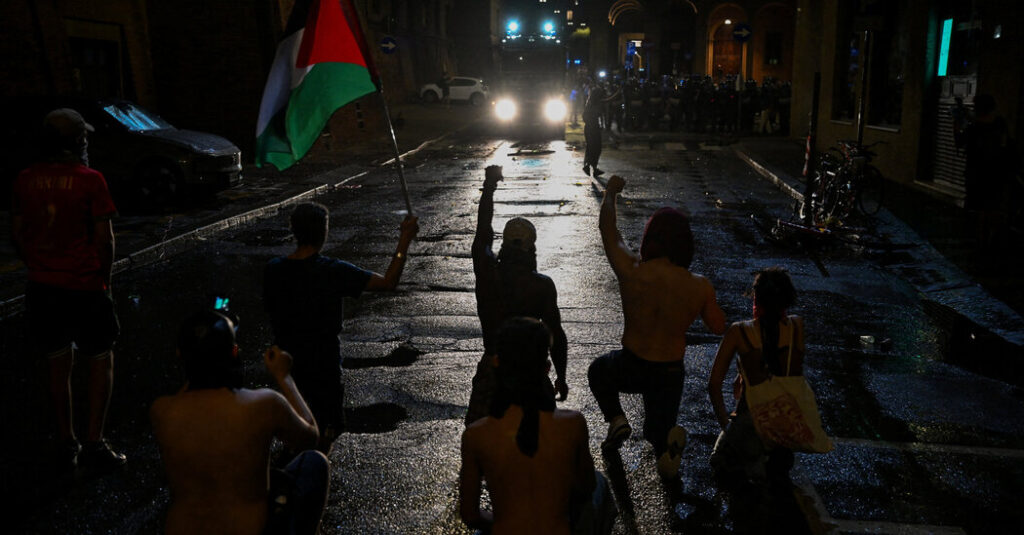
A day after Mr. Fakir’s death, hundreds of protesters gathered in front of City Hall in Bologna to condemn his treatment.
Officers, wearing riot shields, unleashed tear gas at the protesters after some demonstrators threw bottles at the police. The police said 64 officers were injured in the clashes, none of them seriously, and that protesters burned two cars.
Yossra Fakir, Mr. Fakir’s niece, distanced her family from the unrest.
“The pain we are feeling is huge,” she said in a video, “but it can’t and it shouldn’t be transformed into violence.”
James McManagan contributed reporting from London and Aida Alami contributed research from New York.