

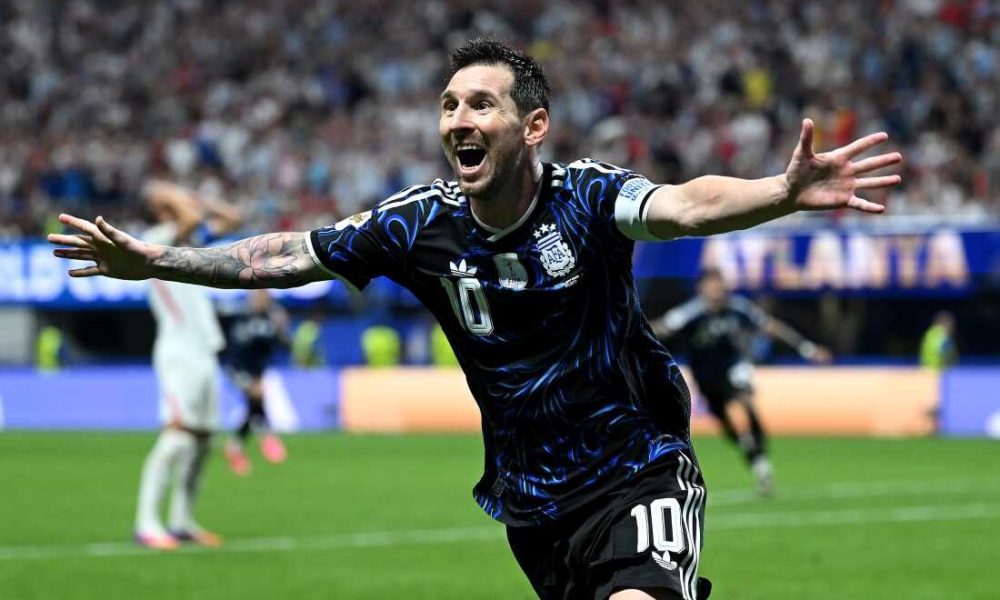
There are footballers who win matches, there are legends who define generations, and then there is Lionel Messi—a player who continues to rewrite history long after many believed his greatest chapters had already been written.
On a dramatic night at the 2026 FIFA World Cup, the 39-year-old Argentine captain once again reminded the football world why he remains one of the greatest players to ever grace the game.
With Argentina staring at elimination against England in the semi-finals, Messi seized control of the contest, inspiring a stunning late comeback that sent the reigning champions into another World Cup final with a thrilling 2-1 victory.
It was not merely another win. It was another masterpiece in a World Cup journey that has become as much about resilience as brilliance.
From Qatar Glory to One More Mission
When Messi lifted the FIFA World Cup trophy in Qatar in 2022, many believed football’s greatest story had reached its perfect ending.
The image of him holding the golden trophy after years of heartbreak seemed destined to become the final defining moment of his international career.
Retirement from international football appeared inevitable. Instead, Messi chose one more challenge.
While many of his contemporaries stepped away from the international stage, the Argentine icon remained committed to Lionel Scaloni’s rebuilding project.
Questions surrounded whether age would finally catch up with him, whether he could still dictate matches against younger, faster opponents, and whether Argentina could successfully defend their title—an achievement accomplished only by a select few nations in football history.
Over the past four years, Messi has answered every doubt with the quiet confidence that has characterised his extraordinary career.
He no longer relies on explosive acceleration to beat defenders. Instead, he controls games with intelligence, flawless vision, impeccable timing and an unmatched understanding of space.
His influence has evolved from chief goalscorer to master conductor.
England Dreamed. Messi Delivered.
For much of the semi-final, England looked destined to reach their first World Cup final since 1966.
Anthony Gordon’s early second-half strike stunned the defending champions and gave the Three Lions a deserved lead.
England defended with discipline, frustrated Argentina’s attack and appeared capable of surviving the remaining minutes.
Then came Messi.
With Argentina’s title defence hanging by a thread, the captain produced the moment that changed everything.
In the 85th minute, his perfectly weighted pass split England’s defence, allowing Enzo Fernández to fire beyond Jordan Pickford and restore parity.
Suddenly, momentum belonged entirely to Argentina. But Messi was not finished.
Deep into stoppage time, he delivered another moment of genius, floating an inch-perfect cross into the penalty area. Substitute Lautaro Martínez timed his run brilliantly before heading into an empty net in the 92nd minute.
Within seven unforgettable minutes, Argentina had transformed defeat into victory.
Once again, Messi had written another chapter in football folklore.
Leadership Beyond Statistics
The numbers alone cannot fully explain Messi’s impact on Argentina.
While goals and assists remain important, his greatest contribution has arguably become his leadership.
This Argentine squad contains established stars such as Enzo Fernández, Julián Álvarez, Alexis Mac Allister and Lautaro Martínez, but it is Messi’s calm presence that gives the team confidence during moments of adversity.
His ability to slow the game when necessary, accelerate attacks at the perfect moment and inspire belief has become Argentina’s greatest weapon.
Against England, he demonstrated why experience often outweighs youthful energy on football’s biggest stage.
Scaloni’s Argentina Continue to Grow
Manager Lionel Scaloni deserves enormous credit for building a team capable of complementing Messi rather than relying exclusively on him.
Argentina have developed into one of the tournament’s most balanced sides, blending defensive organisation with technical excellence and relentless midfield intensity.
Their ability to remain composed after falling behind against England reflected the maturity that has become the hallmark of Scaloni’s reign.
Rather than panic, Argentina trusted their system—and trusted their captain.
Both delivered.
Spain Awaits a Clash of Champions
Standing between Argentina and consecutive World Cup titles is a formidable Spanish side.
Spain booked their place in the final with an impressive 2-0 victory over France, showcasing the tactical discipline and technical brilliance that have defined their tournament.
The final promises a fascinating battle between two footballing philosophies.
Spain arrive with youthful exuberance, fluid possession football and tactical precision.
Argentina arrive with championship pedigree, battle-tested resilience and the enduring genius of Lionel Messi.
For football fans around the world, it represents one of the most anticipated World Cup finals in recent memory.
One More Opportunity to Make History
If Argentina defeat Spain, they will secure a fourth FIFA World Cup title and become the first nation in more than six decades to successfully defend the trophy.
For Messi, the achievement would elevate an already unparalleled legacy to even greater heights.
Winning one World Cup fulfilled a lifelong dream.
Winning two consecutive titles would place him in territory occupied by very few players in football history.
Regardless of Sunday’s outcome, Messi has already accomplished something extraordinary.
At an age when most footballers have retired from international competition, he continues to decide World Cup semi-finals against the world’s best teams.
As Argentina prepare for another date with destiny, one question echoes across the football world:
Can Lionel Messi complete the perfect final chapter by leading his country to back-to-back World Cup titles?
The answer awaits in Sunday’s final against Spain, where football’s greatest storyteller has one more chance to produce another unforgettable ending.