

To the Editor:
Re “Stymied on Netanyahu, Mamdani Takes to Video” (front page, July 23):
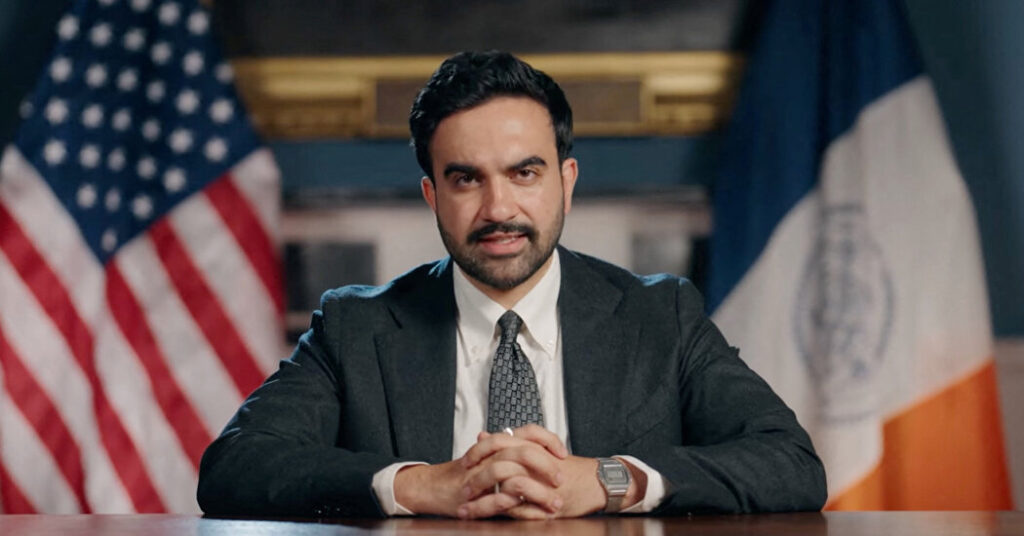
New York’s Mayor Zohran Mamdani acknowledged in the video he released on Tuesday that he lacked the power to arrest Prime Minister Benjamin Netanyahu of Israel if he comes to New York.
Certainly one can make strong arguments for arresting Prime Minister Netanyahu for war crimes. But given the mayor’s powerlessness in this regard, why should he spend his political capital polarizing his electorate and the national population? After all, he may be reaching out to both of them if he has ambitions for higher political office.
As a Jew who is sympathetic to the plight of the Palestinian people caught in the middle of the conflict between Israel and Hamas, and as a person very disappointed in the worst of what the Israeli government and its supporters do, my wish is that those in positions of national and local influence set good examples for compassion rather than create gratuitous polarizations that only exacerbate tensions.
Please, Mr. Mamdani, think long and hard about how you use your bully pulpit and spend your political capital.
Steven Seeche Cambridge, Mass.
To the Editor:
Mayor Zohran Mamdani’s recent video discussing whether he could arrest Prime Minister Benjamin Netanyahu of Israel has received tens of millions of views across social media. The video is significant not only because it appears to so many to be an expression of antisemitism and anti-Zionism but also because it makes the city he now leads — the home of nearly one million Jews — less safe for Jewish people.
Antisemitic incidents in the city have risen sharply since Mr. Mamdani came to power. He claimed his comments were in keeping with his responsibility to the Palestinian community but what of the Jewish community? His comments in this video will only fan antisemitic hatred.
Sheldon Landesman Queens
To the Editor:
Mayor Zohran Mamdani spent the better part of a week musing publicly about arresting Prime Minister Benjamin Netanyahu in New York if he comes here during the U.N. General Assembly session in September, then announced he lacked any basis for the action.
This stunt did nothing to make the city more affordable, safer, cleaner or healthier for any New Yorker. The mayor knew, when he proposed the action, that he couldn’t carry it out. And it was completely at odds with his campaign promise to focus on meeting the needs of those who live and work in New York City.
Indeed, the strategy is almost Trumpian in its timing — a headline-grabbing statement that diverted attention from his administration’s tepid response to the Legionnaires’ disease public health threat.
Richard W. Mark New York
A.I. Jobs for Philosophers
To the Editor:
Re “Hire Deep Thinkers for A.I. Research? It’s a No-Brainer” (Sunday Business, July 5):
We do not share the giddiness this article conveyed about the trend of A.I. companies and related nonprofits hiring philosophers to advise on ethical issues. Certainly, philosophy can help illuminate the many ethical and political issues raised by the A.I. industry. But we find it extremely implausible that the deep and critical inquiry these issues demand will come from philosophers who are on the companies’ payrolls.
The most pressing ethical issues raised by the A.I. industry include the training of A.I. using stolen human creative and intellectual labor; the outsourcing of grave choices to unaccountable, privately owned machines; and the environmental effects of data centers that use as much energy as cities. This article mentions none of them. Addressing such issues would require far-reaching democratic control of the A.I. industry — something A.I. companies have furiously resisted.
Instead, the philosophers profiled fixate on issues such as “A.I. welfare”: that is, questions about whether humans owe moral regard to language models or similar products. One of the profiled philosophers sometimes closes his interactions with Claude, a language model, by typing “ilu,” short for “I love you.”
It seems that the A.I. industry now has the philosophers it wants. It may end up being left to others to ask the truly hard questions. Either way, the world will have to live with the consequences.
Jonathan Gingerich Grace Helton The writers are, respectively, a law professor and a philosophy professor.
A Health Care Battle
To the Editor:
Re “Health Insurance in the Hot Seat” (Business, July 14):
Health plans operate in highly competitive markets and are strictly regulated at the federal and state levels, with transparency and accountability requirements that are distinctive within health care. Health plans negotiate substantial savings for consumers and provide comprehensive benefits, services and prescription drug coverage to improve patient outcomes.
In contrast, hospital systems and provider groups have consolidated steadily over the past two decades to gain market power, thwart competition and raise prices. At the same time, brand drugmakers have exploited what are supposed to be defined periods of market exclusivity to delay competition and systematically overcharge American patients.
There is no evidence that arbitrarily disrupting efforts to better integrate coverage and care would make health care more affordable. Common-sense bipartisan reforms are needed to promote competition in care delivery and prescription drugs, protect consumers from providers and drugmakers’ anticompetitive practices and transition away from the perverse incentives of fee-for-service medicine.
Mike Tuffin Washington The writer is the president and chief executive of AHIP, the national trade association for the health insurance industry.
If You Can’t Run, Walk
To the Editor:
I am surprised that “When Runners Have to Step Away” (Science Times, July 7) did not mention the most straightforward alternative: fast walking.
I am an 81-year-old physician who in 1968 began running at least two miles absolutely every morning (except when I had pneumonia in 1976). I was a slow runner; I never ran a marathon and had no interest in running as a group activity. For me, it was a beneficial addiction. It benefited both heart and brain. It also served as a mechanism for sightseeing when traveling.
Five years ago and after two back surgeries, I switched from running to fast walking. I found that the walking was as fast as the running had become! It provides an aerobic workout, with far less musculoskeletal trauma. I hope to be doing it (though inevitably at a steadily decreasing speed) for some years to come.
Jonathan R. Wolpaw Chestertown, N.Y.
When I Was Pregnant
To the Editor:
Re “The Exultant Revelation of Baby Bumps” (Thursday Styles, July 16):
During a 10-year stretch of my 94 years, I was pregnant for a total of 45 months. I never felt more beautiful than when I was wearing my maternity clothing. Nobody had any doubt as to what lurked beneath.
Just because a pregnant belly today is also undergoing a creation in progress, it doesn’t mean that everyone gets to have a front-row seat.
Sophie Murray Pompton Plains, N.J.