

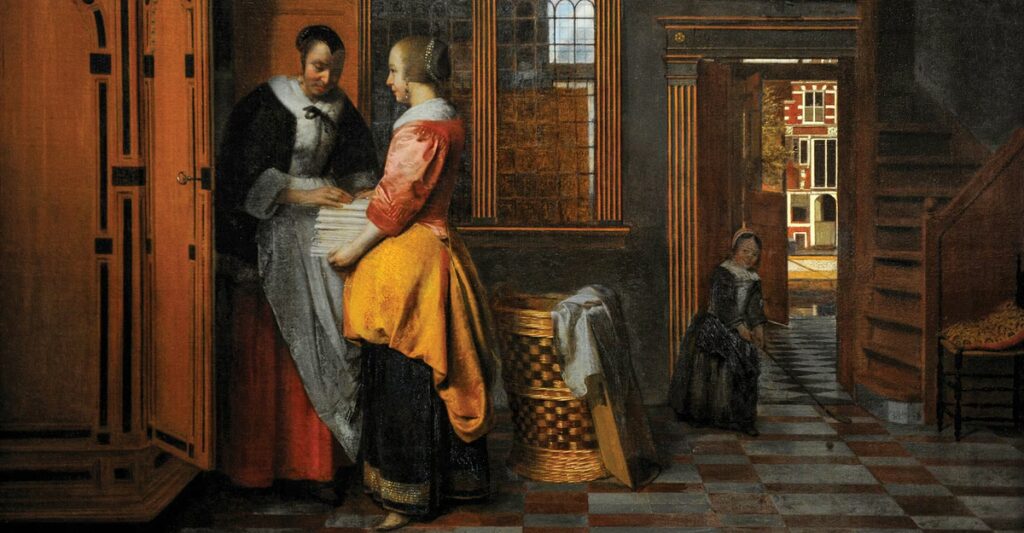
Pieter de Hooch was a contemporary of Johannes Vermeer in the Dutch city of Delft for a time; they painted similar subjects, in similar costumes, engaged in similarly quotidian activities. But they were quite different artists. De Hooch’s 1663 painting Interior With Women Beside a Linen Cupboard delivers exactly as little drama and numinous transcendence as its title promises. (It was formerly called The Good Housewife, which is hardly better.) The intrigue lies elsewhere.
De Hooch’s picture is a puzzle box—an ingenious construction of openings and closings, insides and outsides, revelation and concealment. The sturdy wall behind the standing women with their crisply folded stack of linen is breached in three different places, extending our vista with sudden depth. On the right is a stairway twisting up and out of sight, on the left a window, and in the center a door.
[From the May 2023 issue: How to look at a Vermeer]
These last two open onto the voorhuis, a foyer punctuated with a second, taller window and another doorway, beyond which we can see a sunlit snippet of the outside world—a bit of tree, the suggestion of a canal, and a building on the opposite side, with its own syncopated grid of windows, doors, and brickwork. (Look again at the spot of sky, diced by overlapping panes of glass, and you might catch a glimpse of the light and structure, the clarity and enigma, of Piet Mondrian.)
Our attention is being endlessly redirected. The brightest things in the picture—that bit of blue heaven and the red-and-white house across the canal—are also the most distant. Meanwhile, the one piece of incipient action is hidden in shadow: a child of 5 or 6, standing on the threshold between what we can see clearly and what we can’t, with a kolf stick cocked to send a small ball straight out of the picture and into our world.
[From the December 1972 issue: The inside story of the Mellon art collection]
Looked at one way, De Hooch’s scene is assertively ordinary. Looked at another way, it’s a lesson in the limits of visibility and knowledge. There’s the rectilinear orderliness of floor tiles and bricks, limpid windowpanes, and perfectly folded fabric. And there’s mayhem, writ small, in the unpredictable trajectories of a child and a ball.
This article appears in the August 2026 print edition with the headline “Interior With Women Beside a Linen Cupboard.”