

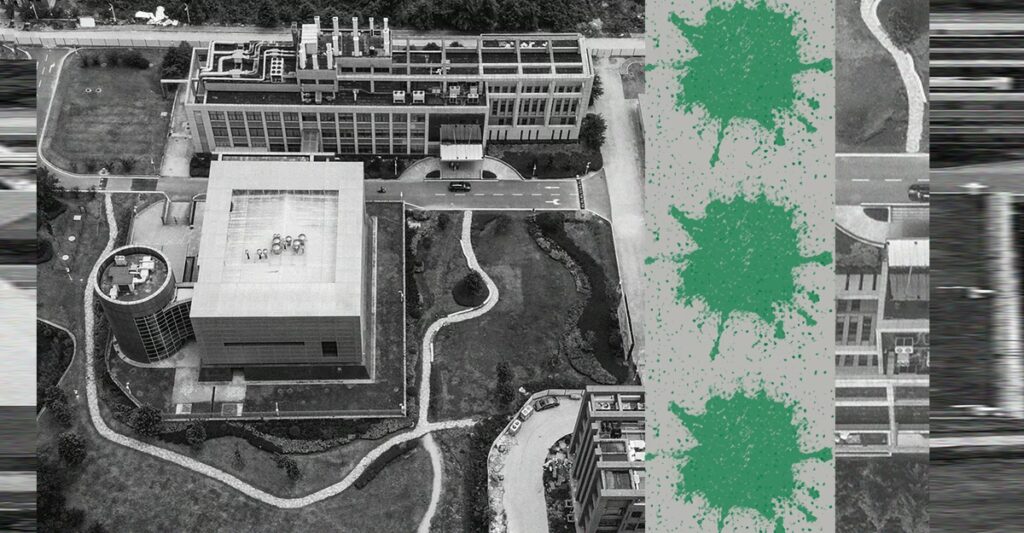
The origins of the coronavirus pandemic remain contested; the evidence is incomplete. But pundits, activists, and members of the Trump administration have long insisted that the case is closed, and that the virus slipped out from a lab in China. They’ve maintained the view that U.S. scientists were involved and later tried to hide the facts. They’ve said that justice must be served.
Now the reckoning they want appears to have arrived. An expert on the flu got hauled off by the FBI. A coronavirus researcher was indicted in Detroit. Two prominent virologists stepped down or were removed from senior roles. And a fifth infectious-disease researcher—Anthony Fauci, the central figure in an alleged “lab-leak” cover-up—was recently subpoenaed to appear before the U.S. Senate.
The precise timing of these cases, which have all come to light since April, may be a coincidence. Yet all five are centered on a small community of scientists affiliated with the National Institute of Allergy and Infectious Diseases, which Fauci ran for nearly 40 years. “There has been a snowballing of developments recently,” Richard Ebright, a molecular biologist at Rutgers University who focuses on biosafety issues and has repeatedly denounced Fauci and his “criminal associates,” told me. “I can’t provide an explanation for why it’s taken so long for that process to begin.”
The first case was Ralph Baric, a 72-year-old virologist and bat-coronavirus expert at the University of North Carolina at Chapel Hill. Baric worked closely with researchers at the Wuhan Institute of Virology, which many adherents to the lab-leak theory posit as the source of the pandemic; one contingent thinks that Baric might have been the creator of the SARS-CoV-2 virus. On April 15, the NIH, which has in the past provided Baric’s lab with hundreds of millions of dollars in research funds, referred him for debarment from all federal contracts for at least three years. The claims against him focus on some inconsistencies in paperwork and a series of decade-old experiments that the agency says were carried out in violation of a pause of a “gain-of-fuction” research. Baric told Science magazine’s Jon Cohen that he’s fighting the debarment, and that he’d been targeted on account of the furor over COVID origins; he appears to have retired from UNC on June 1. (Neither Baric nor the Department of Health and Human Services, which oversees NIH, responded to requests for comment.)
The day after the government kicked off Baric’s debarment proceedings, David Morens, a 78-year-old influenza specialist and one of Fauci’s close advisers at NIAID, was indicted for conspiring to hide or falsify discussions of coronavirus research grants. “We have to keep all communications like this on private email so that it can’t be retrieved via a FOIA,” he wrote in one message from 2021. On April 27, per Cohen’s reporting, armed federal agents in bulletproof vests arrived at Morens’s home in Chester, Maryland, and handcuffed him in his underwear. Morens pleaded not guilty to the charges. (The FBI told Science that this description of the arrest was “inaccurate”; Morens’s attorney declined to comment for this story.)
Just a few weeks later, news came out that the acting head of NIAID—the virologist Jeffrey Taubenberger, a very close colleague of Morens’s—had either stepped down or been fired from his role. He and Morens had worked together on more than 60 academic papers, including 13 that also list Fauci as an author—and both had been on the radar of the lab-leak hard-liners. (Taubenberger did not respond to a request for comment.)
News also broke in May that the FBI was investigating another NIAID virologist, Vincent Munster, who had been called out for collaborating with Baric and the scientists in Wuhan. Since then, prosecutors have filed an indictment charging Munster and another researcher from his lab with a conspiracy to smuggle mpox into the U.S. and with making false statements to federal agents. The government claims that on January 25, Munster and that colleague arrived at an airport in Detroit from the Republic of the Congo with a black plastic case containing samples of the mpox virus, seemingly deactivated and noninfectious, and that they both lacked proper documentation for these materials and misled the customs agents who questioned them. The two virologists have pleaded not guilty. (Munster’s attorney did not respond to a request for comment.)
[Read: Trump thinks he knows what started the pandemic]
The strongest argument for connecting all of these cases is that lab-leak activists themselves have done the same. Anthony Bellotti, the founder and president of the White Coat Waste Project, an animal-activist group that has leveraged the lab-leak theory in pursuit of its goal of ending all taxpayer-funded animal testing, declared that “Morens’ indictment should be the beginning—not the end—of long-overdue lab leak accountability at NIH.” Just two weeks before Munster was indicted on charges that seem to have no connection with the pandemic, Bellotti’s group joined the right-wing activist Laura Loomer in hawking what they called a “whistleblower report” about the virologist’s alleged misdeeds. That document describes Munster as a “Fauci acolyte and all around egotistical, arrogant foreigner that joined his research project (to aerosolize covid virus) to Ralph Baric’s project (to weaponize it).” I could find no evidence that Munster, who is a Dutch citizen, ever worked on a project to “aerosolize” SARS-CoV-2. In the meantime, Senator Rand Paul has linked Munster’s name to an early draft of a Defense Advanced Research Projects Agency grant application, with Baric listed as a principal investigator, that proposed to gauge the spillover risk associated with bat coronaviruses. The project’s ultimate goal was to limit that threat but involved altering the viruses in ways that might have made them more infectious—and more like SARS-CoV-2. (The final version of that proposal does not mention Munster, and the extent to which he knew its details are unclear.)
If you believe, as Paul and others do, that this unfunded DARPA project may have been a blueprint for generating the pandemic virus—and that, one way or another, virologists’ disregard for biosafety helped cause the deaths of millions—then seeking justice would be natural. If you’re also sure that COVID got its start in studies funded by the U.S. government, and specifically through NIAID, then there is no greater villain in this story than Fauci. Just last week, Paul announced that he’d subpoenaed the lab-leak theory’s final boss to testify in Congress at the end of this month. “He has not really gotten his just deserts,” Paul said in a weekend interview on Fox. He later added: “There needs to be repercussions.” A hearing is one of the clearest avenues to pursue such measures: The blanket pardon that Fauci received from President Biden wouldn’t cover any charges of lying to Congress that arose from new sworn testimony. (Neither Fauci nor Paul responded to requests for comment.)
Those repercussions may yet extend to other scientists. Ebright, the Rutgers professor, gave me a long list of names of researchers who he says should be held accountable. Justin Goodman, the senior vice president for advocacy at White Coat Waste, told me that every holdover from the “Fauci era” at NIH ought to be fired for their involvement in gain-of-function research, which the group sees as responsible for creating COVID. “I would throw Morens, Munster, and Taubenberger all in the same box of reckless and arrogant animal experimenters who fucked around and are finding out,” he said.
Even if this thirst for COVID retribution could be satisfied, its supposed higher purpose—to help prevent the next pandemic, by promoting more responsible research—hasn’t yet been served. Despite the years of Sturm und Drang about pandemic origins, and the wholesale adoption of the lab-leak theory by the party that controls both Congress and the White House, a shaky status quo still persists in biosafety. The rules for how to work on dangerous pathogens and which sorts of experiments should be allowed aren’t clear; oversight is spotty.
A better, more comprehensive system remains a worthy goal. Shortly after President Trump took office, his administration took a few half steps in that direction. Last May, the president issued an executive order meant to limit and track all research that involves the potential enhancement of dangerous pathogens. “This is an historic day—the end of gain-of-function-research funding by the federal government,” HHS Secretary Robert F. Kennedy Jr. told reporters at the signing ceremony; NIH director Jay Bhattacharya said gain-of-function work would “go away forever.” Yet Ebright and others told me that this project has stalled out. The Office of Science and Technology Policy had been placed in charge of revising the rules on this research by the end of last summer and implementing a national strategy for tracking all gain-of-function research before the end of last year. Those deadlines came and went. No such policies were put in place. (In response to a request for comment on this delay, the White House said that the administration “continues to implement our updated framework to govern, limit, and track dangerous gain-of-function research across the United States.”)
[Read: The lab leak will haunt us forever]
In the absence of that administrative work and with little progress being made on the various biosafety laws that have been proposed in Congress, the nation has been left with just the vengeful spectacle of lab-leak prosecutions. In effect, research policy is being handled by the Department of Justice. America’s doctor may soon be dragged out to testify once more: The science that he championed appears to be unfettered; the scientists he funded are at risk of ending up in chains.