

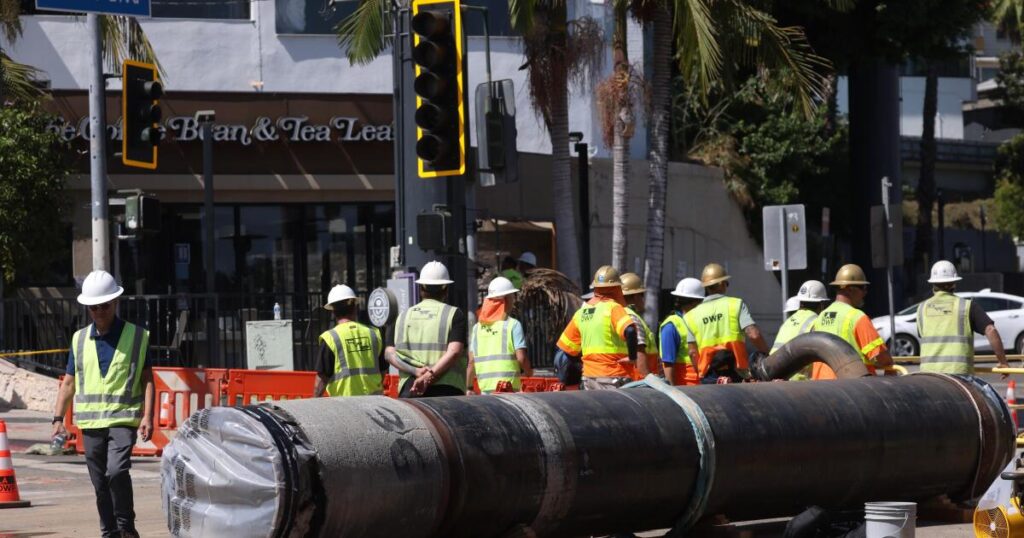
The Los Angeles water system is so old — and money for replacements is exceedingly scarce — that officials are left playing a dangerous game of triage.
They know huge swaths of the system are in desperate need of replacement. But with limited time and money, the Los Angeles Department of Water and Power has no choice but to focus on the lines it believes are most likely to blow.
Sometimes, it can get there before a massive leak. But as West Hollywood discovered this month, sometimes the pipes rupture well before help can arrive.
The Westside has experienced the highest number of leaks across the city’s water distribution system over the past 10 years, according to the utility.
Experts say the age of pipes, the corrosive soil they’re buried in and pressure changes in pipes that send water to hillside neighborhoods all contribute to breaks across the aging system.
This region was the location for the two biggest ruptures of the last few years, including a 17-million gallon leak in West Hollywood last week and a roughly 10-million gallon rupture that flooded Westwood and damaged parts of UCLA in 2014.
Those areas both had pipes that were more than 100 years old. But the rest of the system isn’t much better.
More than 30% of DWP’s mainlines are more than 80 years old and at least 6% of them are considered high priority for replacement. In a 2018 assessment, more than 50% of DWP’s trunk line segments were more than 65 years old and 11% were more than 100 years old.
The utility prioritizes replacement projects based on a variety of factors including the age of the line, leak history and the consequences of failure in a particular area. DWP engineers weigh those factors when prioritizing pipes for replacement, assigning a letter grade to each water main based on its likelihood of failure and the potential consequences of a break.
About 6% of the water main system earned grades of D and F, according to The Times’ analysis in 2015.
Trunk lines appear to be in better condition than the utility’s mainlines. Data provided by the agency showed that less than 1% of its trunk lines have “D” or “F” condition ratings, according to a survey conducted by DWP in 2022.
Los Angeles is one of many cities across the nation fighting an epic battle to solve a multibillion-dollar problem buried underground.
Like many other large cities, much of Los Angeles’ vast network of water mains and trunk lines were installed at the turn of the 20th century and are at risk of breaking, disrupting service and potentially inundating communities with water.
“It’s a very difficult problem, and society as a whole is not investing enough money in infrastructure … especially water infrastructure,” said Lucio Soibelman, a professor of civil and environmental engineering at USC.
Los Angeles’ water system experiences leaks daily, which rarely garner much attention, but several more significant breaks in the last decade have renewed concerns.
A ruptured trunk line in 2014 on Sunset Boulevard in Westwood sent millions of gallons of wateronto the UCLA campus, flooding several buildings and causing several million dollars in damage.
Last week, a 110-year-old riveted steel trunk line pipe — part of the system of major arteries that deliver water from reservoirs and tanks to smaller distribution mainlines across Los Angeles — ruptured in West Hollywood. The break left a giant sinkhole on Sunset Boulevard and sent about 17 million gallons of water into surrounding neighborhoods, shuttering businesses, and flooding homes and underground parking.
DWP has an $8-billion, five-year Water System Capital Plan to address the aging pipe issue.
Still, it’s not likely that the utility is going to be able to get ahead of the upgrades that are needed, experts say. DWP officials concede they’re hampered by budget restraints, manpower limitations, long project timelines and the sizable footprint of the repairs needed.
“Even with unlimited funding and human resources, we can only do so much work so as not to severely overburden our local communities with impacts to traffic and interruptions to local residents and businesses,” a utility spokesperson told The Times.
DWP plans to replace about 45 miles of mainline, which deliver water to individual services across neighborhoods, this fiscal year. Thirty-three percent of those lines are rated as a high priority for replacement based on factors including age, leak history, pipe material and surrounding geological conditions. Another 54% are rated high-moderate priority and 13% are considered moderate priority, according to the utility.
The agency anticipates replacing just over a mile of trunk line across the city this fiscal year. But within the next four years, DWP says it plans to accelerate replacement of high-risk trunk lines to 5 miles annually. The utility hasn’t specified how it plans to fund such a ramp up of projects.
There are about 547 miles of trunk line underground across the city and 6,780 miles of distribution pipes, or main lines, in Los Angeles. There are more than 40 trunk line projects in the agency’s capital improvement plan, which will be in construction from now until 2057.
DWP identified a trunk line on Century Boulevard near LAX, one that delivers water in Rampart Village, Silver Lake and Echo Park, and another in the Sunland/Tujunga area of the city as among their top priorities for replacement this year, according to the agency.
The utility tries to coordinate with other departments in case other public works projects can be done at the same time, limiting the number of times they have to dig in certain areas, said Anselmo Collins, DWP’s chief operating officer and senior assistant general manager.
“We try to do as many projects as we can, ensuring also that we’re not affecting traffic in all areas of the city at the same time,” he said.
But it’s not as easy as just deciding what project to do and then digging, he added. Officials have to design the project, get the necessary approvals and permits and coordinate with other departments before work can begin.
“It’s quite complex,” Collins said.
To help stop leaks from becoming bigger problems, DWP has deployed teams in recent years with acoustic technology to help identify small leaks before major breaks happen.
“You can connect to the pipe and listen and detect where potentially you have a leak because there’s water flowing,” Collins said. “These are leaks that we haven’t seen surface yet. Unfortunately, we’re still going to have situations where we do have a leak and we need to respond quickly.”
Major cities across the country are also grappling with the effects of aging water infrastructure.
A survey of water industry leaders conducted by the nonprofit American Water Works Assn. this year showed that infrastructure renewal and replacement, and financing for capital improvements were the top two concerns.
Another report by the association estimated that over the next 25 years total drinking water infrastructure construction needs are projected to reach a cost of $2.4 trillion across the nation. To close the gap, an additional $56.6 billion in capital — above what is currently spent — would need to be invested annually every year from 2026 to 2050. Otherwise, water rates would more than double, according to the report.
If funded entirely through increases in water rates, an estimated 30.4 million households would spend more than 2.5% of their income on drinking water, according to the report.
And it’s not just replacing the aging pipelines that causes strain for utilities.
Emergency repairs or system failures almost always result in overtime requests, stretching budgets and leading to burnout among employees, according to more than half of utility executives who responded to the survey.
“There are other consequences that society doesn’t understand and we don’t evaluate,” Soibelman said. “The beauty of this is if society would understand how much bigger the cost is from the failure of infrastructure we could finally invest more money in keeping up our infrastructure as we should.”