

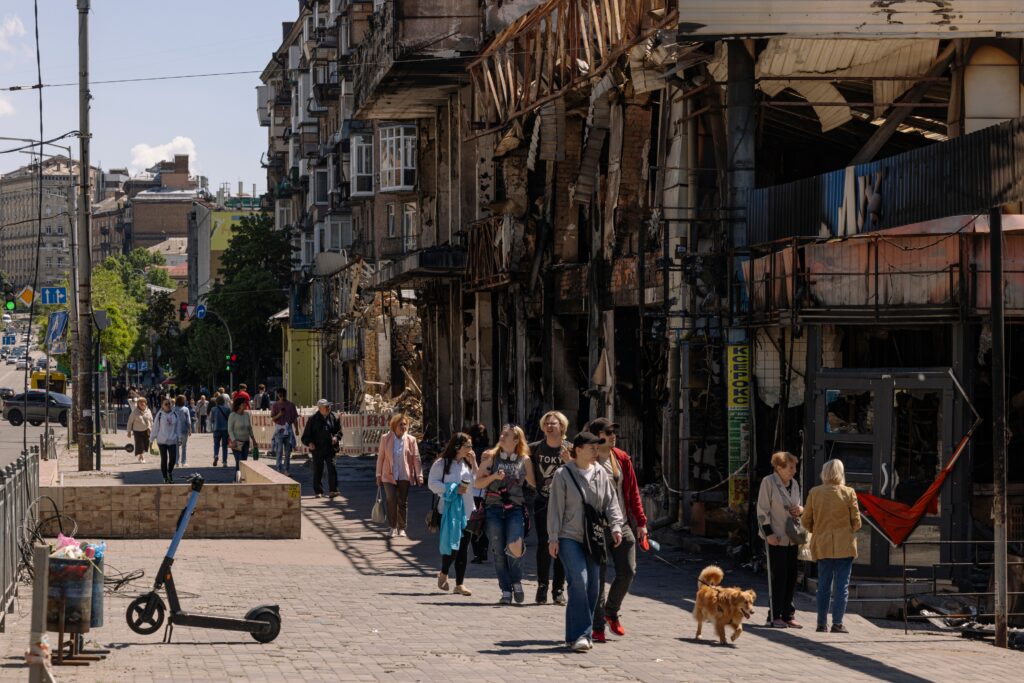
KYIV — With each cappuccino that barista Anya Balyokha made on a recent morning, the scent of coffee gained a bit more on the smell of burned shopping mall — the air still acrid from the Russian ballistic missile that destroyed the stores across the street a week earlier.
But business was still good in Lukianivka, the beleaguered hilltop community that is the most-bombed neighborhood in the most-bombed district in Kyiv.
Regulars nursed flat whites, a war-scape of burned brick and shattered glass visible through the windows not covered in plywood. Commuters stopped for lattes on their way to the nearby Metro station, which doubles as an air raid shelter where some may have spent the night.
“After the last strike, everything was cleaned up within a day and we reopened the following morning,” said Balyokha, 18, over the hiss of an espresso machine that has kept pumping through five attacks damaging the cafe since Russia’s invasion began in 2022.
After four years of war, life in Lukianivka, the most frequently hit part of the Ukrainian capital, is a mix of adaptability and endurance, defiance and denial, resignation and resilience. How these neighbors carry on is a measure of what is at stake as Washington and Western nations debate their support for Ukraine: not abstract political platitudes, but people who refuse, stubbornly and at real cost, to be erased by Russia.
This working-class plateau of Soviet-era apartment blocks and factories just northwest of the government center has been damaged, repaired and damaged again by more than 13 Russian strikes over the last 52 months. It started with artillery bombardments and continues now with missiles and drones, most recently Thursday night during a massive citywide barrage that killed at least 27.
A Shahed drone slammed into an apartment building on a recent Monday morning in an attack that left 140,000 people without electricity citywide.
The attack on May 24 that incinerated the shopping mall was even bigger — it killed one resident in a nearby flat, crushed part of the Lukianivka Metro entrance and destroyed the historic Lukianivskyi Market, a fixture since the 1880s.
And still residents mostly decline to leave, bound to Lukianivka by work, by children, by cost, by colleagues, by cats and by the stubborn human tendency to call a place home long after it stops being safe. Many have revised their lives rather than retreat or flee.
Olha Dudka has watched herself evolve into a wartime city dweller in the course of the seven times she has replaced the windows of the dentist office she manages. The first blast, in 2022, was treated like a crime scene. Police photographed almost every shard, Dudka said. Journalists came. Artists painted a “Born to be Brave” mural on the plywood windows. It was destroyed by a second blast two weeks later.
That time, no one even drew up a damage report. Following the first attack, the British supplier paid to repair an expensive CT scanner — following the second, they demurred.
“After that, we just crossed ourselves and carried on,” Dudka said.
Now the office keeps repair supplies on hand and all movable equipment is rolled into a windowless room each night before locking up. Dudka and her partners built the practice of their dreams, she said, and as long as patients keep coming they will keep rebuilding.
“This has become everyday life,” she said.
Nearby — and up 21 flights of stairs when the power is out — the Oksens keep a baby stroller packed with everything but the baby, ready to bolt for the basement when another Russian missile is streaking toward their building complex. It has been hit four times.
But often they just stay put, having mastered the art of distinguishing various noises and handicapping the risk.
“At some point you know the difference between a Shahed, a missile, air defense and something flying farther away,” Ilona Oksen said. “You start building routines around it.”
When she does make a midnight run to the basement, her husband Andriy, 32, who is a lawyer, helps get the kids down. But he usually comes back up to sleep in his own bed.
“Unfortunately, you adapt. Not because it becomes normal, but because otherwise you simply cannot function,” Andriy said. “You still have to work. You still have to raise children. You still have to buy groceries. Life does not stop.”
Russia is not likely to stop either, until the war is over.
At the center of Lukianivka is a Cold War defense factory that Russia says still provides equipment to the Ukrainian military. Ukraine will not confirm what the firm produces, but it had been known to make missile guidance components in the past.
The strikes, however, have battered the whole district, demolishing homes and shops miles from the factory. The Metro station, which is the neighborhood’s biggest public air-raid shelter, has been hit seven times, making it Kyiv’s most targeted transit site.
The local McDonald’s — Ukraine’s first, which opened in 1997 — has been struck seven times. Five people were killed when a Russian cruise missile struck near the Soviet-era TV tower built on top of a Jewish cemetery and adjacent to Babyn Yar, where Nazis massacred more than 33,000 Jews in a ravine.
“What doesn’t strike us flies past us,” reads a neighborhood patch that someone designed, picturing a missile soaring past Lukianivka. No one who lives here thinks the attacks around Lukianivka, where at least 84 civilians have been killed district-wide, will stop.
The Oksens moved into their newly built apartment in 2022 after the complex had already been hit by one drone. They hoped — in a lighting-doesn’t-strike-twice way — that would be it. It wasn’t. Another strike took the roof of an adjacent tower soon after.
“And then it happened again,” Ilona said. “And again. At some point you stop counting.”
Yes, the couple said, they worry about their two children, their own safety, their mental health. Ilona, on the advice of her therapists, practices not letting her eyes rest on the blackened market and scattered destruction below to preserve her prewar memories.
Yes, they’ve thought of moving. But while other neighborhoods may get hit less often, no neighborhood is immune. And Lukianivka is the one they love, its history, the convenience, their kindergarten. The covered market where they shopped almost daily, now wrecked but planning to rebuild.
“People often say, ‘Just move somewhere safer.’ But where exactly? Odesa gets hit. Dnipro gets hit. Lviv gets hit. Kyiv gets hit. So where is it safe,” Andriy asked. “In the evening everyone just prays to survive, and in the morning everyone continues living.”
Ukrainians are bound to their homes by both economic and emotional ties. Unlike in much of Europe, where renting is common and mobility is high, almost 95 percent of Ukrainians own their apartments and houses — the highest rate in Europe — a function of post-Soviet privatization. Leaving is not simply a matter of packing bags but of abandoning property that may equal a lifetime of savings.
Added to that is something harder to measure: a depth of attachment to a place that keeps people in small towns near the front line just as surely as it keeps them in Lukianivka.
“I think Ukrainians have an exceptionally strong sense of home,” said Maksym Holovko, an architect and head of the Urbanyna, a nonprofit planning and reconstruction consultancy in Kyiv. “Giving up your own apartment feels much like abandoning your family home in a village.”
And learning. In the basement of Lukianivka’s 1902 Mala Opera House, Volodymyr Hubankov runs a free theater school for teenagers, many of whom were displaced from even more battle ravaged cities near the front lines.
During air raid alerts, he said, “we pretend there is no air raid” and the teens rehearse through them. When the last blast wave broke windows in the basement studio, Hubankov had the frames repaired and staged a performance a week later.
“So what? We restored everything. Life goes on,” said Hubankov, 52, who works days as an analyst and teaches acting on a volunteer basis, as do all five of the theater school’s teachers. This is their resistance. “If I’m not at the front,” he said, “I have to do something.”
Yelyzaveta Volhova and Viktor Vasylchenko moved into their apartment in Lukianivka before the 2022 invasion — she in October 2021, he the next May, drawn by local amenities and landlords who waived rent for months after the war started. They will marry in July.
Their balcony windows have been blown out and replaced four times. “I really like that it is wooden and nice,” said Volhova, 25, a pediatrician who no longer practices. “I don’t want to close it off. We spend all our evenings there.”
During the May 24 attack, they sat in the apartment corridor, their chosen shelter, 500 yards from the Metro in a neighborhood where, they noted, someone always seems to die on the road between. They were ready with their two dogs, their passports, the dogs’ passports, and some cash.
At 3 a.m. that day, the apartment filled with orange light. Volhova saw the school they walk the dogs past every day burning on the hillside. By morning, when the first photos circulated, they understood the market and their favorite cafe were gone. For now.
But a new cafe had opened recently, so they go there. Businesses still start in Lukianvika. People still marry. Routines continue. At the park, where they know neighbors not by their names but by their dogs’ names, people check in.
“Everyone is like, ‘Did you go to the basement?’ — ‘No, and you?’ — ‘All good, did you replace the windows?’ — ‘Not yet.’”
Are you leaving? “Not yet.” And if they can hold on, not ever.