

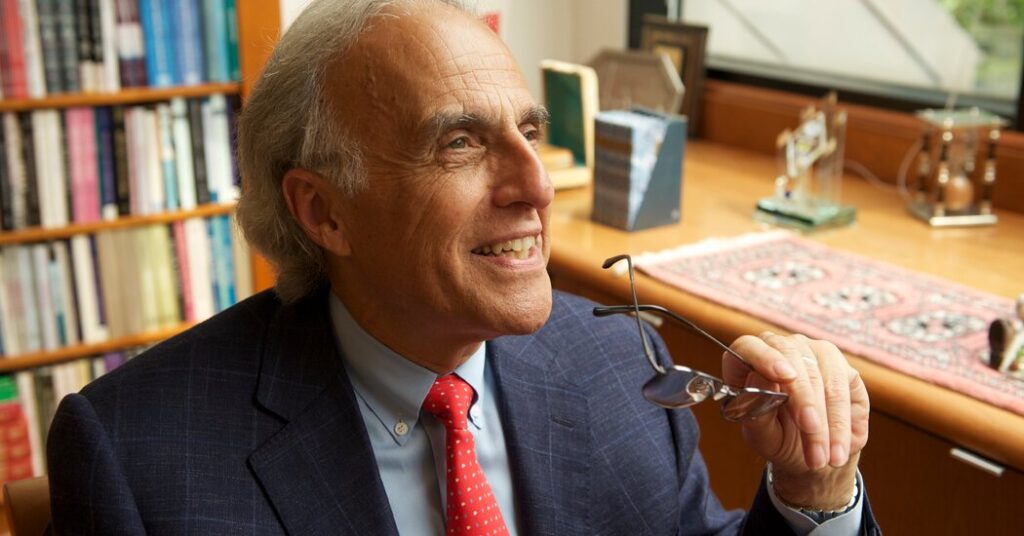
John L. Esposito, a leading scholar of political Islam whose career was shaped by two blows to American security, the Iranian Revolution of 1979 and the terror attacks of Sept. 11, 2001, and who sought to counter a backlash against Muslims after each crisis, died on July 15 in Wynnewood, Pa., near Philadelphia. He was 86.
His death, in a hospital, was from complications following heart surgery to unblock an artery, his wife, Jeanette Esposito, said.
A practicing Catholic born in Brooklyn, Dr. Esposito was, in the 1990s, the founding director of the Center for Muslim-Christian Understanding at Georgetown University.
“His Italian American background and his Catholicism allowed John to interpret the Islamic tradition sympathetically but not uncritically,” the center said in a statement after his death.
A prolific scholar who became a public intellectual, Dr. Esposito wrote or edited more than 50 books. He addressed general readers in works like “What Everyone Needs to Know About Islam” (2002) and academic specialists as editor in chief of “The Oxford Encyclopedia of the Islamic World” (2009).
He was one of the few American experts on Islamic fundamentalism and its political offshoots when Iranian revolutionaries seized hostages at the U.S. embassy in Tehran in 1979. Overnight, Dr. Esposito was sought out by the media, government officials and publishers offering book contracts. He joked, “I owe my career and my first Lexus to Ayatollah Khomeini,” the leader of the revolution.
But his sympathetic analysis of Muslim political aspirations ran counter to the upsurge of anti-Muslim sentiment that has coursed through the United States over the past four decades, both popularly and among scholars writing of a “clash of civilizations” between Islam and the West. Critics of Dr. Esposito accused him of soft-peddling the threat of Islamic fundamentalism.
In his books “Islam and Politics” (1984) and “The Islamic Threat: Myth or Reality?” (1992), Dr. Esposito emphasized two points: that unlike Western secular states, Islam was a way of life, in which religion intertwined with government, law and society; and that the Muslim world’s grievances with America traced not to religion but to U.S. foreign policy, chiefly its support of Israel and authoritarian Middle East rulers.
“Esposito did not interpret Muslim societies through the prism of U.S. empire but through their own historical perspectives,” Nader Hashemi, the current director of the Muslim-Christian center at Georgetown, said in an interview. “For that reason, his views on political Islam generated controversy.”
Many scholars, though, Dr. Hashemi added, found him “refreshing, nuanced and objective.”
Dr. Esposito’s gregarious personality opened doors across the Muslim world, and his organizing skills drew international scholars to conferences he set up. In 1993, he was recruited to become the founding director of the Center for Muslim-Christian Understanding, started with substantial funding from the billionaire Hasib Sabbagh, a Palestinian Christian. (The center was renamed in 2005 after a Saudi donor, Prince Alwaleed bin Talal.)
A former colleague at the center, John O. Voll, recalled in an interview how in the late 1990s, Dr. Esposito arranged a meeting in Tehran between the two of them and a daughter of Ayatollah Khomeini. The topic was women’s rights.
“Here sits this Brooklyn Catholic, and she was laughing,” Dr. Voll said, explaining Dr. Esposito’s knack for putting people at ease. “Cultural boundaries did not stop John.”
The terrorist attacks of Sept. 11 brought another surge of interest in his scholarship, from both friendly and hostile sources. The hard-right author David Horowitz included him in a 2006 book about the “most dangerous academics in America,” writing that Dr. Esposito was “averting his scholarly eyes from the study of Islamist violence on grounds that it ‘reinforces stereotypes.’”
Dr. Esposito emphasized that America had been attacked by Al Qaeda, not by Islam. In a 2007 book, “Who Speaks for Islam? What a Billion Muslims Really Think,” written with Dalia Mogahed and based on Gallup surveys in 35 Muslim countries, he told readers that the vast majority of Muslims condemned 9/11 and supported peace, democracy and women’s rights. Just 7 percent said they condoned 9/11.
Martin Kramer, the editor of Middle East Quarterly, criticized Dr. Esposito in a 2001 book, “Ivory Towers on Sand,” which argued that scholars of Islam at American universities had downplayed Islamic fundamentalism for decades and failed to see the possibility of the Sept. 11 attacks.
“In their view, any Islamic movement is either moderate or potentially moderate,” Mr. Kramer, speaking of Dr. Esposito and others, told The New York Times two months after the World Trade Center towers fell. “So every time there is a disagreeable act by some Muslim group, what they say is, ‘Well, this doesn’t represent Islam; this is not true Islam.’”
John Louis Esposito was born on May 19, 1940, in Brooklyn, one of three sons of John and Mary (Marotta) Esposito. His father was a camera repairman and his mother worked in a garment factory.
Inspired by his mother’s devotion to Roman Catholicism and his father’s concern for the downtrodden, John aspired to become a priest. From the age of 14 to 24, he lived in a series of Capuchin Franciscan monasteries, but left before he was ordained to pursue the academic study of religion.
He received a B.A. from St. Anthony College in New Hampshire in 1963 and an M.A. from St. John’s University in 1966. While studying for his Ph.D. in Catholic theology at Temple University, he was advised by his department chair to take a course with a newly hired Muslim scholar.
“I didn’t have any great desire to do that,” Dr. Esposito recalled in a 2025 interview with the podcast Unapologetic, produced by the news site Middle East Eye. “I knew nothing about Islam and Muslims. I had seen a movie called ‘Exodus,’ which I thought was historically based, and of course, it really wasn’t, and I gave in because the chair was, you know, the chair of the department.”
The course, taught by the Palestinian American scholar Ismail al-Faruqi, mostly drew foreign students from Muslim countries. Dr. Esposito came to appreciate Islam’s significance and to believe that what is widely known as the Judeo-Christian tradition should be understood as the Judeo-Christian-Islamic tradition.
He switched his focus to Islamic studies, earning his Ph.D. in 1974. At the time, jobs in that field were nearly nonexistent. But the small Jesuit-run College of the Holy Cross in Worcester, Mass., hired him to teach comparative religious studies. He stayed two decades, rising to department chair.
At Georgetown, where he was a professor of religion and Islamic studies, he was given the prestigious title of University Professor in 2000. Beyond the classroom, he consulted with the U.S. State Department, the European Union and American politicians, including Joseph R. Biden Jr. when he was a senator.
Besides his wife, whom he married in 1965, he is survived by a brother, Richard. He and Ms. Esposito divided their time between Marco Island, Fla., and a retirement community in Newtown Square, Pa.
In recent years, he directed a research project called the Bridge Initiative, also housed at Georgetown, that monitors and issues reports on Islamic bigotry around the world, such as India’s repression of Muslims and violent acts prompted by Islamophobia during the 2016 U.S. presidential election.
“Islamophobia as I define it,” he told The Daily Oklahoman in 2014, “is not about people who have a kind of good fact-based criticism of the Islamic religion. There’s nothing negative about that. People are entitled to those types of criticisms. Islamophobia is when you have an unfounded irrational fear that tends then to lead to bias, discrimination, hate speech and hate crimes.”