

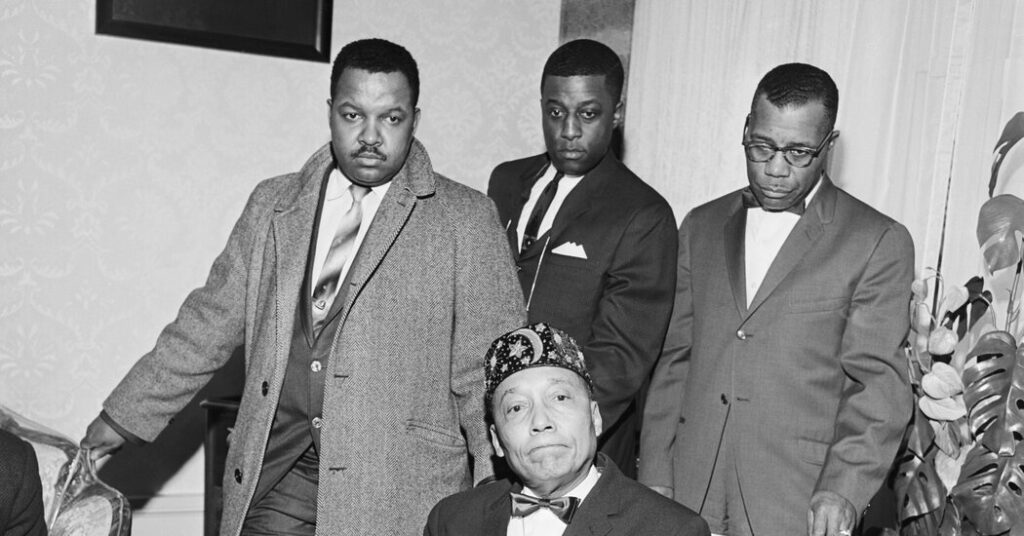
John Ali, a top official in the Nation of Islam in the 1960s who oversaw the religious group’s tumultuous split with one of its most famous members, Malcolm X, and who was later accused of being an F.B.I. informant and of playing a role in Malcolm’s assassination in 1965, died on Sunday at his home in Philadelphia. He was 98.
His son Jon Ali confirmed the death and said that his father had lived in Chicago until recently.
The assassination of Malcolm, at the Audubon Ballroom in New York, stunned a country still reeling from the murder of President John F. Kennedy just over a year earlier. Like the Kennedy assassination, the killing of Malcolm was — and remains — clouded by conflicting narratives, government stonewalling and rampant conspiracy theories.
At the center of the mystery is Mr. Ali, who as the national secretary of the Nation of Islam was the de facto second-in-command to its leader, Elijah Muhammad.
Mr. Ali, who had a degree in accounting, was in charge of the Nation’s business operations, including its extensive involvement with the boxer Muhammad Ali, then a follower of Mr. Muhammad’s, and his career.
Mr. Ali was also the group’s official spokesman and its enforcer, a role that put him in direct conflict with Malcolm, who by the mid-1960s was the Nation’s most prominent figure but had also begun to break with the group over Mr. Muhammad’s numerous extramarital affairs.
Mr. Ali credited Malcolm with bringing him into the Nation, and the two men were once close friends and roommates.
But after Malcolm characterized Mr. Kennedy’s murder as “chickens coming home to roost” in December 1963, it was Mr. Ali who told reporters that he had been suspended and forbidden from speaking publicly.
And shortly after Malcolm left the Nation, in March 1964, it was Mr. Ali who forced Malcolm’s brother Philbert X, a midlevel minister in the organization, to denounce his brother in a speech that Mr. Ali had written.
By then, Mr. Ali was facing his own controversy. In 1963, the journalist Louis Lomax had accused him of being an informant for the F.B.I., a charge that he repeated in several books and that Mr. Ali persistently denied.
It was no secret, though, that the F.B.I. was keeping a close eye on the Nation of Islam and on Malcolm. Declassified documents later revealed that the bureau claimed credit for helping orchestrate the split between the organization and Malcolm through Cointelpro, its secret anti-radical project.
Over the year between Malcolm’s stormy departure from the Nation and his assassination, Mr. Ali repeatedly beat back reports in the press that the group had plans to harass or kill Malcolm, though historians and journalists later interviewed former members who said the Nation had tried to deploy hit squads against him.
On Feb. 21, 1965, Malcolm was preparing to address a crowd of 400 people at the Audubon Ballroom in Harlem when a man rushed forward and shot him in the chest with a sawed-off shotgun. At least two more men followed, shooting Malcolm with pistols. He was dead by the time he reached the hospital.
In the chaos, all but one of the assailants, Mujahid Abdul Halim (then known as Talmadge X Hayer), escaped.
Mr. Halim and two other men, Muhammad Abdul Aziz (then known as Norman 3X Butler) and Khalil Islam (then known as Thomas 15X Johnson), were arrested, charged and convicted of the killing. Mr. Halim was a member of the Nation of Islam mosque in Newark; the other two belonged to the Nation’s mosque in New York.
Mr. Halim confessed to the crime, but he maintained that Mr. Aziz and Mr. Islam were innocent. Those two men, who each spent decades in prison, were exonerated in 2021.
In the years since the assassination, historians, including the authors of two Pulitzer Prize-winning biographies — Manning Marable, in “Malcolm X: A Life of Reinvention” (2011), and Les and Tamara Payne, in “The Dead Are Arising: The Life of Malcolm X” (2020) — have argued that the additional gunmen likely came, as Mr. Halim did, from the Newark mosque.
The independent researcher and historian Abdur-Rahman Muhammad reached a similar conclusion, as shown in the Netflix documentary “Who Killed Malcolm X?” (2020), based on his work and directed by Rachel Dretzin and Phil Bertelsen.
No one has been able to pin down whether Mr. Ali played a direct role in the killing. But there is at least one incriminating piece of evidence: Mr. Ali, who lived in Chicago, was in New York at the time of the assassination, and met with Mr. Halim the night before.
Decades later, Mr. Ali insisted that he and the Nation had not been involved. “People knew if we wanted to do it, we could have done it,” he told Jonathan Eig in an interview for Mr. Eig’s 2017 biography of Muhammad Ali, “Ali: A Life.” “We didn’t do it.”
John William Simmons Jr. was born on Nov. 3, 1927, in Avery, Ga. When he was still a baby, his parents, John and Viola (Brown) Simmons, moved the family to Philadelphia, where his father worked as a chauffeur.
At 18, John was drafted into the Army. A white colonel, impressed with his aptitude for numbers, recommended that he apply to Bryant University in Rhode Island, which had an accelerated program for veterans.
He graduated from Bryant in 1950 with a degree in accounting. He later said that his academic performance had so impressed the university’s president that a job interview was arranged for him at the F.B.I. He was turned down for an agent position and offered a job that he considered beneath him, which he declined.
He returned to Philadelphia, where he worked as an accountant. In 1954, a friend took him to a Nation of Islam mosque to hear Malcolm, who was fast gaining a reputation as an eloquent speaker.
Mr. Simmons joined the Nation, adopted the name John Ali and went to work with Malcolm in New York. For three years, they and their wives lived together in the Elmhurst section of Queens.
In 1961, Mr. Muhammad was looking for a new national secretary, and Malcolm suggested his friend. Mr. Ali quickly gained Mr. Muhammad’s trust, and within a year was managing the Nation’s day-to-day operations.
But Mr. Ali’s relationship with Malcolm began to sour. He grew critical of Malcolm, who suspected Mr. Ali of trying to turn Mr. Muhammad against him. In 1964, Malcolm told Mr. Lomax, the journalist, that Mr. Ali was his “archenemy.”
Mr. Ali’s involvement in the Nation’s business operations continued to expand through the 1960s. In 1966, he became the business manager of a new venture, Main Bout, that handled most of Muhammad Ali’s promotional rights and, therefore, much of his income. According to Mr. Eig, John Ali made a fortune over the next several years as Muhammad Ali became a superstar.
He stepped down as national secretary in 1970, but remained active in the Nation.
Mr. Ali’s first two marriages, to Minnie Coleman and Delores Bustamante, ended in divorce. His third wife, Carolyn Ali, predeceased him. Along with his son Jon, he is survived by another son, Sultan Ali, and a daughter, Marie Ali, from his first marriage; a daughter, Clara Ali, from his second marriage; six grandchildren; nine great-grandchildren; and a brother, Michael.
Over 60 years later, it remains unclear why Malcolm was assassinated, and by whom. Many of the witnesses are long dead, and the F.B.I. has refused to declassify relevant files. But researchers strongly believe that Mr. Ali played a role, perhaps as a messenger between Mr. Muhammad and the killers.
“I think it’s possible he carried the order,” Abdur-Rahman Muhammad, the historian, said in an interview. “But a lot of what happened was not going to be written down.”