

Who is responsible for American independence? The most common answer invokes a short list of familiar names: Washington, Jefferson, Adams. Despite their mistakes and biases, these men deserve the credit they’re typically given. But by focusing so much on the Founders, the conventional telling of America’s origin story leaves out perhaps its greatest heroes.
American independence wouldn’t have been possible without the thousands of people who spurred the mass political movement that came before it. Recalling their role is essential today, as many of us—their successors—lose faith in our collective ability to address problems. They have left an unsurpassed example of how to resolve common grievances, cultivate empathy, and perfect the democracy they gave us. Indeed, the Founders would have been hopeless without them.
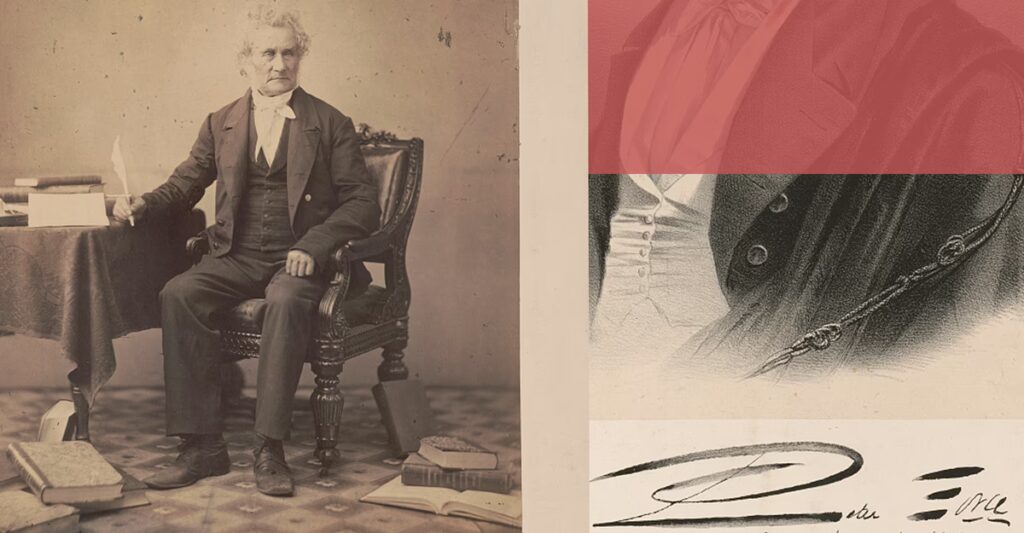
To begin to piece together a fuller history of the Revolution, start with the work of Peter Force. Born in 1790, Force grew up hearing stories from soldiers who had battled the British, which instilled in him a lifelong interest in the fight for independence. In the 1820s, as he built a successful career as a printer, Force realized that a combination of storms, insects, fire, and plain indifference had placed Revolution-era documents at risk in all 13 original states. After lobbying the government for funds, Force marshaled scribes across the new country to scour local archives and send back copies of material dating from 1774 to 1776. Force’s plan came to fruition in 1837, when the government published nine volumes—most of them considerably more than 1,000 pages—under the magisterial title American Archives.
[From the November 2025 issue: The unfinished Revolution]
In the introduction to the first volume, Force explained why he had taken on such an ambitious challenge. “A complete collection of the materials for a history of this country would not only be a proud monument to the memory of our ancestors,” he wrote, “but would serve as an invaluable guide to us and our posterity, by exhibiting the vital spirit which has pervaded the past, the true foundations upon which our institutions rest, and the essential principles upon which their existence and perpetuity depend.”
Force’s collection didn’t just preserve the memory of the Revolution; it showed the indispensable role that everyday Americans played. In addition to letters from Washington and other leaders, Force included a large number of reports from communities across the country. He organized the documents chronologically, allowing historians such as myself to trace how the rebellion against Great Britain was progressing on any given date in communities separated by hundreds of miles. His work tells the Revolutionary story through thousands of Americans debating the merits of political change, weighing the risks of armed resistance, and reassuring friends and neighbors that they were engaged in a worthy cause.
Take May 19, 1774, a date that does not figure significantly in traditional narratives of the Revolution. The Archives includes reports on three gatherings that day in far-flung towns, each protesting the military occupation of Boston, which closed the city to normal commerce and threw many people out of work. In Farmington, Connecticut, “near one thousand people” resolved that the British, “being instigated by the Devil, and led on by their wicked and corrupt hearts, have a design to take away our liberties.” The protesters insisted that the “pimps and parasites” who advised the king to oppress the colonists “be held in utter abhorrence by us and every American.”
On the same day, a political committee in Westerly, Rhode Island, compared the British troops to the Roman legions once dispatched to level Carthage. “This horrid attack upon the town of Boston, we consider not as an attempt upon that town singly, but upon the whole Continent,” the group declared. In Portsmouth, New Hampshire, another committee voiced its belief that “a plan may be devised, and resolutely pursued by all as may prevent the cruel effects” of the occupation.
Many histories of early Revolutionary activity focus on New England—and Boston in particular—but Force’s collection extends throughout the mid-Atlantic and the South, revealing how each region was responsible for erecting America’s national consciousness.
On June 6, 1774, inhabitants of Prince William County, Virginia, concluded that “no person ought to be taxed but by his own consent,” and that Boston “is now suffering in the common cause of American liberty.” In all likelihood, few residents of Prince William County had ever visited the city, but they had no trouble empathizing with Bostonians for enduring the military occupation. The same day, more than 200 miles north, residents of Lower Freehold, New Jersey, decided that “the cause, in which the inhabitants of the town of Boston are now suffering, is the common cause of the whole Continent of North America.” Thanks to the determination of these and many other communities, the bonds of empire began dissolving well before July 4, 1776.
[David Brooks: America needs a mass movement—now]
The committees in these towns and cities played an especially important part in mobilizing the American people, yet they have received only passing analysis by historians. Committees began to appear as early as 1765 and had become vital centers of a wide range of political activities by 1774. Some were composed of only a dozen or so local leaders, either appointed by officials or elected by the people. Others involved more than 100 members, many of whom had little previous political experience. By one estimate, more than 10,000 men joined committees who—in the words of a Massachusetts reverend—“had not before been honored with the confidence of the people.”
“The great bulk of those who were the active instruments of carrying on the Revolution were self-made industrious men,” David Ramsay, a Continental Army veteran and one of the first historians of the war, wrote. “These, who by their own exertions had established or laid a foundation for establishing personal independence, were most generally trusted and most successfully employed in establishing that of their country.”
Few if any of the committees called for democracy, which probably would have smacked of anarchy to them. Yet as they went about their business—not only condemning British rule but also gathering arms and enforcing commercial boycotts—they practiced a kind of democracy nonetheless. Britain’s oppression invited the people to take charge of their government, inaugurating a period of broader political participation.
Topsfield, Massachusetts, offers a striking example of how these committees understood the significance of what they were accomplishing. On June 14, 1776, on the eve of independence, residents gathered to confront “the greatest question that ever Came before this town,” a local committee reported. Just a few years earlier, the prospect of casting off British rule “would have been Treated with the uttmost contempt. We then thought ourselves happy in being the Subjects of the King of greate Britten,” the committee continued. “But the Sene is now Changed; our minds and sentiments are now altered. She that we call our mother Country and Pairent State is now without any Just Cause or Injury done by these Colonies, become their greatest enemies.”
By that point, America had hundreds of Topfields, each inspiring and legitimating the work of the Founders. Indeed, several days earlier, delegates at the Continental Congress had noted that they could declare independence only when “the voice of the people drove us into it.” America’s leaders knew that the people “were our power.” They still are.