

Recent efforts by the Avignon Festival, France’s largest theater event, to highlight a different language each summer have often lacked conviction. In 2023, English was represented by only a handful of productions, and last summer the majority of Arabic-related offerings were dance shows, rendering the question of language somewhat moot.
But the focus on Korean at this year’s festival, which runs through July 25, has opened an inviting window onto a language that is rarely heard on Western stages.
South Korean directors including Jaha Koo and Lee Jaram are making their Avignon debut as part of the lineup, and the 2024 Nobel laureate Han Kang is in France as a guest of honor. On Wednesday, she even appeared onstage to close out a staged reading from her 2021 novel, “We Do Not Part.”
In fact, “We Do Not Part” was the inspiration for two separate shows at the festival. The reading, titled “Bird” and directed by Julie Deliquet, brought together two acting legends, Isabelle Huppert of France and Lee Hye-young of South Korea, on Avignon’s most prestigious stage: the Cour d’Honneur of the Papal Palace. Meanwhile, an Italian-language adaptation, Daria Deflorian’s “What a Terrible Pain Love Is,” played in another open-air venue nearby.
Seeing both proved helpful to understanding Han’s allusive, poetic novel, which follows Kyungha, a writer and historian in Seoul who receives an urgent request from her longtime friend Inseon. An accident has left Inseon hospitalized, and Kyungha is tasked with traveling to her friend’s remote home on Jeju Island to feed her parakeet. Along the way, she learns more about Inseon’s family history and the massacres that took place on Jeju in 1948 and 1949 in the name of anticommunism.
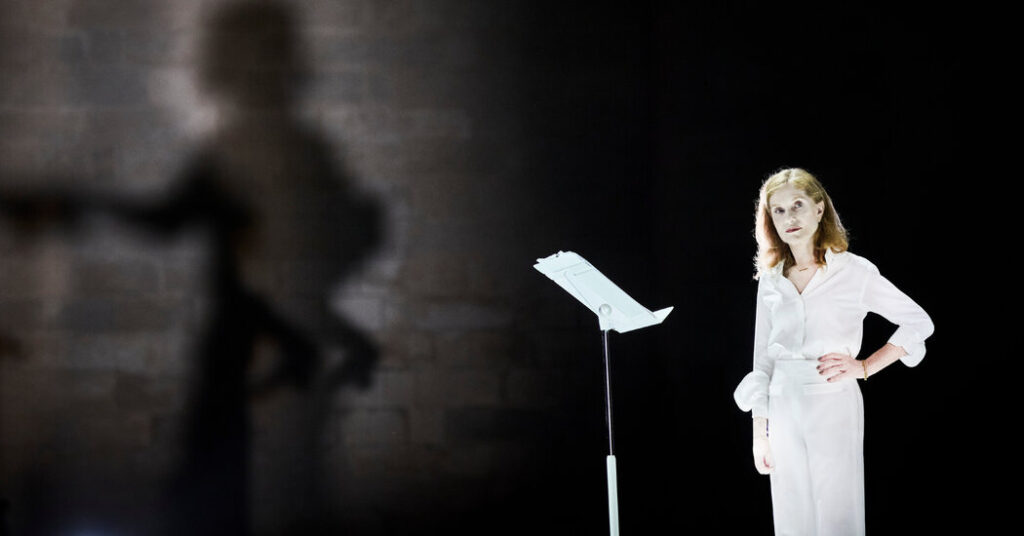
The layers of history in “We Do Not Part,” and the timelines Han moves between, were easier to follow in the simple setup of “Bird.” For the occasion, the cavernous stage was empty, save for two lecterns. Huppert and Lee, armed with their printed text, each played one of the central characters, speaking in their native languages: Huppert, in French, was Kyungha; Lee took over in Korean whenever Inseon spoke. (Subtitles were provided in French, English and Korean.)
The back-and-forth made for an intriguing dialogue, emphasizing the distance that had opened up between the two friends before Inseon’s accident. Kyungha is puzzled by her request, and becomes trapped in a snowstorm when she arrives on Jeju. Images of the snow — quite a contrast with the Avignon heat — are interwoven with memories of the two women’s relationship.
The pared-down nature of the reading brought out the best in Huppert, who spoke first and performed most of the text. In recent years, her stage appearances have had an off-puttingly histrionic edge, from her brittle Lyubov in Chekhov’s “The Cherry Orchard” — directed by the festival director Tiago Rodrigues at Avignon in 2021 — to her quasi-solo turn in Romeo Castellucci’s “Bérénice.”
In “Bird,” after a slightly rushed start, Huppert settled into Han’s elegant prose with appealing simplicity. The tone of her voice, often cool and reserved, softened when Kyungha was reunited with Inseon. She moved very little by the lectern, pausing only to look up around her when the snowstorm materialized in the text — and behind her as falling snow was discreetly projected on one of the Papal Palace’s windows.
Lee, a well-known actress in South Korea since the 1980s, brought a more assertive energy to her role. While she and Huppert were both dressed in white, they still managed to look completely different, with Huppert in tailored straight pants while Lee’s were cut up and slouchy. There was a directness to Lee, as she performed in Korean, that brought out Inseon’s quiet persistence in confronting the trauma her family suffered during the Jeju massacres.
Over the 90-minute running time, Huppert and Lee read the first section of the novel, and Han then appeared in a belted white dress to read some additional pages. Her eyes lowered on a copy of the book, she described the government-perpetrated “campaign of extermination” that left 30,000 people dead on Jeju in the 1940s.
The same lines appear in “What a Terrible Pain Love Is,” performed at the open-air Cloître des Carmes. The Italian director, Deflorian, already adapted another Han novel, “The Vegetarian,” in 2024. Then, as now, the result boasted striking stage tableaux but felt somewhat listless.
This time, Deflorian stages the text around one of the central images in “We Do Not Part”: blackened logs that Kyungha and Inseon intended to incorporate in an art project as a memorial to victims of the Jeju violence. The actors move the cut-down trees, arranging them into sculptural shapes while delivering excerpts from Han’s text.
The production’s three performers, Anna Coppola, Deflorian and Monica Piseddu, are often affecting in their roles, but in this case the evenness of tone that Deflorian favors made it difficult to follow the layers of the story. On Tuesday, it didn’t help that screaming soccer fans were making their displeasure known nearby about France’s loss in the World Cup semifinal.
By comparison, “What a Terrible Pain Love Is” lacked a sense of energy and momentum. Yet between this show and “Bird,” the melancholy elegance of Han’s prose came through fully. It’s a welcome win for the Avignon Festival’s focus on Korean theater.