

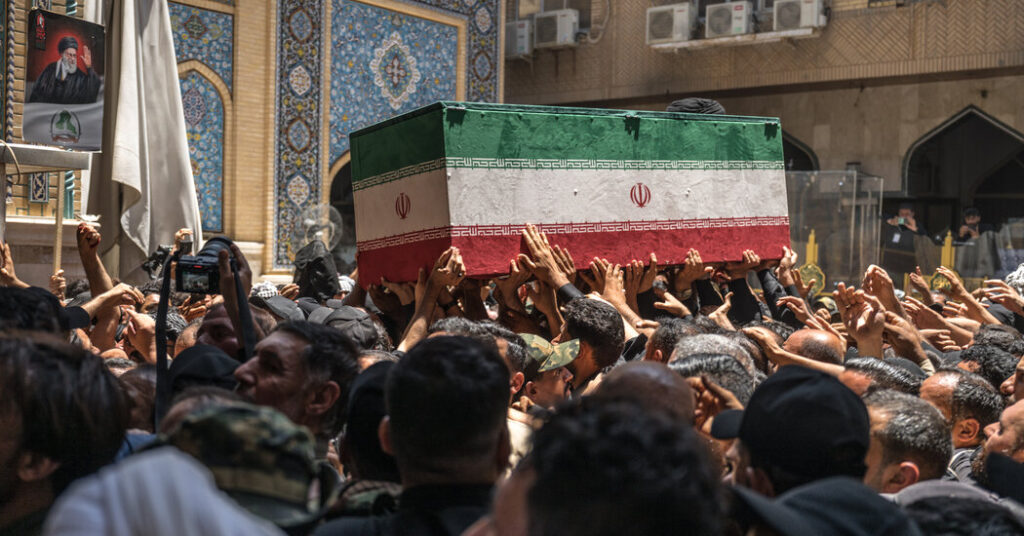
Hundreds of thousands of mourners filled the streets of the Iraqi city of Najaf on Wednesday, chanting, praying and weeping for Iran’s supreme leader, Ayatollah Ali Khamenei, with the crowds pressing up against the truck carrying his coffin.
It was a mass outpouring of grief for another nation’s leader — one who, as a pre-eminent Shiite Muslim cleric and political strategist, had extended Iran’s influence deep into Iraq, and across the Middle East, for decades.
“He was our guardian and protector, and we are here today to return the favor,” said Rabab Jassim, a 45-year old homemaker, who arrived at 3 a.m. from Baghdad to join the procession. “My heart is on fire,” she said, bursting into tears.
The procession followed five days of funeral ceremonies and mass mourning inside Iran for Ayatollah Khamenei, who was killed in U.S.-Israeli strikes at the outset of the war on Iran in February. His body was set to be flown back to Iran on Thursday, when he is expected to be buried in his hometown, the northeastern city of Mashhad.
People from all over Iraq, which has the Middle East’s second-largest Shiite Muslim population, after Iran, have spent days in the cities of Najaf and Karbala, home to two of Shiite Islam’s holiest sites, awaiting commemorations there.
There is little historical precedent for one country holding an official funeral for the leader of another nation, as top officials in Iraq did on Tuesday evening, when the ayatollah’s coffin arrived in the country.
Arash Azizi, a historian and author on Iran, said, “Iraq is the holy land of the Shiite faith, and this is an attempt by Iran to underscore Khamenei as belonging not just to Iran, but to the broader Shiite community.”
It was also a political message at a pivotal moment in the region.
For the past three years, the United States and Israel have sought to dismantle the network of mostly Shiite militant groups that Iran cultivated during Ayatollah Khamenei’s nearly 37-year rule.
In Iraq, Tehran maintains alliances with many Shiite militias, and the funeral is a sign that those bonds are far from broken. The outcome of the recent war has also left them emboldened enough to hold a procession for Ayatollah Khamenei in Iraq — a regional ally of the United States.
Ali Ramadan, a fighter in an Iraqi Shiite militia who had brought his family of four to Karbala for a procession there later on Wednesday, said, “The message here is that we defied the world: America, Israel, and the great global powers.”
“We are with justice, and we are with Iran,” he added. “Khamenei stood for truth against imperialism.”
Falih Hassan and Shirin Hakim contributed reporting.