

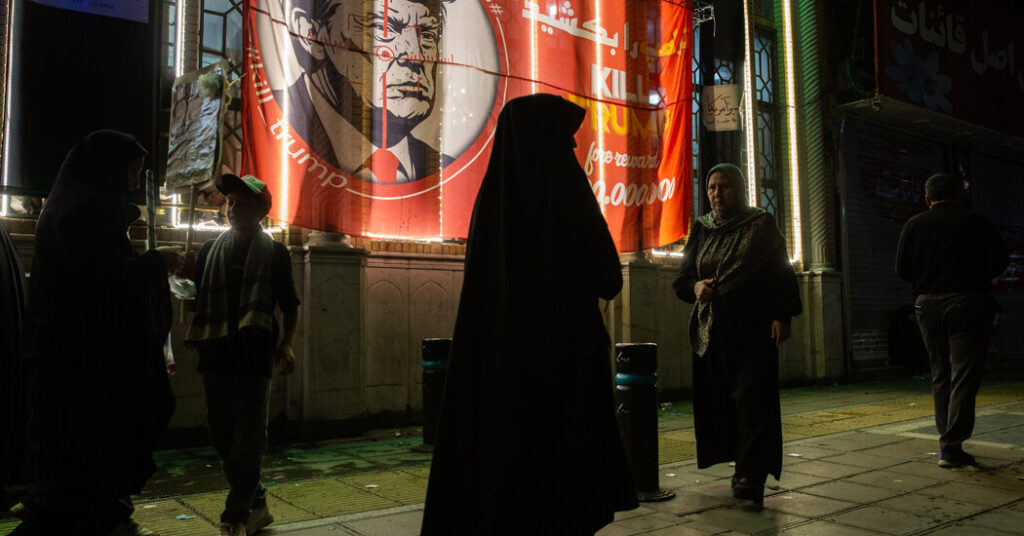
On the 136th day of his war against Iran, President Trump came up with a new plan. He would impose tolls on ships traversing the Strait of Hormuz in exchange for protecting them from Iranian forces.
But that was then. On Day 137, he had another new plan. No tolls after all.
Mr. Trump’s 180-degree reversal on Tuesday in the face of protests from his Arab allies who were not so excited about paying tolls reflected how adrift he seems to be in prosecuting his war against Iran. What was supposed to be a clean four-to-six-week operation is now in its messy 20th week. Improvisation and impulse are not working.
A president who has made flexing his power on the world stage a hallmark of his second term has found in Iran an opponent that so far will not bend to his will and a geopolitical conflict that cannot be won through nasty social media posts or tariff threats. The memorandum of understanding that he brokered with Tehran last month to halt the fighting turns out to have been a memorandum of misunderstanding, and Mr. Trump now seems to have neither a clear military nor diplomatic strategy.
“He’s encountered a country that is not willing to play by his set of rules, which is you bend and kiss the ring and tell him how great he is and try to get whatever concession he’s willing to give,” said Vali Nasr, a professor at the Johns Hopkins University School of Advanced International Studies who has advised presidents and secretaries of state on the Middle East.
Mr. Trump’s no-end-in-sight venture in the Middle East has become a fresh lesson in why the region has been a sinkhole for presidential ambition for generations. The instruments of power that help advance U.S. interests elsewhere around the globe do not necessarily work there, as many of Mr. Trump’s predecessors have discovered.
It has been especially frustrating for Mr. Trump, who has reveled in getting his way since returning to office last year and even boasted that he might be the most powerful man in world history. But while he has successfully pressured NATO allies into increasing military spending, extracted concessions from trading partners and essentially took over Venezuela with a one-night surgical commando raid, it is not clear that he can get his way in the Persian desert.
“Trump’s forceful approach to the world in his second term has benefited from some luck and the occasional willingness of other states to facilitate an off-ramp,” said Suzanne Maloney, vice president and director of foreign policy at the Brookings Institution. “Nothing in the past 47 years should have led him to believe that Tehran would follow that route.”
John Hannah, a former national security adviser to Vice President Dick Cheney and now a senior fellow at the Jewish Institute for National Security of America, in the past has supported the limited use of military force to stop Iran from building a nuclear weapon. But he said that by going for “a massive decapitation strike,” Mr. Trump had clearly underestimated the theocratic power structure that took power in the 1979 Iranian revolution and overestimated American capacity to topple it.
“In retrospect, this was clearly a war based on fatally flawed assumptions,” Mr. Hannah said, “none more damaging than the president’s apparent conviction that Iran’s revolutionary regime was a flimsy house of cards ready to collapse in a hail of American airstrikes and bellicose Truth Social posts.”
“Compounding the error,” he added, “there was no rigorous national security apparatus around the president prepared to speak truth to power and subject his wrongheaded assumptions to systematic questioning based on the knowledge and experience of real foreign policy, defense and intelligence professionals.”
The cease-fire that has now collapsed amid nightly strikes was not even a particularly far-reaching agreement. It was meant to be a stopgap to quiet the guns for 60 days so that the two sides could negotiate the truly thorny disputes, particularly the future of Iran’s nuclear program. If a temporary deal cannot last, it is hard to see how the two sides can get to a permanent accord requiring painful compromises.
Mr. Trump seems uncertain how to proceed. He has turned back to the use of military force and ordered the resumption of a naval blockade in the Strait of Hormuz. He has threatened to take “a nice, big fat shot” at Pickaxe Mountain, a fortified site near one of Iran’s main nuclear facilities. But with popular opinion against the war, he has given little indication that he is willing to resume the sort of full-fledged bombardment that marked the beginning of the war.
At the same time, he has suggested there will be further negotiations but has not articulated how talks that failed before could succeed now. In fact, he has expressed deep skepticism that they could, although of course that might simply be a way of lowering expectations. Instead, Mr. Trump seems to think that he can outlast the Iranians because their economy is in dire shape while the Iranians seem to think that they can outlast him because of the politics of gas prices heading into midterm elections at home.
“Trump’s in a box, and he’s facing a brutal and tenacious adversary whose objectives — maintaining leverage over the strait and a newfound desire for hegemony over the Gulf — now hold him hostage,” said Aaron David Miller, a former Middle East peace negotiator who served presidents of both parties and is now a senior fellow at the Carnegie Endowment for International Peace.
“Iran consumed and tarnished the legacy of one president,” he added, referring to Jimmy Carter and the 1979-81 hostage crisis. “And the way it appears now, with time on Iran’s side, not on Trump’s, it could very well tarnish or ruin the legacy of another.”
Other foreign policy experts rejected the analogy and cautioned against overstating the impact of the Iran war on Mr. Trump’s presidency.
“I don’t think Iran has destroyed Trump’s agenda, which is a broad one,” said Elliott Abrams, a national security official in multiple Republican administrations, including Mr. Trump’s first term. “As long as Americans are not dying, Iran will be a secondary issue for most Americans.”
Other foreign policy challenges like Ukraine, Cuba and China “don’t depend on Iran,” he added, so everyone should “keep Iran in perspective.”
Mr. Abrams noted that Democrats appear increasingly at odds with each other over Israel and the Palestinians, a divide that has played a major factor in some congressional primaries this season. “It’s the Democrats who are in danger of having a Middle East issue, namely Israel, swallow up their agenda,” he said.
The abrupt flip-flop on tolls underscored how much Mr. Trump is ad libbing these days. In announcing that he would charge 20 percent on cargo to protect shipping in the Strait of Hormuz on Monday, he contradicted his own administration’s position that tolls were an unacceptable violation of international law.
His decision to cancel them on Tuesday after calls from anxious Gulf Arab leaders made clear that he had not bothered to consult his allies before announcing the new tolls or disregarded their concerns. He covered for the shift with a face-saving if barely plausible explanation that the Gulf leaders had promised “trade and investment deals” instead.
What investments he did not say, nor were there further details to suggest any concrete commitments. “They’re going to be making massive investments into the U.S., and I like that much better,” Mr. Trump told reporters. “I don’t like the concept of a fee,” he said a day after calling it a simple “matter of fairness.”
It was hardly the only contradiction of recent days. When Mr. Trump sealed the cease-fire agreement last month, he praised Iranian negotiators. “We’re dealing with people that I think are very rational people,” he said then. “They were nice to deal with. They were strong people, smart people.”
By last week, he had changed his mind. “They’re scum,” he complained. “They’re sick people. They’re led by sick people.” Asked what had changed in just three weeks, Mr. Trump said, “I got to know them.” Which of course begged the question of why he did not know who he was dealing with in the first place.
“I don’t think he has a strategy on Iran,” said Abbas Milani, director of Iranian studies at Stanford University and a research fellow at the conservative Hoover Institution. “That’s the key problem. He approaches these things instinctively and he approaches them with two contradictory goals. On the one hand, he keeps saying, ‘We want to make a deal with you guys and make Iran a thriving economy.’ And on the other hand, he says, ‘I’m going to obliterate your civilization.’”
Mr. Milani said he agreed with Mr. Trump that Iran actually does want a peace agreement, and in fact he believes it is “desperate for a deal” because its economy is in free-fall. But he faulted the president for sending negotiators who are not steeped in the region and do not grasp its intricate history and details.
“I don’t think he ever really understood the nature of this regime,” Mr. Milani said of Mr. Trump. “He still doesn’t understand it. It’s not like any other. It always does the unexpected and will go to any limit to keep itself in power.”