


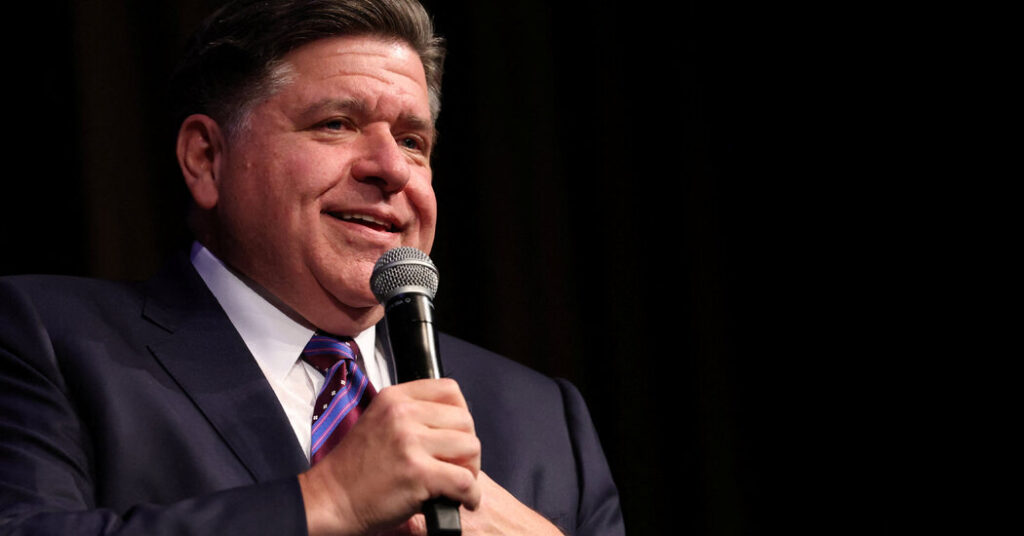
In 2019, Gov. JB Pritzker of Illinois signed a bipartisan law offering new financial incentives to data centers in the state.
How times have changed.
Last month, Pritzker suspended those incentives, saying the tech companies building data centers had gotten out of control and were driving up people’s energy prices. “We can put a pause on the building of data centers by disincentivizing, or at least making it harder, taking away those tax credits,” he said on Tuesday at the Aspen Ideas climate conference in Chicago.
Pritzker was responding to the growing backlash against data centers, a movement that has swept the country in recent months. President Trump announced on Thursday afternoon that nearly 200 companies and politicians have signed a voluntary pledge to prevent A.I. data centers from driving up electricity costs for millions of Americans. But the pledge is largely symbolic and difficult to enforce, experts said.
Last week, Gov. Kathy Hochul of New York enacted the nation’s first moratorium on large data centers. And more such moves may be on the way. As my colleague Claire Brown reported last month, there are now more than 100 proposed moratoriums at the local, county, state and national levels.
Pritzker said he wasn’t opposed to the new technology. But he was quick to emphasize that the companies spending freely on artificial intelligence infrastructure should also be investing in energy.
“The large tech companies have the resources to bring energy with them,” he said. “How about if we say, ‘We’re not going to incentivize you. We’re going to tell you that you’ve got to bring energy with you if you’re going to come, and you’ve got to have closed-loop systems that make sure that you’re not contaminating our water, or taking too much of our water, and costing people in your utility bills, water and electricity.’”
Those are some of the provisions Pritzker hopes to see in a bill making its way through the Illinois legislature that would introduce additional restrictions on data centers. It includes a so-called Beyoncé provision, or “bring your own clean energy.”
“The Beyoncé provision,” Pritzker said, would “both preserve the environment and make sure that we’re not taking away affordability for people.”
Grid issues
Pritzker said he didn’t have the authority to enact a data center moratorium on his own under Illinois law. And he noted that data centers weren’t the only factor in rising energy costs.
“Data centers are contributing to the problem,” he said. “But it’s also a problem of there is more electricity usage across the board as industry increases across the country.”
Pritzker complained about the regional transmission organizations that manage the nation’s antiquated electricity grid, and the fact that higher energy usage in nearby states can result in higher prices in Illinois. “When Ohio builds an enormous A.I. data center, it affects the people in Illinois, because our rates go up here,” he said.
“I almost want to declare independence, not from the United States, although there are moments, but rather from these regional transmission organizations,” he said.
Pritzker, who owns a Rivian electric truck, touted the potential of clean energy industries to create jobs. “I was in business before I became governor,” he said. “I was also an environmentalist, and I don’t think those two things should be in conflict with one another.”
“Fighting climate change does not mean that everybody’s going to have to pay more, and that we’re going to have to lose jobs,” he said. “It’s the opposite of that if we do it right.”
Talking politics
Pritzker, who is being taken seriously as a potential presidential candidate, said the Trump administration was misguided in its attacks on renewable power.
“We cannot allow the current administration in Washington to imbue in people this idea that clean energy is an anathema to growth and an anathema to bringing down electricity prices,” he said. “Indeed, what they have done is like set the house on fire, and then point at other people and say, ‘You guys have to put the fire out.’”
He also took a swipe at President Trump, suggesting that Trump’s position that offshore windmills affect the health of whales was a sign of mental decline. “The president thinks that, you know, wind causes whales to go crazy,” Pritzker said. “I don’t know where he gets these things. I’m sorry. I’m just going to throw out once again: There’s some dementia going on.”
In response, Taylor Rogers, a White House spokeswoman, said: “Like the rest of the Democrat party, Governor Pritzker supports the very unpopular scam of the century: wind energy. For years, Americans have been forced to pay billions more for the least reliable source of energy. President Trump’s priority is unleashing affordable, reliable and secure energy sources that strengthen our economic and national security.”
The dunes sagebrush lizard is stripped of endangered status
At the request of the Trump administration, a federal judge in Texas has stripped endangered species protections from a small lizard whose habitat overlaps with the largest oil-producing region in the United States.
It was the latest twist in a long-running fight over the fate of the dunes sagebrush lizard, a light brown reptile found only in portions of the oil-rich Permian Basin in southeastern New Mexico and West Texas.
The Biden administration classified the lizard as endangered in 2024, saying it faced grave threats from oil and gas development and climate change. The state of Texas sued, and the Trump administration asked the judge to remove the lizard from the endangered species list as part of a settlement with the state.
The judge, David Counts of the U.S. District Court for the Western District of Texas, approved the settlement on Tuesday. Judge Counts, who was appointed by President Trump, found that the Biden administration’s evaluation of the lizard’s habitat was “potentially inaccurate.” — Maxine Joselow and Catrin Einhorn
Read more.
More news from around the web
Read past editions of the newsletter here.
If you’re enjoying what you’re reading, please consider recommending it to others. They can sign up here.
Follow The New York Times on Instagram, Threads, Facebook and TikTok at @nytimes.
Reach us at [email protected]. We read every message, and reply to many!