

The fatal shooting of a man this week by Immigration and Customs Enforcement agents in Houston has brought into focus an aggressive ramp-up of immigration arrests across the country that has largely occurred outside the public eye.
From large cities like Chicago and Las Vegas to small suburbs outside Milwaukee and San Antonio, immigrants have been picked up and detained at courthouses, ICE check-ins and traffic stops, with daily arrests doubling in the last week of June and continuing to climb.
“The operations have purposely been done behind the scenes,” said Getsy Hernandez, a community organizer with Escucha Mi Voz Iowa, an immigrant-led advocacy group in Iowa City.
Then on Tuesday, federal immigration agents killed Lorenzo Salgado Araujo, a Mexican construction worker and father of three who had lived in the country for more than 30 years without legal status. However, Mr. Salgado Araujo was not the initial target of the agents.
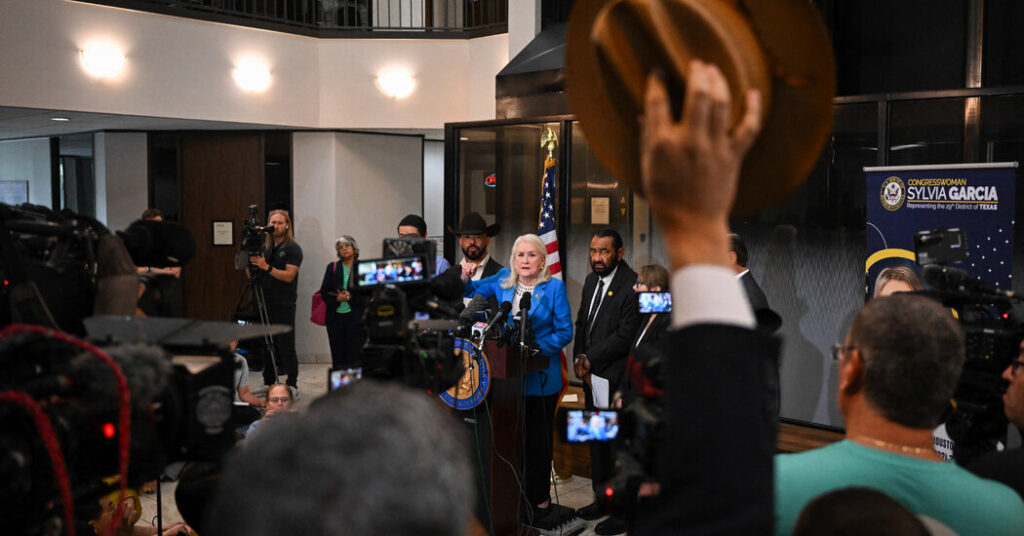
In the days since, the killing has galvanized thousands of protesters, led to calls from local leaders and Latino civil rights groups for independent investigations and prompted promises of legal action from President Claudia Sheinbaum of Mexico.
Mr. Salgado Araujo was killed during a traffic stop by immigration agents who had been searching for a different person, according to a Department of Homeland Security spokeswoman. When agents tried to stop the vehicle, the encounter quickly escalated, and an agent shot Mr. Salgado Araujo in the abdomen. He died at a hospital hours later.
Homeland Security officials said Mr. Salgado Araujo had tried to use his vehicle as a weapon, though three men who witnessed the killing disputed that account and said the victim had never tried to run over a federal agent. No video of the shooting has emerged. The agents were not wearing body cameras, the spokeswoman has said.
The Houston shooting has dragged ICE and the tactics used by immigration agents back into the national spotlight. Although federal officials are defending their actions as part of highly focused operations, Latino community leaders and immigration lawyers argue the incident follows a string of violent confrontations that have accompanied the surge in arrests — clashes they say show federal agents are continuing to use their most aggressive tactics.
Federal immigration agents have shot at more than 20 people since September, nearly all of them in their cars. Some of the shootings have been fatal.
The Trump administration is continuing to push for more deportations. A Republican-led package signed by President Trump last month has funded $31 billion for ICE activities, such as supporting local and state authorities that have signed cooperation partnerships with the agency, known as 287(g) agreements. For jurisdictions that refuse to cooperate, the funding package has earmarked another $350 million to expand enforcement operations.
In a period of five days at the end of June, ICE officers arrested more than 10,000 people, according to documents obtained by The New York Times. After a brief lull during the July 4 holiday weekend, arrests picked back up by Tuesday, the day Mr. Salgado Araujo was shot. From Tuesday through Thursday, ICE officers across the United States arrested more than 6,000 people, internal records show, a pace of about 2,000 arrests a day.
The effect of the push is being seen across the country.
In Chicago, immigrant rights groups and Hispanic community organizers in a news conference on Thursday had counted at least 70 people taken in three days, many around courthouses. Many of the immigrants apprehended had been charged with minor traffic violations or had been trying to make their appearances before immigration judges. Calls to one legal aid center alone had more than doubled to 1,700 in that time, organizers said.
“Despite claims that Operation Midway Blitz has ended, it isn’t over,” said Berto Aguayo, a lawyer, referring to the immigration dragnet last summer in Chicago. “We are in solidarity with Texas demanding for justice.”
In North Carolina and Iowa, where laws require local and state authorities to help federal officers with civil immigration enforcement, immigrant rights organizers have tracked upticks in traffic stops. Many were workers who, like Mr. Salgado Araujo, were stopped on their way to construction sites, organizers said. Officers claimed to be searching for specific people but arrested anyone else who was undocumented, organizers said.
The newer enforcement operations “may be more targeted, but they escalate quickly, and it is leading to violence just like before,” said Damary M. Bonilla-Rodriguez, a Hispanic community leader in Pennsylvania. “That is the part that is scary.”
In Puerto Rico, a pastor said she had seen federal agents deploy increasingly aggressive tactics against Black and darker-skinned immigrants, including many from Haiti, who have recently seen their humanitarian protections revoked.
Homeland Security officials did not immediately respond to a request for comment.
Federal officers tend to prefer to stop people in cars as opposed to trying to enter their homes, former ICE officials said, because it is less likely that they will barricade themselves or have weapons on them. But the Houston incident is renewing calls for guidelines over the use of force in such situations and scrutiny over the involvement of local and state police in civil immigration enforcement.
The Houston incident began when ICE officers arrived at a location looking for two different individuals. It was only after ICE officers ran the license plate of a van in the location they were surveilling that they realized Mr. Araujo was the owner, according to two people with knowledge of the incident.
They then ran another check and realized he was in the country illegally, the people said. In other incidents across the United States, ICE has used similar tactics to quickly determine whether immigrants they are seeking are in the country illegally.
When Markwayne Mullin, the former Republican senator from Oklahoma, took over the Department of Homeland Security this spring, he promised a more low-key approach to the Trump administration’s mass deportation campaign than that of his predecessor, Kristi Noem.
At first, he appeared to succeed. The spike in arrests in recent weeks attracted far less public scrutiny than enforcement actions did last summer, when federal agents poured into major cities like Chicago and Los Angeles and clashes erupted on American streets.
But Mr. Salgado Araujo’s killing could change that.
In her news conference Wednesday, Ms. Sheinbaum said her government was preparing legal measures to call for accountability in Mr. Salgado Araujo’s death and the deaths of more than a dozen other Mexicans in ICE custody.
Mexico’s government said on Thursday that at least 17 Mexican nationals had died either in ICE custody or while targeted during raids since last year. The country has used a multilayered legal and diplomatic strategy in response to these deaths. It has sent about a dozen requests demanding a full and transparent investigation into each death, raised the issue with the U.N. High Commissioner for Human Rights and urged the Inter-American Commission on Human Rights to review the cases.
“We cannot allow our brothers and sisters in the United States to be mistreated,” Ms. Sheinbaum said. “Unfortunately, there has been another death of a fellow citizen in the United States while being detained, when his only offense was lacking immigration documents.”
Lauren McGaughy contributed reporting.