

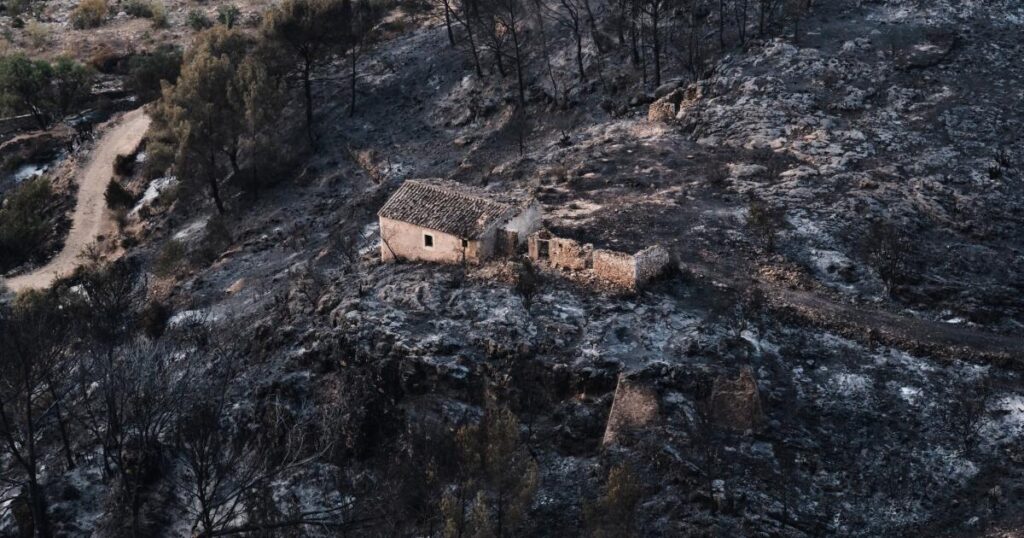
BÉJAR, Spain — Hundreds of firefighters backed by helicopters and fixed-wing aircraft struggled Saturday to contain one of Spain’s deadliest wildfires that erupted earlier this week and killed a least 12 people.
The blazes, which also lashed France, came as parts of Western Europe are facing their third heat wave in six weeks. Europe is the world’s fastest-warming continent, with temperatures increasing twice as fast as the global average since the 1980s, according to the European Union’s Copernicus Climate Change Service.
In Spain’s Andalusia region, a combination of light winds and high humidity are helping crews but the sheer size of the fire still poses challenges, said Antonio Sanz, head of the region’s emergency services. The fire so far has scorched some 25 square miles of forest and farmland, an area about the size of Manhattan.
Sanz said fire crews carried out controlled burns overnight around the perimeter of the fire, which broke out late Thursday in a semiarid area near the Sierre de Los Filabres mountains in Almería province, just as Spain was sizzling.
Most of the victims, who are believed to be foreign nationals, died after ignoring shelter-in-place instructions, authorities said. Seven people died while on foot after abandoning their cars.
Four of the dead were believed to be British, because the steering wheel of their burned-out car was on the right side, as with British vehicles, regional authorities said.
Sanz said Saturday that authorities had completed autopsies and DNA samples were collected to identify them.
Spain’s Foreign Minister José Manuel Albares has spoken with his counterparts from the U.K., Belgium, Canada and the Netherlands about the fire, Spain’s official EFE news agency reported. Almería is home to one of the largest communities of foreign nationals in Andalusia.
Authorities proactively evacuated 1,448 people from some 11 areas.
Many are fleeing the flames
Jeffrey Kember and his wife, Christine, were watching a favorite TV show in their Los Pinos farmhouse when the blare of a siren alerted them to the fire. The couple jumped into their respective cars while also trying to help a neighbor with two toddlers.
The husband described how they got separated and how he was unable to speak to his wife because she didn’t have a phone on her.
“I’m driving through the flames. It was actually flames. I thought, ‘I can’t stop, I just gotta go,’” he told the Associated Press as he sat with his wife outside an evacuation center. “It was eerie because all of a sudden I came out of the flames and it was all bright sunshine. It was, like, surreal.”
Meanwhile, Spanish authorities arrested two people for ignoring evacuation orders and returning to a high-risk area, according to EFE. Authorities are still combing through the Bédar area in search of any victims.
Europe withers in intense heat
Spain has battled frequent and severe heat waves in recent years, with temperatures often exceeding 104 degrees. Wind, high temperatures and little rainfall help small wildfires grow into unchecked blazes.
Justice Minister Félix Bolaños on Saturday attributed the ferocity of the Almería wildfire to a “climate emergency.” He said the fire, at its most intense, advanced as fast as 100 yards per minute.
Spain’s Meteorological Agency warned that the wildfire risk over the weekend would remain very high.
In June, Spain experienced several days of record-setting heat, with more than 1,000 excess deaths. Globally, 2025 was the third-hottest year on record, bringing several intense heat waves across Europe.
Wildfires lash France
Several wildfires remained active across France on Saturday as temperatures soared. Interior Minister Laurent Nunez said that 32 people have been arrested across the country since the beginning of summer in connection with wildfires.
“Those unacceptable acts, which have disastrous consequences and mobilize our firefighters at the risk of their lives, now fall into the hands of the justice system,” he said. “We will continue our determined action and will not let anything slide.”
French President Emmanuel Macron also weighed in, recalling in a post on X that 9 out of 10 wildfires start because of human activity. More than 62,000 acres of land have burned in France since the start of 2026, roughly double the area compared with the same period last year.
France is experiencing the peak of its third heat wave this summer, with temperatures reaching 104 degrees across western and central areas and around 98 degrees in Paris. In the French capital, the Eiffel Tower will close in the afternoon over the weekend instead of late at night, as it usually does. The Louvre and Orsay museums have also announced reduced opening hours because of the heat wave.
Last month was France’s hottest June on record, with deaths surging by nearly a third during the hottest week.
Iberian wildfires
Spain is no stranger to wildfires, with last year’s fire season burning more than 1,500 square miles, according to the European Forest Fire Information System, an area twice as large as London. Four people died.
Spain’s deadliest wildfire was in 1979, when 21 people perished in Lloret de Mar, a coastal town about an hour north of Barcelona.
In 2017, a wildfire in neighboring Portugal left 66 people dead in Pedrogao Grande, about 120 miles northeast of Lisbon. In that blaze, 47 people died on one road while attempting to flee in their cars.
Rodrigo and Cartwright write for the Associated Press. AP writer Samuel Petrequin in London contributed to this report.